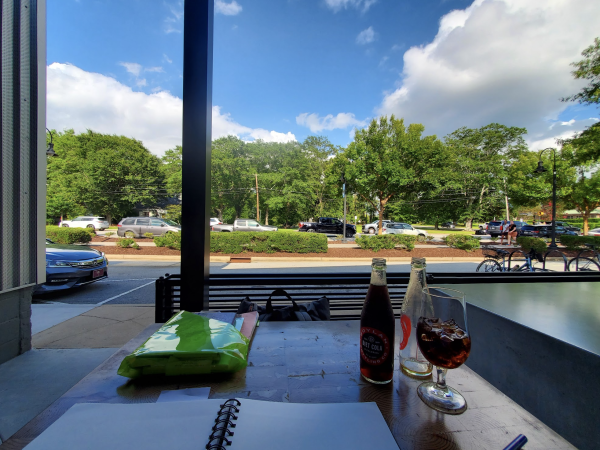
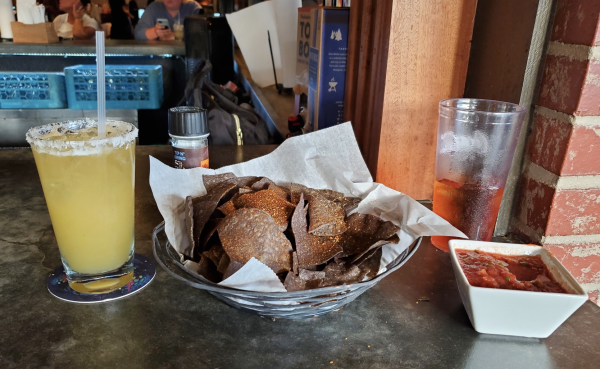
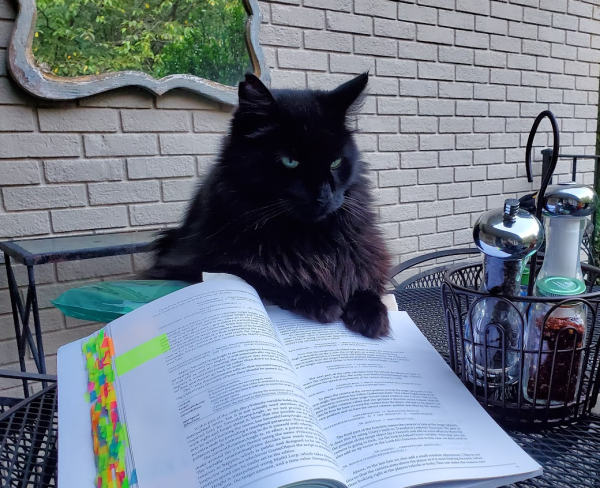
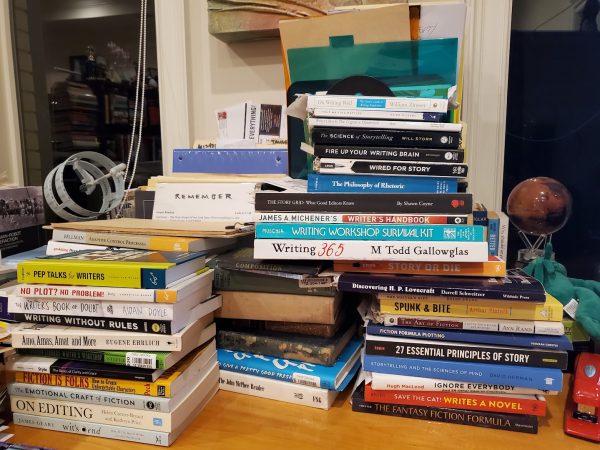
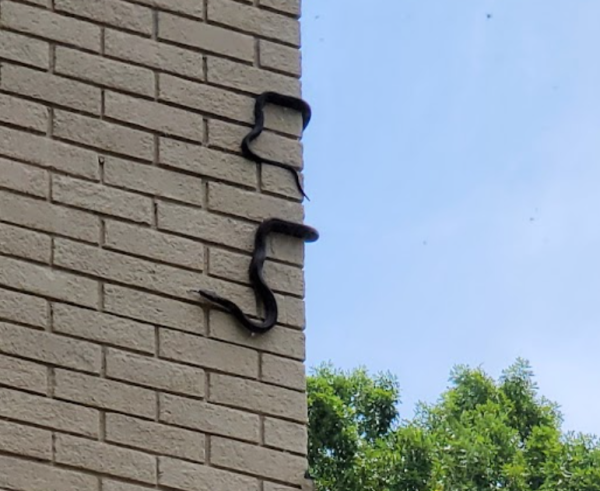
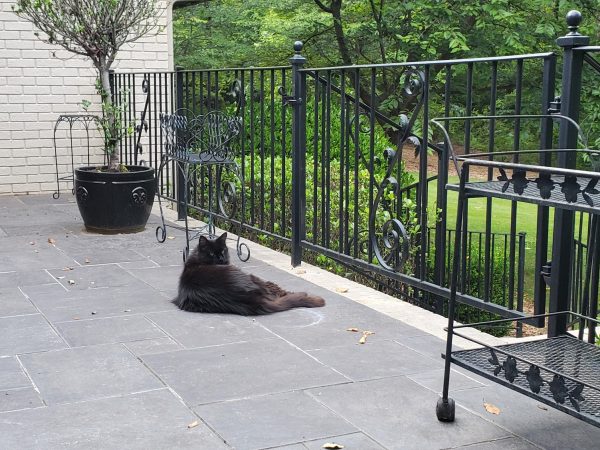
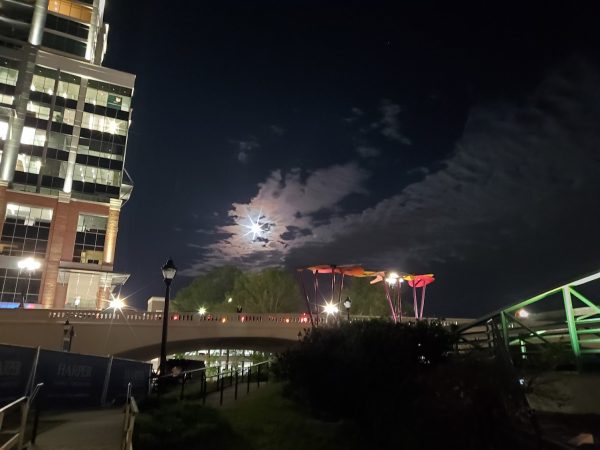
Had a great day with a buddy from grad school who drove up so we could bike the Swamp Rabbit Trail. During that, I had a great idea for a blogpost, which has completely evaporated on the bike back.
Continuing on the forest theme, sometimes you come across a tree that you think is just dead. This is a good time of year for it: the foliage is falling, so you can more clearly see all the trees, but some of them still have leaves, making the ones which are completely barren stand out. Often the bark is black and cracking, or all the small branches have fallen off, leaving just a stick. I've twisted a fair few of these out of the ground with one hand and added them to the growing border that is creating our path.
But others are bigger - the kind that tree experts call "widowmakers". You can walk up to one, and just push on it, and it may start to fall - but you get more than you bargained for. The tree's momentum, once started, cannot be stopped, and its weight - even if rotten - is enough to cause a cascading chain reaction, breaking off healthy limbs and knocking over other trees on its way down. These slender systems, dead but balanced in a semblance of life, crash with unexpected impact, ringing out through the forest as they land.
It may be fun to knock over a system you don't like, but the crash can kill you, and it can do a lot of damage to other people as it falls to rest.
-the Centaur
Pictured: Well, I don't have pictures of the trees that fell over, but I do have vines that I've pulled down, which looked twenty feet long but proved to be fifty feet of falling debris that also could kill you.
Sometimes when working on a vast project it transcends "you can't do it all at once" and moves into the territory "it's hard to know where to get started". One such project is trying to bring the woods in our house under control. Apparently the previous owner's yard folks had been trimming the landscaping around the house and throwing the cuttings into the forest, so an entertaining variety of invasive ivy, grapes, something like holly, and other vine-like things were progressively destroying the trees of the forest.
It's been a process. The yard looked like wilderness once you got past the landscaping and was nearly impassable. But, after we were forced to take out the first of our dying trees (NO, well, full disclosure, a delivery truck took out the FIRST of our trees when it ran into it) when it got consumed by ivy one year and threatened to fall on the driveway, we decided to start the multi-year project of rehabilitating the yard.
We took out that tree, then took out another half-dozen. We hired goats that year to eat the vines down to the ground, then followed up with chainsaws and clippers to sever the roots of the vines climbing the trees. The goats decided they were done with it and didn't eat any new growth that came back up, so the next year, we hired a guy to bring in a "mulcher" (really, a bobcat with a giant grinder on the front of it) to clear out runways through the landscape, leaving islands of greenery for the deer and other animals.
Then, we started on the paths.
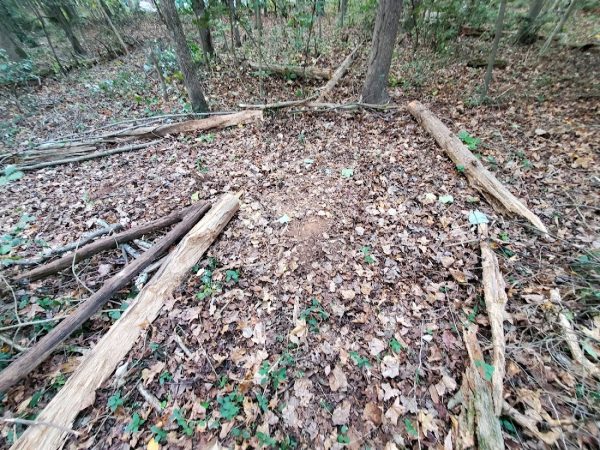
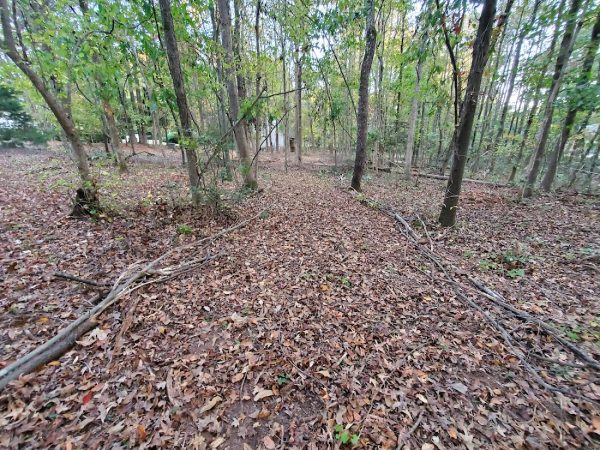
Our idea - and I'm not saying it's a good or feasible one - is to have paths running through this forest. This would take way, way more money than we want to spend on it - but we're patient, and have time. So, slowly, step by step, we've been taking fallen tree limbs and creating borders for the paths.
Drawing that line is an act of magic - even if it's just with an old rotten piece of wood thrown onto some leaves. As soon as the line is drawn, you know what's inside it, and what's outside it. You know which plants you can leave alone, and which weeds need to be pulled up. And once you've done that, you have an even larger area of order, which brings increased clarity, which brings more opportunities for order.
I don't know if we will ever complete our plan to rehabilitate the forest.
Often as we go through our lives we encounter situations where we feel, "I can't take this." There's a lot of subtle reasoning behind this: our emotions are derived from whether we think we can cope with losses (secondary appraisal), how well we think we're doing in relation to others (relative deprivation) and our disproportionate fear of short-term losses compared to short- or long-term gains (myopic loss aversion).
These are reasonable fears. A sufficiently large short-term loss can kill you. SO it's rational to worry more about those. And we can't see ourselves from the outside; looking at how others are doing around us as a guideline is also reasonable. And we certainly don't want to tackle situations we can't cope with.
When real shit happens, it sometimes puts things into perspective. For me, I used to complain that grad school was hard, and it was, but it wasn't as hard as Grandmother breaking her hip after midnight on Christmas Eve. I used to complain that work was hard, and it was, but not as hard as getting the call that you've lost your mother. And preparing for a complex business trip can be hard, and maybe it is, but it is not as hard as discovering that you misread the expiration date on your passport just before flying.
When any of those things happen, you have to stop fretting about it and just get on with doing it. Now, admittedly, some people can break down when that happens, but for me personally, I find that my emotional fretting turns off, and my mind just focuses on what I need to do to get it done.
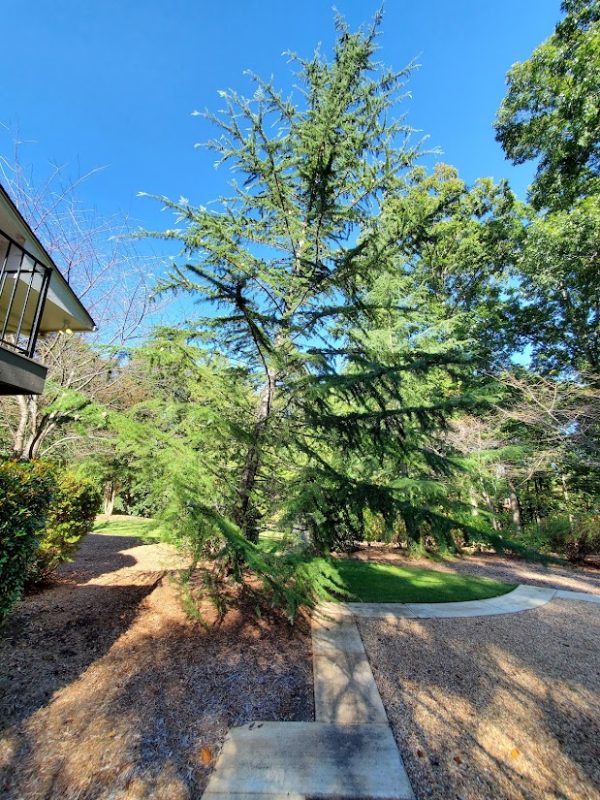
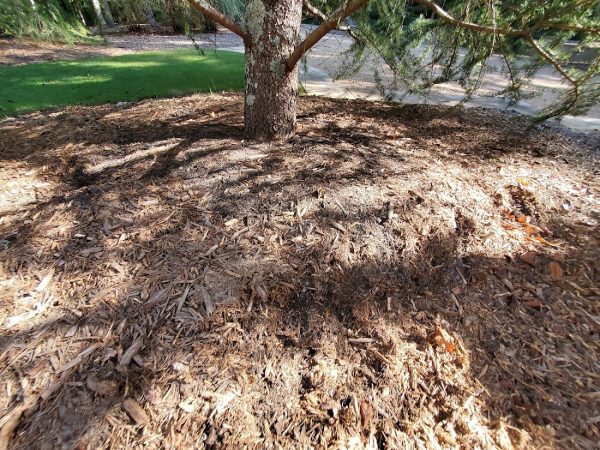
Case in point: above is a tree.
My wife and I used to walk under the limbs of that tree almost every night that we took a walk. You'll note you can't do that anymore, because the tree started leaning. As best as our tree doctors can figure, many of the trees that the previous owners planted on the property were planted with the transport basket still on the tree; while the tree would remain healthy for a while, eventually the roots get too big to go through the mesh of the basket, the roots turn inward, the tree becomes root-bound, and the whole basket turns into a big ball bearing as the tree gets bigger and bigger ... and unhealthier and unhealthier, preparing to fall.
This one began leaning a month or two back, but we didn't notice it until one day it just was too low to walk under. Shortly thereafter we saw that the tree was beginning to tear up the ground as it twisted in its great ball bearing. We've done this dance before; this isn't the first tree we've lost to this process, or the second.
Now, after I left Google, we deliberately dialed back our work on fixing up the yard - which, due to the year and a half the house sat between owners, needs a lot of work. It's been a juggling act as I spun up my consulting business, and fretting was involved as we traded a goal to fix this broken thing against an aspiration to improve that thing that versus a desire to maintain this other thing. We're blessed to have this nice yard, but at some points, it can feel like we might be more blessed with a small apartment.
But once we started whacking ourselves in the head with that tree limb we used to walk under, we had to focus, make a decision, and get it done. We had to get on with getting it gone, as I said in the title.
It's sad to lose the tree. But, if there's any silver lining in that, it feels good to know you can solve a problem when you need to. And I find focusing on that is really helpful, because the next time something happens, you can remember times you solved those problems, and use that emotional resource to solve the next one.
long day driving down to atlanta to see oppenheimer with a friend, followed by work on the novel and on social navigation paper followups. very tired, crashing. oppenheimer is good, go see it.
-the centaur
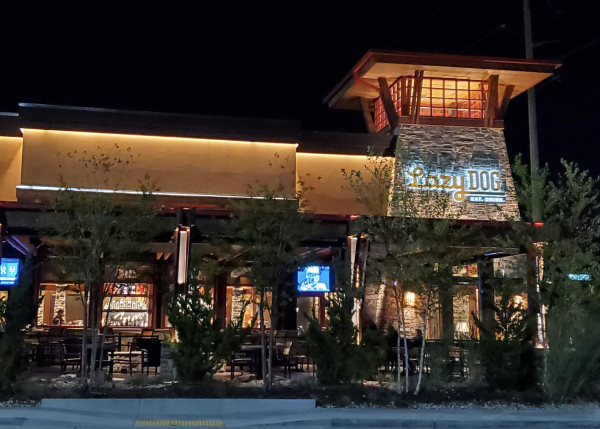
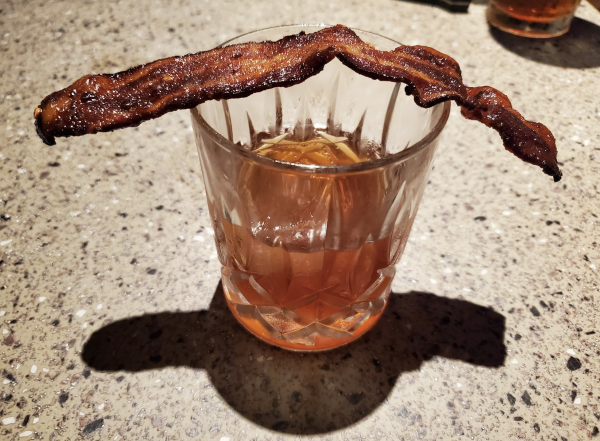
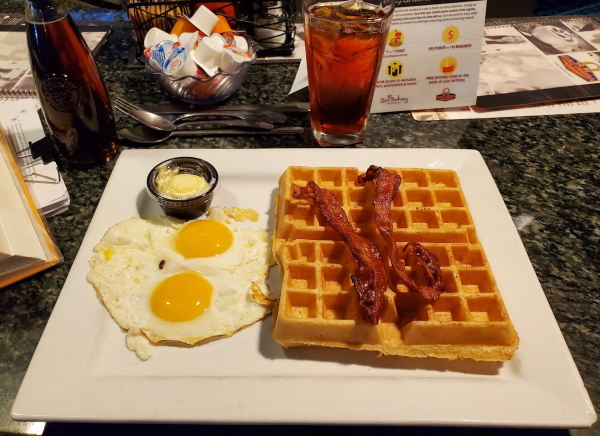
pictured: lazy dog atlanta, and their signature smoked maple bacon old fashioned. it's good, go drink it.
The Swamp Rabbit Trail rules! But it is very long, and I'm tired after two hours there, two hours back (even with a break in the middle for a bookstore / writing run, and a break for dinner on the return journey.).
So, no real blog post for you ... but I learned something very interesting on the way about how to push through things, such as, for example, a steep unexpected hill when you are a very out-of-shape cyclist.
Actually, the steep expected hills are even worse, but the same trick works on them too - very simply, counting to a hundred, and doing that again. More on that tomorrow.
-the Centaur
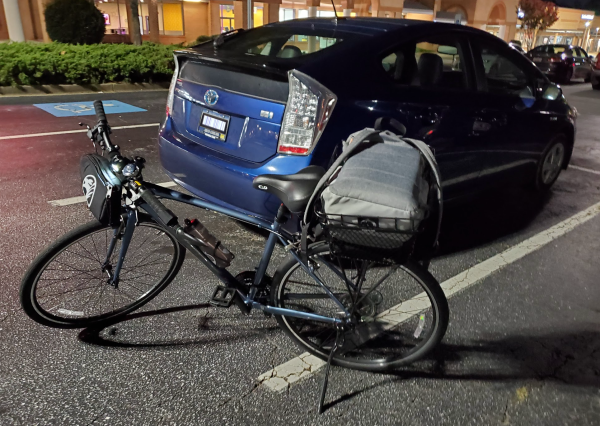
Pictured: the car, and the bike, after the ride; the break to write in the middle; and the dinner near the end.
Yeah, right, buddy. You just want my dinner, after not eating yours.
Lots of news, much of it good - particularly, a new way to structure projects with a literature review, book document and manuscript doc. But workmen arrive in the AM, so you just get a picture of a cat.
So, in case you don't own this cat, the little brow-furrowed face Loki is currently making is his "I really want your food but you're not letting me eat it, so I'm going to sit just at arms length and fume" face. He thinks if he waits long enough, he'll be able to sneak in and try some. My long arm thinks otherwise.
Anyhoo, while I said I wanted to put blogging at the first of the day to make sure it got done, it turns out that I was way more interested in making sure that I didn't fall grievously behind on my Camp Nano project, Dakota Frost #7, SPIRAL NEEDLE, nor miss any of my other responsibilities.
I'm mostly caught up now, so I'm trying to put blogging back on the queue. Interestingly enough, after my rant about blocks, the WordPress folks have reached out to talk to me about blocks. Talk about customer service! So I'm also blogging trying to replicate the bugs I observed the other day that set me off.
So far, I cannot replicate the cut-and-paste error, where trying to select all the text only copied part of it - it is entirely possible that the system had just gotten into a cruftly state, which can happen to any program of sufficient complexity.
I can, however, replicate the cut-and-paste problem I had, where trying to re-order sentences introduced new paragraph breaks in a way that's not standard for Word, Google Docs, or TextEdit. This is probably most directly attributable to the text being in blocks, but it might be fixable.
I also reproduced the "Where's Waldo" interface issue where I could not easily inject new blocks - though now I see that can be fixed with a carriage return followed by a slash, which is documented in the interface, it is also possible that at the time something was just wrong with my editor.
I also debugged the problem I had with the interface. In TextEdit, Word and Google Docs, the first line of your document is the first line of your document. In WordPress, it is invisibly a title, as opposed to the Classic Editor which distinguishes this with a different text entry box. This is also probably fixable.
But there are other strange errors. Like, the sidebar that let you change the properties of the post are normally present when I blog, but had disappeared when I started this post. Weirdly, not even the button to show them was present - I had to toggle several other buttons and then it appeared, just where I remembered it. Not sure what's going on there. Since I restarted my computer recently and re-logged into WordPress, perhaps this is a "sticky" setting that went away when I cycled my browser. Still investigating.
-the Centaur
Pictured: Loki, trying to help me study generative AI.
Last week, frankly speaking, I was feeling kind of low. I had launched a major paper to arXiv (an event which I tweeted et al, but somehow haven't blogged yet) and had a big opportunity to get caught up on stuff. But I couldn't seem to get rolling, not even on my Camp Nano project, Dakota Frost #7, SPIRAL NEEDLE.
I met with my buddy Jim Davies and came up with the idea of restructuring my day, which worked well and I blogged about last week. But when Monday rolled around, and a lot of stuff wasn't done, I decided that I needed to throw away that script and make sure that the important "hanging tasks" got done.
And I did. Maybe not a third of the ones I wanted to get done, but I chewed through a lot of them. And I realized that, after spending a year and a quarter on that big arXiv paper and the Embodied AI Workshop, that I probably needed more recharge time than I had given myself.
But I had felt I didn't have time, as I had to roll into Camp Nano on July 1st and there were other tasks, like managing the repair of our air conditioning system and disbursing awards to the winners of Embodied AI Workshop challenges, that also couldn't wait. Things often just start when they are scheduled to start.
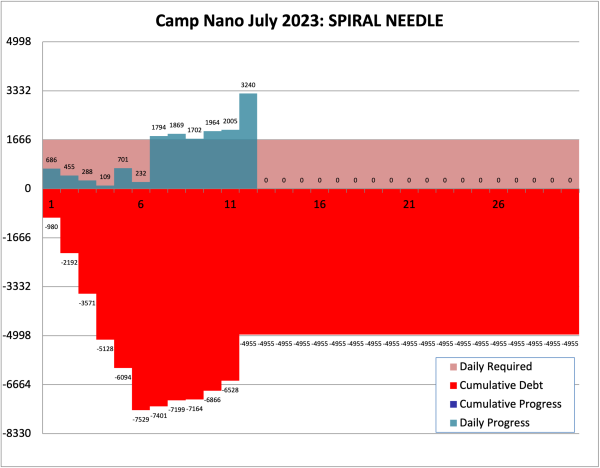
But whether I had that time to take off, I needed that time, as you can maybe see above. The first week of Camp Nano, I was running below full power. After a week's worth of the motor sputtering on 50%, giving me a forced recharge, you can see my writing rate start to climb up again, as it should be.
But the lesson isn't just that it's important to be kind to yourself - the modern phrase is "self-care" - because, as I said, things often start when they wanna start. And this includes planned things, like Camp Nano, and unplanned things, like lightning taking out your A/C. And even emergencies, like a sick cat.
So, I had put blogging aside a bit until Camp Nano was rolling again and my business were taken care of, and was getting ahead on both this morning, just prior to going to lunch with my 90-year-old uncle, when our cat Loki started yowling, puking, and trying to go to the bathroom without success.
The little guy has a history of urinary tract infections, which can kill a cat in hours and almost killed him three times, and had gotten the zoomies after trying to use the litterbox last night. His condition didn't seem bad then, but it was markedly worse today, and reluctantly I called Uncle Paul to cancel, then called the vet.
It often seems that I'm called to do the most just when I've "run out of spoons" dealing with some other problem, but, somehow, God provides enough spoons in the clinch when I need them. Less than an hour after canceling with Uncle Paul, I was pulling into the vet's office, who worked us in to their lunch hour.
Blessedly, the surgery Loki had after his previous urinary tract blockages prevented any buildup this time; in fact, the doctor suspected this was possibly a simpler case of a gastrointestinal infection - kitty food poisoning - and gave him antibiotics / anti-inflammatories to help Loki's system calm down.
Within hours of getting home, he was eating and drinking again, and soon returning to his alternately lovable/needy, grumpy/jerky self. And I got yet another lesson that the resources you need to solve your problems are often there, even if you don't always feel like they are.
Be good to yourself. But put first things first when you have to, and often, it will all work out.
-the Centaur
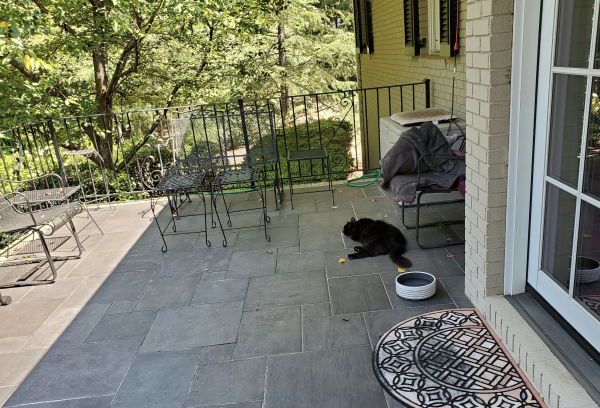
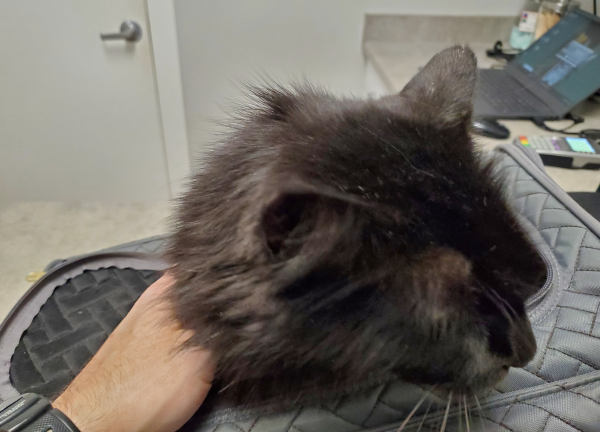
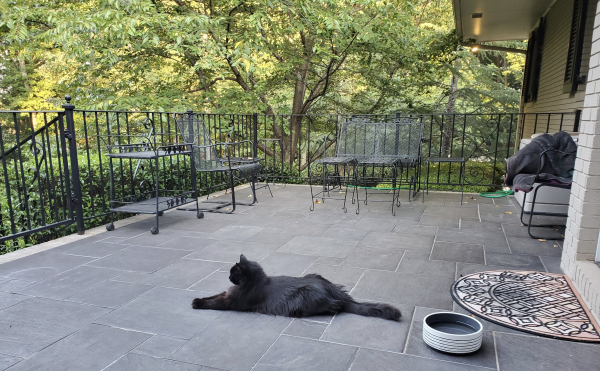
Pictured: Loki, after recovery (but looking like he looked when he was sick), Camp Nano progress, Loki at the vet, and Loki definitely in recovery mode with his medicine in him. And may I complain again about the Gutenberg editor making simple operations like selecting text an exercise in frustration?
So far, so good, on the new strategy of starting off with the projects, rather than the maintenance: I've tweeted, checked in with LinkedIn, worked on some non-fiction books, am blogging, and am about to switch gears to writing my Camp Nano entry, SPIRAL NEEDLE.
Jim taked to me about how prioritizing book-writing was critical for his process. I don't really have to do that for fiction - or, more properly, I have structured my entire life around ensuring I have time set aside for fiction writing, so at this point it is practically free - but non-fiction books are new to me.
But one of his other suggestions baffled me, not because it didn't make sense, but because it made too much sense - except I was already doing it, and it wasn't working. Jim pointed out that most people go through periods of vigilance, slump, and recovery during their day, and that as a morning person he reserved book writing, which required critical thinking, for his early vigilant time. Errands like bill-paying worked well for him in the slump, and he felt most creative in the recovery period in the evening.
Okay, great, I thought, I can use this. Already I can see shifting the order I do things in my day - as a night owl, I start my day off in the slump, recover from that, and then get increasingly and increasingly vigilant the further and further I go into the night. (If I have a project due and no obligations the next day, this can go on for hours and hours before exhaustion starts to outpace execution and productivity finally drops).
So maybe switch errands to earlier in the day, I thought, and productivity in the afternoon. But wait a minute: I'm already using my late nights for my most creative time. Why isn't this working.
What I realized is that I have an irregular schedule. In THEORY my late-night time is my most productive time, but in PRACTICE on some nights I get an hour, on some nights I get two (or five) and on some nights I am already so wiped that I really don't get much done at all.
But I do almost always get something done in the morning, even if it takes me time to get rolling. And for me, catching up on papers or writing notes or catching up on my blog is a mostly mechanical activity: it's not that creative thought isn't required, but it isn't to the level of, say, a novel or a scientific paper, where a hard-won sentence may be the result of a half an hour's search tracking down a key reference or fact, or, worse, an hour's worth of brainstorming alone or meeting with others to decide WHAT to write.
So: I can't count on myself to do a creative "chore" - something that has to be done regularly, like blogging or social media, or something that has to be done incrementally over a long period of time, like collating references or thoughts for a non-fiction book - by putting it in my evening creative block. The evening creative block is too irregular, and needs to be reserved for novels and art anyway.
The fix: blog (et al) in the morning.
Let's see how it goes.
-the Centaur
Pictured: tomato and lettuce sandwiches for breakfast, with the leftovers of the tomato as a side dish. At the breakfast table is Christopher Bishop's Pattern Recognition and Machine Learning, also available as a PDF, the latest of a long series of "difficult breakfast table books" which I laboriously read through, a page at a time - sometimes, one page over several days, until I "get" it - to increase my understanding of the world. Past breakfast table books have included Machine Vision, A New Kind of Science, and Probability Theory: the Logic of Science, the first is out of date now, but the latter two are perennial and highly recommended.
Normally I post at the end of the day, which means if I run out of time in the day, I don't post. Well, I want to change that, and unlike most of my other tasks, most of my blog posts don't expand into projects of unusual size. So I'm trying out starting by day with a tweet, a blog post, and a some work on my very longest-horizon projects, like my novel series or my nonfiction books, which cannot be completed in one sitting or even in a simple concentrated push over a few months, and must, therefore, be taken one step at a time.
And, so, hey! Here's a post. Enjoy.
-the Centaur
Pictured: I don't really do mornings, so this is the first "early" picture I could find, breakfast at Stax Omega.
No good picture for this one yet, but today I found out that the lightning strike that took out our internet may also have taken out the air conditioning for the upstairs (where, ya know, our bed and sleeping is). I seem to recall it having trouble before the lightning strike, but that may have been a completely different problem with the filters, which also need replacing.
Apparently this repair is going to be pricey, and it may be cheaper to replace the entire unit. This will take another week or so. In the meantime, we've run the fan so much the wallpaper has started to peel in the bedroom due to the humidity, and it's still to hot to sleep most nights. As Dr. McCoy would say, "Oh, joy."
My wife has wondered whether we should get lightning rods installed on the house. After several years here, this is our first strike, and I wonder whether it will happen again. There's the old saw that you prepare for the last disaster, and that seems to be true: we first had sewage problems, then a burst supply line on a toilet, then a separate problem with the AC, then tree removals due to ivy, then a freeze, now this. Not much of a pattern there except for the trees and ivy, which we're working on as a long-term project.
Hopefully next up we will not have tornadoes or flooding, because we really can't do that much about tornadoes, and since our house is high on a ridge, if we get flooded out, you can kiss Greenville goodbye.
More news as it develops.
-the Centaur
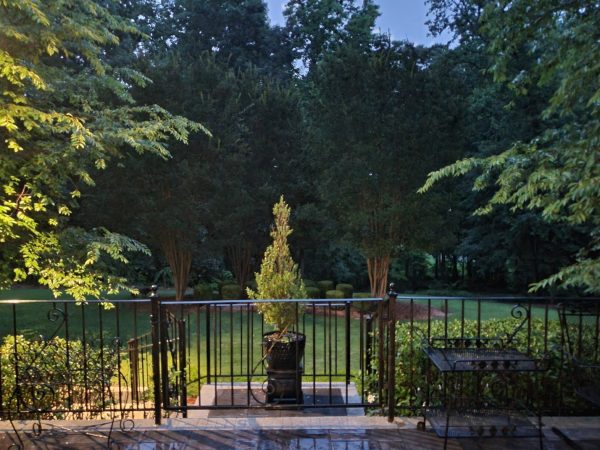
Pictured: the back porch at night, since I do not seem to have any good pictures of the recent torrential rains and the associated lightning strike, even though I distinctly recalled having taken some. :-/
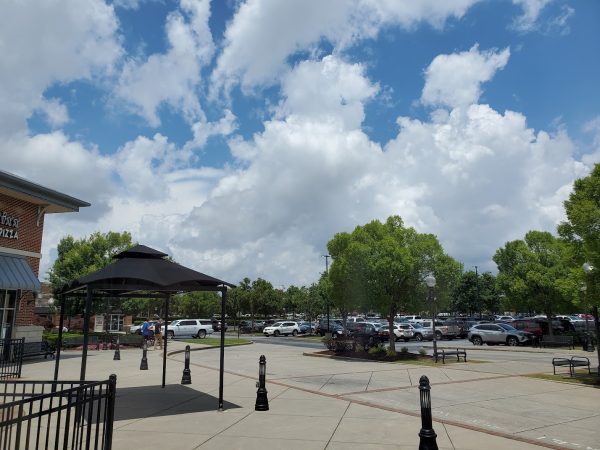
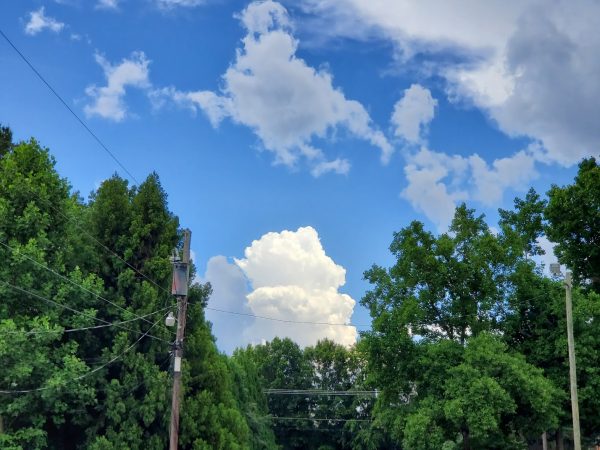
I wished I had a drone or something to fly up, or more hours in the day to drive around and find some place to take pictures not blocked by buildings and power lines. Even so, look at those beauties:
No filters, no AI, no nothing, just a Samsung phone (and Android's computational photography libraries).
Sorry for the no posts for several days. I'd say it's because I've been busy prepping for the Embodied AI Workshop - and I was - but when I brought up the Library of Dresan interface, I saw a half-finished post on my cut hand, and realized, oh yeah, lightning struck the computer while I was working on this. And it did, or more properly, struck the broadband gateway and fried all the Ethernet-connected devices attached to it. Fortunately, the laptop was not one of those things, but it did put a crimp into things for a while. Back to it.
-the Centaur
Pictured: Well, I didn't capture a picture of the lightning, or the aftermath, as I was too busy dealing with the loud SNAP simultaneous with the lightning flash at 2am last week, but I did capture this picture of the torrential rains overwhelming our house's drainage system later that week.
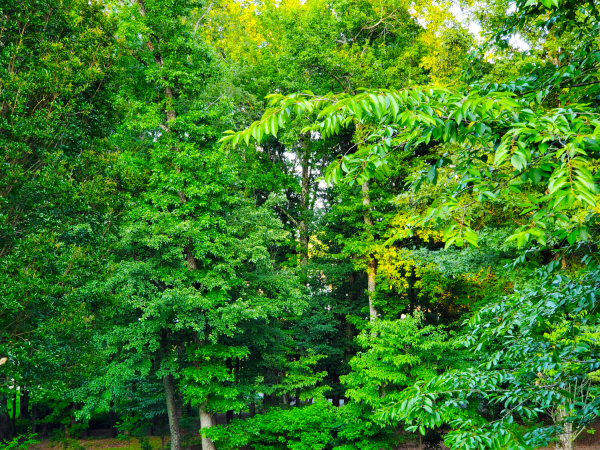
Sunlight, shining through the trees behind me, striking just some of the forest ahead. I took a few pictures (and even played with the contrast and vibrance of this one in Photoshop) but none of them quite captured the glow that the unseen sunset was leaving on these leaves.
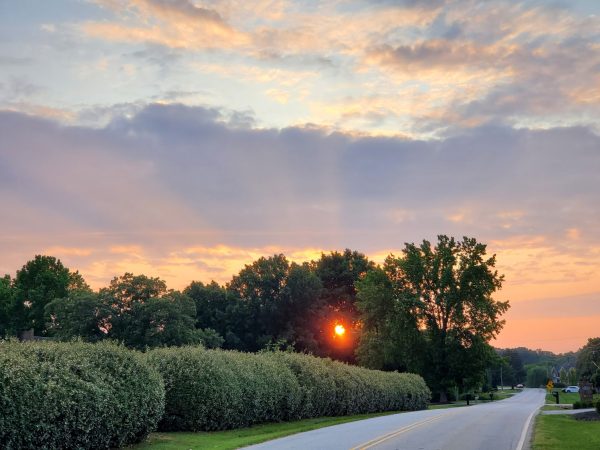
Have been prioritizing the Social Navigation Principles & Guidelines paper (and helping my wife get ready for her business trip) so no detailed posts for you. Enjoy a sunset and a margarita.