Press "Enter" to skip to content

Posts published in “Writing”

The art, craft, and life of writing.

[twenty twenty-four day fifty-eight]: the seven-part story test

centaur 0

So I’ve developed a new tool for story analysis that my co-editor on The Neurodiversiverse, Liza Olmsted, called “your seven-part story test,” and it fits in one long sentence: “Who wants what, why can’t they get it, what do they do about it, how does it turn out, why does that matter to them, and what does that mean for the reader?”

This six-part test is an adaptation of Dwight Swain’s story question “Who wants what and why can’t they get it?” as well as Vorwald and Wolff’s pithier but less useful “What happens?”, called the Major Dramatic Question (MDQ) in their book “How to Tell a Story.”

Now, V&Q unpack their MDQ into the broader questions “What does my character want? What action do they take to get it? What keeps them from getting it? Who succeeds or fails?”. Like many writing coaches who have their own language for similar ideas, I think both Swain and V&W are tackling the “Major Dramatic Question”, just from different angles - but “how it turns out” is a key question not encapsulated in Swain’s version, and I think it helps us understand what is going on - or should be going on - in a story.

Ultimately, I think a story is an engaging and surprising case, in the case-based reasoning (CBR) sense. For those not familiar with CBR, it’s a reasoning technique back from the days of symbolic artificial intelligence (AI), pioneered by Janet Kolodner, the leader of the AI lab where I was trained (and my original thesis advisor). A case, in the traditional sense, is a labeled experience, which is marked by what problem is being solved, what solution was applied, how it turned out, what lesson it taught, and how we might remember it.

Well, in the age of content-addressable memories and vector databases, we worry less about labeling cases so we can remember them, as the content itself can help us find relevant cases. However, it remains important to analyze our experiences so we can better understand what happened, what we did, how it turned out, and what lessons that taught (or should have taught) us. And the last two are related, but different: what happened are the bare facts, but the same bare facts can have different meanings to different people that experience them - or to different observers, watching from the outside.

Think of a woman in an abusive marriage. What she wants is a peaceful life; why she can’t get it is a husband who’s a Navy SEAL with PTSD. Let’s say what she does about it is try to kill him, and how it turns out is that she gets away with it. But what does that matter to her, and what does that mean for us (the writer, the editor, the publisher, and the author)?

Well, that same outcome could matter in different ways. Perhaps our heroine gets to build a new happy life away from a man who abused her - or perhaps our heroine is now living a life of regret, with a child that resents her and feelings of guilt about killing a man who couldn’t cope with his wartime trauma and needed her help. Because the truth of it is, no-one should have to put up with domestic violence - but a small percentage of people who struggle with PTSD end up acting out, and need help to deal with their trauma.

There’s no right answer here - a skilled author could present a spectrum of situations in which most of us would say either “get them help” or “girl, get out”. But if the author shows our heroine murdering their husband and getting away with it, the story is implicitly endorsing murder as a solution for domestic problems. Conversely, if the author shows the heroine forgiving violence in an attempt to get the husband help, the story is implicitly endorsing women enduring domestic abuse. Not only is there no right answer here, there’s no good answer here - which might lead you as an author to question the whole setup.

That’s why it’s really important to step back and think about what you as an author are endorsing in your story - and whether you’re comfortable with that message. Despite what some writing teachers will tell you, you’re not the god of your story: you’re playing in a playground of your own making, but the materials from which that playground is fashioned - people, places, events, actions, reactions, and emotions - are all drawn from the very real world in which we live, and stories by their nature communicate messages about that real world to those who read them, even if the events in the story are purely fictional.

(This principle of authorial endorsement extends to the editor, publisher, and even the reader as well. There were many good stories submitted to The Neurodiversiverse that we chose to reject because of their implicit message - for example, we wanted our anthology to be empowering, so we didn’t select some powerful stories in which the character’s neurodiversity helped them communicate with aliens, but didn’t help the horrible situation that they were in; these stories might be a great choice for a horror anthology, however). 

But the point can get lost if you start asking a lot of unconnected questions about your story. That’s why I like the idea of the unified MDQ, and I like the expression of that in Dwight Swain’s three-part question “Who wants what, and why can’t they get it?” But that three-part version is not enough, and expanding that question into a single phrase that incorporates the important elements of action, outcome, impact and meaning turns it into my seven-part test: “Who wants what, why can’t they get it, what do they do about it, how does it turn out, why does that matter to them, and what does that mean for the reader?” 

The rewards for thinking through these questions are great. Thinking about how the story turns out matters to the protagonist creates options for tweaking the ending (or the material leading up to it) for greater resonance; and thinking about what meaning the story delivers for the reader creates opportunities to weave that message through the whole story. The seven-part story test can help us create stronger, more impactful, and more meaningful stories that make more sense and feel more satisfying.

So, to unpack the seven-part test further:

  • Who? Who is the protagonist of your story?
  • Wants what? What’s their goal, and why are they motivated to seek it?
  • Why can’t they get it? What’s the conflict in the story? Is it derived from a classical antagonist, or is the conflict based on internal or environmental factors?
  • What do they do about it? What action does the character take (or fail to take, as Hamlet fails to take action for much of his story)? Ultimately, most good stories are about what people do when facing conflict, so they should not be wholly passive - they should have some agency which affects how the story turns out.
  • How does it turn out? With the exception of vignettes that are all atmosphere, we want to know the outcome of the protagonists’ action. Did they succeed? Did they fail? Are we left with a situation that’s definitively not resolved (as in the ambiguous endings of Inception, Cast/Away, The Sopranos, or John Carpenter’s The Thing)? Any of these are acceptable endings (though a definitive lack of resolution is the hardest trick to pull off) but you as the author need to pick one.
  • Why does that matter to them? The ending of Cast/Away is a great example, in that our uncertainty about what the main character does next is actually symbolic of the main character’s situation. It matters to the main character that they are in a state of indecision, because that indecision represents what they lacked when cast away on that island: freedom of choice.
  • What does that mean for the reader? Regardless of what you choose to the previous questions, you should think through the implications of what that means for the reader, and whether that’s the image you want to present for your story. While you aren’t the god of your story, you are the playwright and stage director, and if the message of your story isn’t what you want, you can just change it. 

Overall, I’ve already got a lot of good mileage out of these questions in the new series of stories that I’m writing (which I’m variously calling “The Porsche Xenobiology Stories” or “Tales of Failaka” depending on which planet I’m writing on this week). By asking these questions, I’ve been able to reformulate my endings to focus not just on the outcomes of the character’s actions, but how it matters to them, which makes the endings more satisfying; and also to focus on what it means, which has enabled me to make the stories more cohesive, as well as inspiring ideas for new stories.

“Who wants what, why can’t they get it, what do they do about it, how does it turn out, why does it matter to them, and what does that mean for the reader?” It’s a short, seven-part story test, easily compressible into a sentence that can be used to interrogate your story, and it’s been very useful for me; I hope it is useful for you too.

-the Centaur

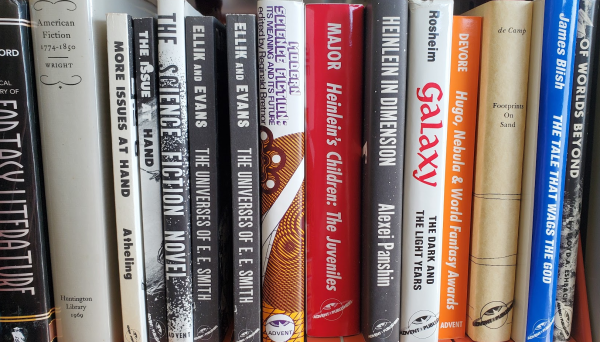
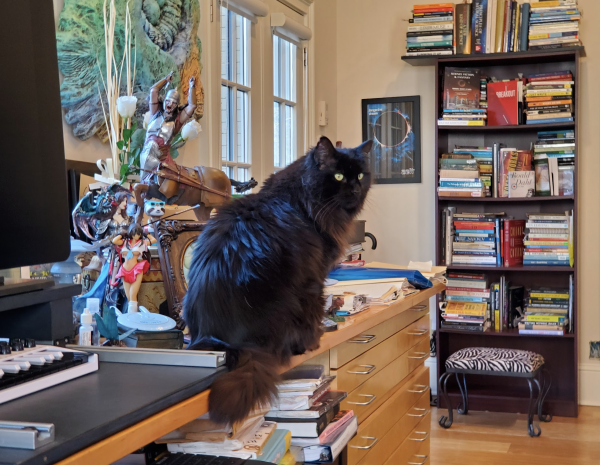
Pictured: Loki, and in the background, the reading "pile" for a writing book that I'm working on called "The Rules Disease." Yes, it has filled most of a bookshelf by this point - there's a lot of writing on writing.
[twenty twenty-four day fifty-three]: you can’t predict edits

centaur 0

So I'm done with the bulk of my first-round edits for The Neurodiversiverse, and I can report that you can't predict how long an edit letter is going to take. The easy ones end up with a hundred line edits, and the hard ones go smooth as glass.

-the Centaur

[twenty twenty-four day thirty-seven]: editors have superpowers …

centaur 0

Editors have superpowers, but you can't save everybody.

One of Ayn Rand's most useful distinctions for writers is between abstractions and the concretes that realize them. She's obviously not the only person to employ such a distinction, but if you think of abstractions as representations of a set of concretes, it helps you realize that you cannot portray pure abstractions like justice or injustice: you need to show the abstraction in concrete actions to communicate it. For example, the theme of your story may be "the mind on strike" but it must be realized using a set of concrete characters and events that (hopefully) illustrate that theme.

Once you've decided on an abstract theme, it can help you ruthlessly cull unnecessary concretes from your story, or to flesh the theme out to fit the concretes that you do have, or both. The same is true for editing anthologies, only with a little less flexibility as we don't completely control the submitted stories. For example, the Neurodiversiverse's theme is "neurodivergent folks encountering aliens", and if we get a story that does not feature neurodivergent folks, aliens, or encounters, we are not in the position of a writer who can tweak the themes or their realization until they both fit: we have to just reject off-topic stories.

But, as my coeditor and I like to say, editors have superpowers. There's more than one story in the anthology where we've been able to suggest edits - based on the theory of conflict, or the major dramatic question ("who wants what, why can't they get it, what do they do about it, and how does it turn out"), or even just line edits - that would resolve the problems in the story to the point that we'd go from a reject to an accept - or would resolve them, if the author goes along with the changes, that is.

But sometimes we can't even do that. There have been several stories where we applied our editing superpowers and drafted a way to fix the story to fit our theme - but where we, reluctantly, declined to pass on the story anyway, because we were no longer convinced that the edited story would be what the author intended. If a story was way off the anthology's theme, but the story's theme was really integral to the story's implementation, then changing the text to fit the anthology may not have suited the story.

In the end, despite our editorial superpowers, we can't "save" all stories, because not all stories NEED saving: some of them may not be right for this particular project ... and that's OK.

-the Centaur

Pictured: A nice heritage indoor mall in Asheville, which is a great writing town.

[twenty twenty-four day thirty]: the questions i now ask

centaur 0

As a writer, it's important to have humility - no matter how enthusiastic you are about your work, there's no guarantee that it will land the way that you want it to with your readers. So I share my stories with "beta readers" who are, presumably, the kind of people who like to read what I want to write, and I use comments from beta readers to help me edit my stories before submitting them to editors or publishers.

I used to ask almost no questions of the beta readers BEFORE they read it, as I neither wanted to prejudice them about the story nor wanted to draw their attention to features that they might not have noticed. But, over time, I have started adding questions - perhaps in part because my research in social robot navigation exposed me to better ways to ask questions of people, and perhaps just through my own experience.

I settled on the following questions that I ask beta readers:

  • Is this the kind of story you like to read?
  • What did you like about it?
  • How could it be improved?
  • Would you like to read more stories in the same universe?
  • Is there anything that could be clarified to make it stand better alone?
  • Are there any questions that it raised that you'd love to see answered in another story?

The first three I think are generic to all stories, and are the ones that I started with:

  • First, if your story isn't the kind of story that your reader wants to read, their comments might not be about your story per se, but may actually be a subconscious critique of its genre, which can be actively misleading if you try to apply them to a story in that genre. I found this out the hard way when I gave The Clockwork Time Machine to someone who didn't like steampunk - many of their comments were just dissing the entire genre, and were useless for figuring out how to improve my particular story.
  • Second, it's important to know what people like about a story, so that you don't accidentally break those things in your edits. If one person dislikes something, but two others like it, you might be better off leaving that alone or gently tweaking it rather than just taking it out.
  • Third, no matter how big your ego is, you cannot see all the things that might be wrong with your story. (Unless you've won the Nobel Prize in literature or are a New York Times bestselling author, in which case, I especially mean you, because you've probably become uneditable). Fresh eyes can help you see what's wrong and where you could make it better.

But these questions weren't enough for someone who writes series fiction: my stories refer to a lot of background information, and set up ideas for other stories, yet should stand alone as individual stories:

  • Do you have a good vehicle? Have you set up a framework for telling stories that people are interested in? This goes beyond whether an individual story is satisfying, and to whether the setting and storytelling method itself are interesting.
  • Does your story stand alone? Are you pulling in backstory which is not adequately explained? This is information that should either be taken out, or woven into the story so it is load-bearing.
  • Does your story pull people in? Even if the story stands alone, you want it to either hint at questions to be answered in other stories or to answer questions from previous stories.

So far, these questions have worked well for me and my science fiction serial stories. Your mileage may vary, but I think that if you avoid asking anything specific about your story, and focus on the general functions that your story should fulfill, then you can get a lot of profit by asking beta readers ahead of the read.

-the Centaur

Pictured: A gryphon made of books in a store window in Asheville.

[twenty twenty-four day twenty-eight]: yeah there were a few

centaur 0

We got a LOT of submissions for the Neurodiversiverse. Many were actually on topic! Some, however, despite being well written, were not. And we really want this anthology to follow its theme of empowering stories of neurodivergent people encountering mentally diverse aliens, so we're focusing on that - and already have several strong stories that we know where we want to place in the story sequence.

Onward!

-the Centaur

[twenty-twenty four day sixteen]: blog early, blog often

centaur 0

I'm a night owl - I'd say "extreme night owl", but my wife used to go to bed shortly before I woke up - and get some of my best work done late at night. So it constantly surprises me - though it shouldn't - that some things are easier to do earlier in the day.

Take blogging - or drawing every day, two challenges I've taken on for twenty-twenty four. Sometimes I say that "writer's block is the worst feeling in the world" - Hemingway apparently killed himself over it - but right up there with writer's block is deciding to call it a night after a long, productive evening of work - and remembering that you didn't draw or blog at all that day.

Sure, you can whip up a quick sketch, or bang out a few words. But doing so actively discourages you from longer-form thought or more complicated sketches. Drawing breathes more earlier in the day, especially in the midafternoon when your major initial tasks are done and the rest of the day seems wide open. And blogging is writing too, and can benefit as much from concentrated focus as any other writing.

SO! Let's at least get one of those two things done right now.

Type Enter, hit Publish.

-the Centaur

Pictured: Downtown Greenville as seen from the Camperdown complex.

[twenty twenty-four day two]: writer’s block sucks

centaur 0

Now, it's not true that I have writer's block: I wrote +600 words on a new story, "Plains of Deathless Ice", a sequel to my recently-submitted story "Shadows of Titanium Rain". But I do seem to have blogger's block, as I had two or three ideas for posts but had great difficulty writing them.

This is not one of those post ideas.

Pfui on you, writer's block.

-the Centaur

Pictured: Some books from my "books wanted" album.

Blog This

centaur 0

In ATL for the Conference on Robot Learning, very tired after a long day, please enjoy this picture of a Page One from Cafe Intermezzo. Actually, today was a really good example of "being where you need to be" ... I ran into a fair number of colleagues from Google and beyond just by being out on the town at the right time and the right place, and was also able to help out a fellow who seriously needed some food. And when the evening was ending ... three more Google colleagues appeared on the street as I sat down for coffee.

I don't actually believe we live in a simulation, or in the Secret, or whatever ... but if you're doing the right thing, I find that Providence tends to open the doors for you right when you need it.

-the Centaur

P.S. Being in the right place DOESN'T mean you get all your nano wordcount done though. I am making progress on "Blessing of the Prism", my Neurodiversiverse story, but on Dakota Frost #7 I found myself spending most of my writing time sorting chapters in the big manuscript into sections, as I realized that one of the ungainly sections I didn't like was actually a coherent start for Dakota Frost #8.

P.P.S. On my blogroll, I saw someone say, "no writing is wasted", and in a sense the chapters I just saved are not wasted. In another, and I say this as a bloviating maximalist, a big part of writing is selection, and sometimes having too many versions of a thing can make it hard to pick the right one and move on.

Okay, really going to crash this time, peace out.

Just because you love it doesn’t mean it works

centaur 0

So the turkeys are out again! Love to see these fellas in the yard. But they're not the only big ungainly birds out there. I've been reading a lot of writing books recently, and some of them have really great advice. True, in each good book there is, usually, at least one stinker.

But most of the good ones build on the two related ideas that "whatever works, works," so you can adapt their advice to your own needs - HOWEVER, "some things usually work better than others," so if you are having trouble, here are some tools you can try.

One thing I draw from this is a refutation of the idea that if an artist achieves their artistic vision then there's nothing wrong with that piece of art. Phooey. It may be great for them that they achieved their vision - heaven knows, I so rarely do that - but what they envision itself may be flawed.

Dwight Swain, who wrote Techniques of the Selling Writer, talks about this in audio courses built on his book. As a novelist, he claims you often don't know how good an idea is until you get a chapter or three into the story, and that if you find your idea doesn't work (or that you don't care about your protagonist), quit.

There's no shame in this. But if you've got the time, talent or treasure, you can sometimes push a bad idea to its logical conclusion without ever questioning the foundation. For example, hiring Samuel Jackson, but directing him to act woodenly as if he's in an old Republic serial (I'm looking at you, George Lucas).

What you focus on as your artistic vision is itself a matter of choice, and achieving your artistic vision does not mean that you'll end up with something that is aesthetically effective. Hey, as always, you're free to do you, but that doesn't mean that the rest of us are going to get what you've got.

-the Centaur

Two at once

centaur 0

So! National Novel Writing Month is here again, but I haven't finished my story for the Neurodiversiverse. So I'm working on two stories at once. Hopefully this will not become confusing.

But, if you see something from me in which space centaurs fight werewolves, or Dakota Frost goes to space, you know why - hang on, wait a minute, I already had those storylines going.

Hmm ... this might be trickier to debug than I thought...

-the Centaur

The Kickstarter Funded!

centaur 0

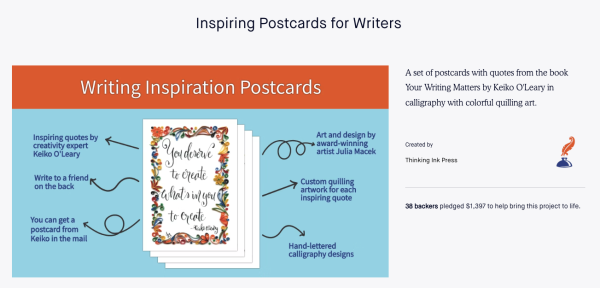
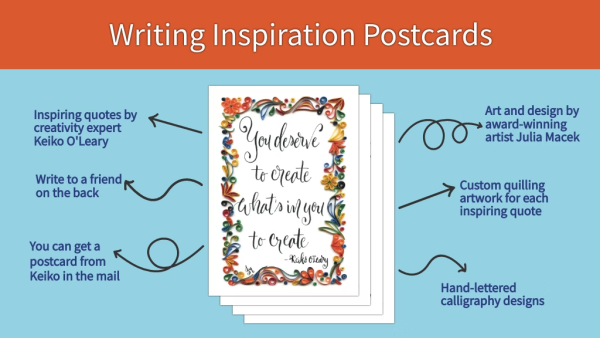
Hooray! Our Kickstarter for Writing Inspiration Postcards funded!

This project was fascinating for me because we learned so much about what to look for in our Kickstarter campaigns:

  • We changed the title (from "Beautiful Inspiring Postcards" to "Writing Inspiration Postcards") because we didn't realize that the title didn't reveal what the postcards were about until after launch (the information was available in the text and image, it just wasn't salient in the title).
  • We tweaked our reward tiers to provide more of what people wanted.
  • We realized as the Kickstarter was ending that we could have added even more reward tiers with useful things that people would have wanted (e.g. Keiko's "White Mice" postcard, or Thinking Ink's other writing postcards that we've already made).

And, for me personally, I'd have run the Kickstarter for another week, as we were just figuring out how to improve our outreach as the Kickstarter wound down. But, there's a tradeoff between how long the Kickstarter runs and how much time and effort it takes for us to manage it, so there's no exact formula for how long a Kickstarter should run in terms of wear and tear on the team.

Anyway, I hope you backed it, and get to enjoy the postcards!

-the Centaur

We want your stories for the NEURODIVERSIVERSE Anthology!

centaur 1

Hey folks, I and my coeditor Liza Olmsted are happy to announce we're looking for stories for THE NEURODIVERSIVERSE ANTHOLOGY, which will explore how neurodivergent folks might have an advantage in dealing with aliens whose thought processes might also be different. From the call for submissions:

The universe is filled with aliens—creatures with different histories, cultures, and even biologies—who may seem strange to us. But our world is filled with a diversity of people, many of whom find each other strange. One particular group finds the rest of humanity especially strange: neurodivergent people.⁠

Would neurodivergent folks find themselves at an advantage in dealing with aliens?⁠

Let’s find out.⁠

From the call for submissions:

We're looking for short stories, flash fiction, poetry, and black-and-white line art. You can find out all the details at www.neurodiversiverse.com. Send us your stories! We can't wait to read them.

-the Centaur

[eighty-four] minus one-oh-five: so far, so good, morning edition

centaur 0

So far, so good, on the new strategy of starting off with the projects, rather than the maintenance: I've tweeted, checked in with LinkedIn, worked on some non-fiction books, am blogging, and am about to switch gears to writing my Camp Nano entry, SPIRAL NEEDLE.

I'd felt like I was falling into a bit of a slump after getting through the big Embodied AI and Social Navigation deadlines (more on that later) and I gave this new strategy a try after chatting with my buddy, popular science author Jim Davies (author of Riveted, Imagination, and Being the Person Your Dog Thinks You Are).

Jim taked to me about how prioritizing book-writing was critical for his process. I don't really have to do that for fiction - or, more properly, I have structured my entire life around ensuring I have time set aside for fiction writing, so at this point it is practically free - but non-fiction books are new to me.

But one of his other suggestions baffled me, not because it didn't make sense, but because it made too much sense - except I was already doing it, and it wasn't working. Jim pointed out that most people go through periods of vigilance, slump, and recovery during their day, and that as a morning person he reserved book writing, which required critical thinking, for his early vigilant time. Errands like bill-paying worked well for him in the slump, and he felt most creative in the recovery period in the evening.

Okay, great, I thought, I can use this. Already I can see shifting the order I do things in my day - as a night owl, I start my day off in the slump, recover from that, and then get increasingly and increasingly vigilant the further and further I go into the night. (If I have a project due and no obligations the next day, this can go on for hours and hours before exhaustion starts to outpace execution and productivity finally drops).

So maybe switch errands to earlier in the day, I thought, and productivity in the afternoon. But wait a minute: I'm already using my late nights for my most creative time. Why isn't this working.

What I realized is that I have an irregular schedule. In THEORY my late-night time is my most productive time, but in PRACTICE on some nights I get an hour, on some nights I get two (or five) and on some nights I am already so wiped that I really don't get much done at all.

But I do almost always get something done in the morning, even if it takes me time to get rolling. And for me, catching up on papers or writing notes or catching up on my blog is a mostly mechanical activity: it's not that creative thought isn't required, but it isn't to the level of, say, a novel or a scientific paper, where a hard-won sentence may be the result of a half an hour's search tracking down a key reference or fact, or, worse, an hour's worth of brainstorming alone or meeting with others to decide WHAT to write.

So: I can't count on myself to do a creative "chore" - something that has to be done regularly, like blogging or social media, or something that has to be done incrementally over a long period of time, like collating references or thoughts for a non-fiction book - by putting it in my evening creative block. The evening creative block is too irregular, and needs to be reserved for novels and art anyway.

The fix: blog (et al) in the morning.

Let's see how it goes.

-the Centaur

Pictured: tomato and lettuce sandwiches for breakfast, with the leftovers of the tomato as a side dish. At the breakfast table is Christopher Bishop's Pattern Recognition and Machine Learning, also available as a PDF, the latest of a long series of "difficult breakfast table books" which I laboriously read through, a page at a time - sometimes, one page over several days, until I "get" it - to increase my understanding of the world. Past breakfast table books have included Machine Vision, A New Kind of Science, and Probability Theory: the Logic of Science, the first is out of date now, but the latter two are perennial and highly recommended.

[seventy-eight] minus eighty-two: tl;dr: get to the point

centaur 0

tl;dr: get to the point in the first line in your emails, and also in the subject.

"TL;DR" is an acronym meaning "Too Long; Didn't Read" which is used to introduce a quick summary of a longer document - as I did in the first line of this email.

Often when writing an email we are working out our own thoughts of what should be communicated or should happen - which means that the important point usually comes at the end.

But people don't often read to the end. So it's important, when you get to the end of your email, to port the most important point up to the top (which I typically do with the TL;DR tag).

And, even better, if you can put it in the subject line, do that too.

Your email is more likely to work that way.

-the Centaur

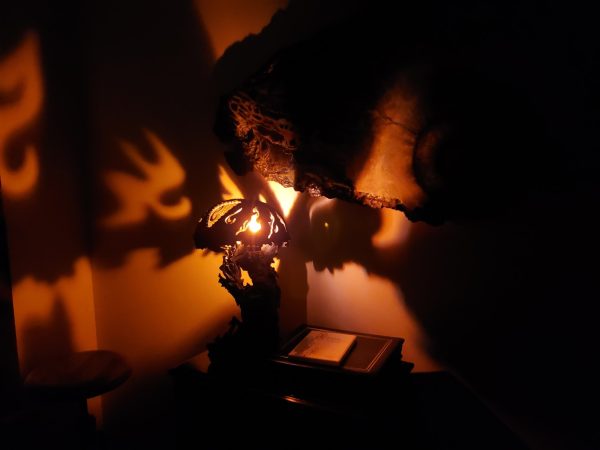
Pictured: our wedding dragon lamp, sitting on a side table with our wedding DVD, which is sort of a coincidence; and a very cool light bulb.

Discussed: a topic I swear I've written about in this blog, but I cannot find via searching past posts.

[seventy] minus fifty-nine: what a beautiful evening

centaur 0

After truly terrific hailstorms, we were treated to a truly awesome sunset.

And, got some work done on editing SPECTRAL IRON: Dakota Frost #4. FINALLY, getting the rewrite of the slow section rolling with some good Dakota Frost action segueing right into an ambulance ride.

That's more like it.

-the Centaur

Viiictory, Thirty-Five Times

centaur 0
the Camp Nano victory badge for 2023

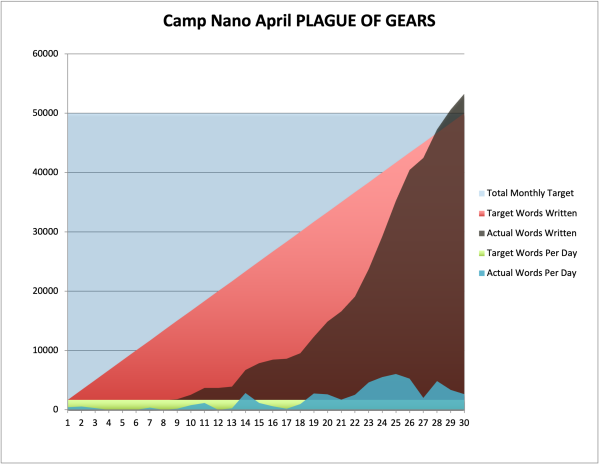
Woohoo! After being just about as behind on a Nano challenge as I have ever been and still won, I managed not only to complete 50,000 words in the month of April, but to blow past it to 53,266 words! Hooray!

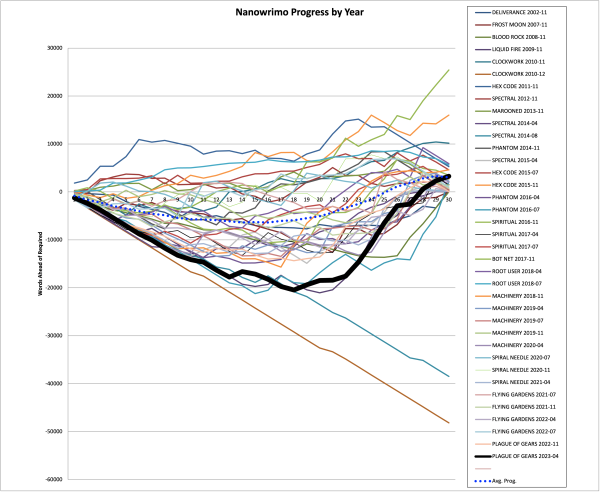
progress chart for PLAGUE OF GEARS this April

To be frank, that steep slope over the top there feels really good, and I'm quite proud of the effort that I put in to make sure I made it this Nano. But, to be equally frank, the steep slope there PRIOR to going over the top really su-u-u-cked, and I pulled two almost-all-nighters (and one actual all-nighter) to finish.

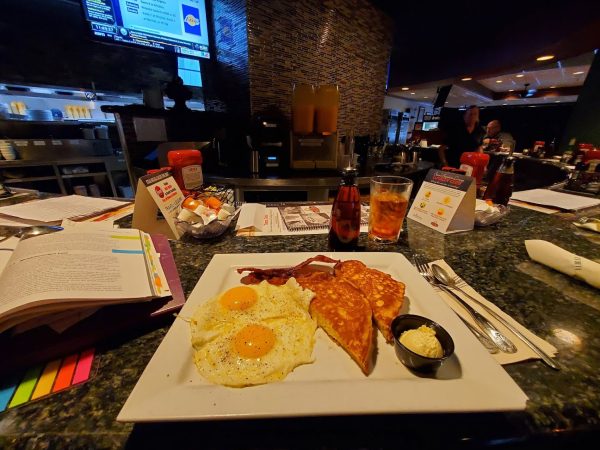
what, me eating breakfast before noon? it's less likely than you think, though I do like it

Early in the month, I prioritized Clockwork Alchemy, and the Social Navigation paper, and getting work done in our old house in California that we're trying to renovate. But once I was back in the East Coast, I really had to knuckle down, writing up to 6,000 words a day near the end.

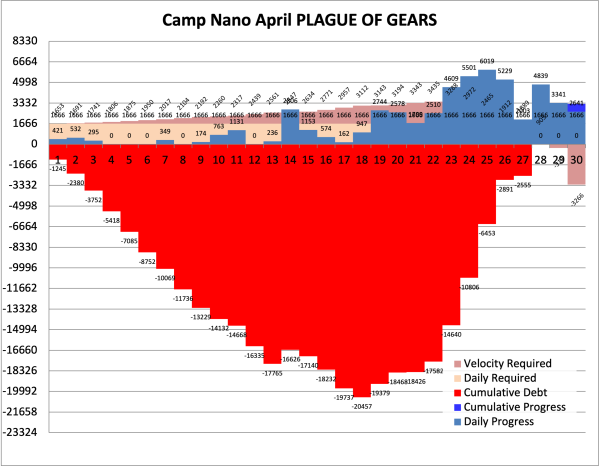
deficits and progress on April's nano

But, by the end, I was so far ahead that the "velocity required" to stay on track actually went negative (as you can see at the very end of the graph). I broke 50,000 words yesterday, but I still had a scene in mind involving the Big Bad of the Jeremiah Willstone stories, the dreaded Black Queen, Victoria. I didn't want to lose that inspiration, so I wrote it today, and the next scene, which is starting to roll back together with other parts I've written already. So now will be a good time to take a break and take stock of my life, to resume editing Dakota Frost #4 SPECTRAL IRON, and to get my new consulting business, Logical Robotics, rolling.

twenty-one years of nano challenges

According to my records, I've attempted Nanowrimo challenges (Nanowrimo, Camp Nano, and Script Frenzy) 37 times, with 35 successes, producing over 1.85 million words in successful months. If I'm lucky, and I can keep up the pace, I may crack two million words next year - wish me luck. But I think it's more pressing to get the editing of the existing books done - so wish me even more luck with that.

Oh, one more thing, the excerpt:

“Alive, but deposed,” Jeremiah said, as the proboscis of the thing behind her touched the back of her head—then bit in with a sickening CRACK. “Aaah! Deposed in 1865—or enslaved by the Plague today,” she moaned, as it dug in. “It’s y-your … choice … your … Majesty—”

The Queen raised the pistol. “I am no-one’s slave,” she said, and pulled the—

Falconer Cadet Specialist Jeremiah Willstone awoke with a start. Staring at the ceiling, she tried to hold on to the dream … no. She knew better than that. It felt like a fading dream … but they were echoes of memories, the last remnants of some disruption in time.

The jumbled recollections were slipping away, the tangled thoughts dissipating: canaries and scarabs and plagues and queens. But she remembered at least three key things: there was a war on, in time; her memories would be out of date; and she had to rise to the occasion.

Jeremiah glanced at the clock: 4:45AM on a radium dial that did not look familiar—no, did not look like her style at all, a frilly elegant thing more French than Austrian. She looked over, found what she expected from seeing the clock, and considered. It was late enough.

“Oi, roommate,” Jeremiah sat up, feet off her cot. “Name, rank, year. No joke.”

The human computer on the cot opposite her groaned. “Wha—” the woman muttered, a dark-skinned woman with impressive curls and chest, who managed to make waking up seem elegant. Then one of the vacuum tubes in her head sparked, and she sat bolt upright, blinking.

“The Lady Westenhoq,” the woman whispered icily, then swiveled to look at Jeremiah. “Liberation Academy Cadet. And, like you, Cadet Willstone, I’m a first year.”

“Thank you, Lady Westenhoq,” Jeremiah said quietly, “but I meant the date.”

Westenhoq looked at her, then swiveled her own feet of the cot to face her.

“Eighteen-ninety five,” Westenhoq whispered. “Out drinking again, Mya?”

“No, and I … think I’m going to start going by Jeremiah.” She rubbed her face. “Sounds more professional, and pet names remind me of my uncle anyway. But, since you knew my nickname and used it freely, I … take it we’ve worked together before.”

Oh, have they. Prevail, Victoriana!

-the Centaur

Pictured: Breakfast at Stax Omega, lots of graphs, and the Camp Nano winner's badge.

[sixty-six] minus fifty-three: i made it

centaur 0

I finished Camp Nano. It's late, I'm tired, I have church in the morning enjoy a random picture, victory post tomorrow.

-the Centaur

[fifty-five] minus thirty-six: back to work

centaur 0
break that fast

No, I'm not giving up on blogging at a rate of once per day this year, even if I am already roughly forty percent behind. But my top focus now that I'm outside the Google firewall is to get back to work: after two and a half months of uncertainty following my layoff from Google, the paperwork is now done: the End Date has passed, the Severance is signed, the laptops have been shipped back to the office, and, excepting a bit of COBRA / IRA business, I be done with all that.

sending back the laptops in their special return box

But my research isn't done. Coincidentally, I had a few scientific papers-in-flight going when the layoffs happened; not coincidentally, I dove in to making sure those went out. One is under review, with a possibility that we may need to open-source the code, but another has already been published, at the Workshop on Human-Robot Interaction in Academia and Industry. This is a "splinter paper," a small topical paper we forked out of a larger journal article in preparation, and that journal paper needs to go out.

Nor is my work done. Today is Camp Nano, the start of yet another 50,000 word challenge, and I hope to finish the novel-in-progress, JEREMIAH WILLSTONE AND THE PLAGUE OF GEARS, which my friend Tony Sarrecchia is helping me adapt into a series of audio dramas. And I need to finish editing Dakota Frost #4, SPECTRAL IRON, at which I recently made a lot of progress solving plot problems - and for which I recently conducted a research trip to Jack Kerouac Avenue to scope out the site of a battle.

jack kerouac attack

That doesn't even count the game artificial intelligence work I want to do, or the games I want to write, or the drawing I want to do, or my new interest in music, or the regular robotics research I want to get started under the Logical Robotics banner.

My point is, "work" for "the man" should not define you. At least, it doesn't define me: it inspired me, definitely, in many ways, but as for now ... I'm tanked up with my own projects, thanks.

Back to work.

-the Centaur

Pictured: Breakfast of the First Day of the New Era, sending back the laptops, Jack Kerouac Alley.