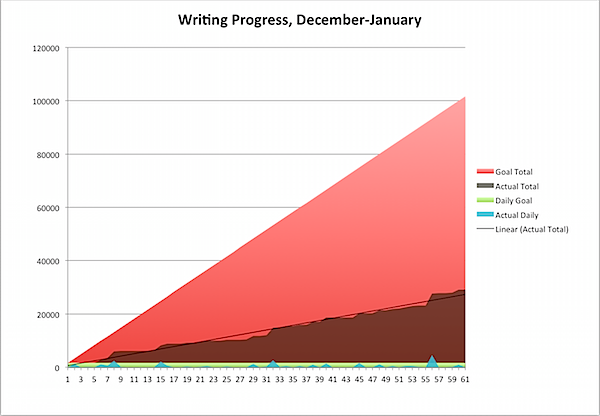
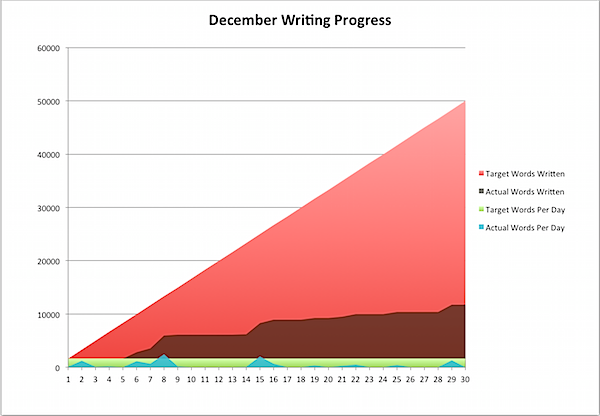
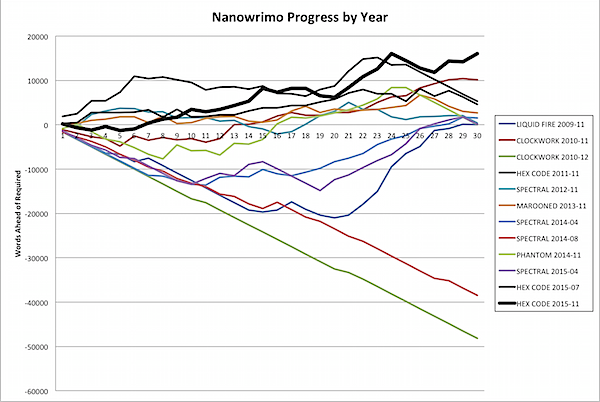
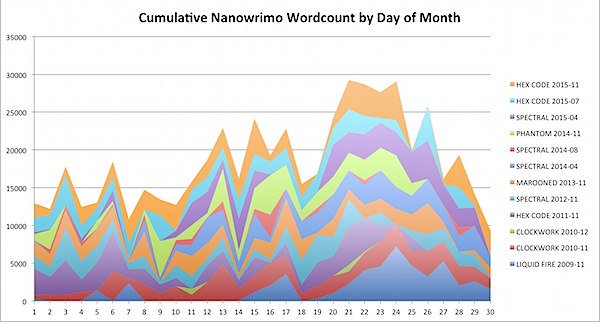
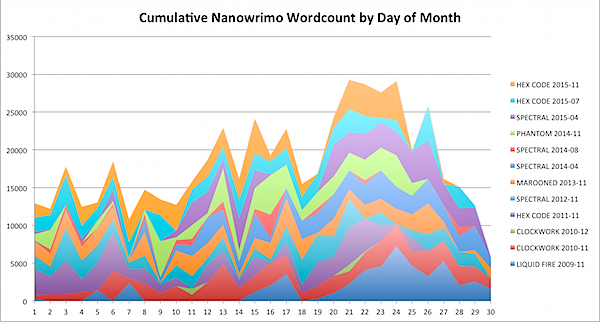
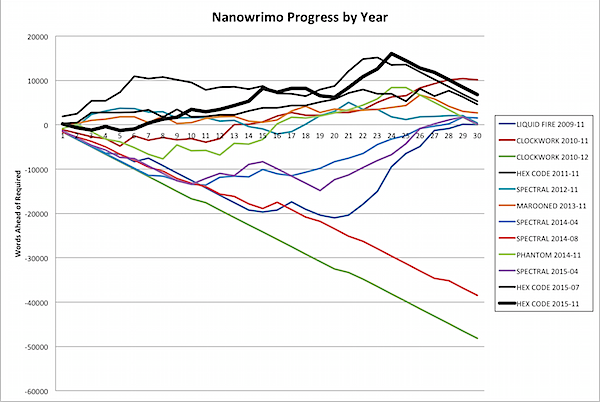
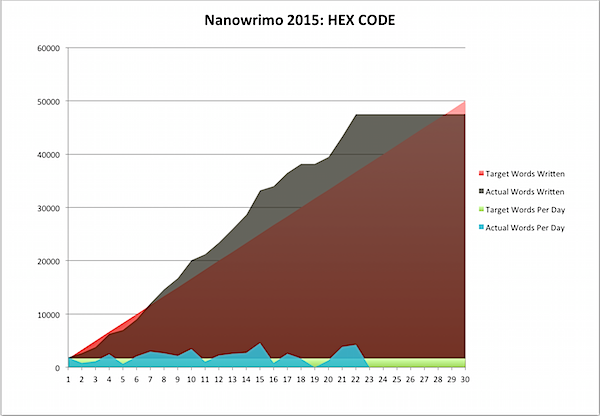
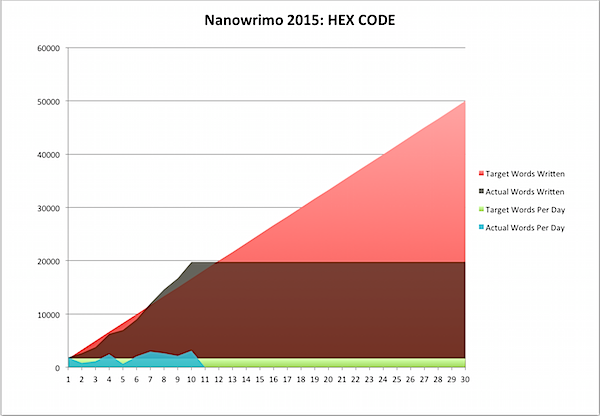
So I’ve got enough data now - two months - and it shows my productivity in non-Nano months is about one third of the Nano goal. Because December and January are 31 day months, by now I should have produced a notch over 100,000 words if this was National Novel Writing Month … but instead I’ve produced a notch under 30,000.
The picture is a bit muddled since my productivity in successful Nano months is slightly higher than 50,000 words, and my productivity this month is slightly higher since I’m not counting some writing (some edits to stories, plus all the nonfiction writing I do at work). But it shows the social effect.
The small press I’m associated with, Thinking Ink Press, has just announced its first anthology, 30 DAYS LATER, edited by A.J. Sikes, B.J. Sikes, and Dover Whitecliff of the Treehouse Writers’ Group! Check out the Thinking Ink Press announcement for more details, but it should be coming out around the time of the Clockwork Alchemy conference this May.
(Self-deprecating note: this blogpost is a rough draft of an essay that I’m later planning to refine for the Write to the End site, but I’ve been asked to share it, so I finished it up and am sharing it as is. When the full article is cleaned up, I’ll link to it … but in the meantime, enjoy, and try not to wince too much).
So for way of introduction to the Write to the End group, I’ve been asked by a lot of people recently “How can I become a better writer?” — a question for which I’ve generated a bit of stock advice I frequently sum up as, “Just Write!” But, when I dug a little deeper, I found almost half of the people asking me that question were really asking the question, “How can I overcome Writer’s Block?” Well, I have some theories. And I’m going to tell you about them. But more importantly, I’ve got some techniques which I’m going to share with you, and even better, I’m using one of them right now: if you sit down to write and get writer’s block, then write down very explicitly why you sat down to write, and what kind of writing you hope to have produced when you get up again. If you don’t know why you want to write, and you don’t know what you hope to produce before you get up again, congratulations! You’re done. Get up from the page and go have a soda, something really nice, not diet, like with Italian flavoring or an ice cream float. If you do know what you want to write, or what you want to have written, congratulations! Actually writing that down can get you … um … on the order of 227 words, according to Scrivener’s count, probably 300 by the time you’re done. The hope is that getting yourself writing ANYTHING will get your pen moving, and saying what you want to write will get you rolling in the right direction; however, if you finish saying what you want to write and remain stuck, then be really explicit about what you want to say next and what you feel is your barrier to writing more. That’s the big thing I want to leave with you: if you have writer’s block trying to write something, you can overcome it by either describing what you want to write, or why you want to write it, and springboarding off that with more questions and answers, until, in the end, you’re just writing.
Huh. A notch over 350 words. I underestimated.
Now, I know some of the people who are reading this are technical writers, and so I want to warn you up front that there’s a problem with my approach that doesn’t apply to fiction writers: describing what you want to write is not a substitute for the thought that needs to go into the technical meat of whatever it is you’re writing. For example, if you’re trying to, say, write a design doc for your teammates, you may think that outlining the project, its goals, its problems, and its possible solutions is enough to make a design doc—but it’s not. That’s what a fiction writer calls an outline. While there are fiction stories that are essentially nothing but outlines, and even more that are outlines in narrative, fiction generally isn’t an outline, but is instead people in places, talking and doing things, told in a particular way — or what we technically call character and setting, dialogue and action, and scene and narration wrapped in that stylistic veneer we call voice. But technical writers, we can get tricked by outlines of technical items into thinking we’ve said something about a problem — so it is really critical that after you get a rough outline down that you go back over it, extract the important ideas, to think about they fit together, and to identify the key ideas that are not obvious about the problem — and those key ideas are what should go into your design doc or project proposal or product requirements document or launch announcement or marketing communication or scientific paper or anything else. The value of your document is not the structure of the problem, which is often well known, but the original thought that you bring to the table.
And that brings us to the primary reason for writer’s block, at least for experienced writers, that is: not having thought clearly enough about what comes next.
But wait! Because I’m writing this extemporaneously — a big-ass word for saying I’m pulling this out of my orifice — I’ve forgotten to tell you about the other kinds of writer’s block, which is somewhat important in case you’re possibly getting bored and want a quick way to figure whether slogging on through the desert of this essay in search of water that will quench your particular search is a vain hope or not, but which is actually far more important because some of those kinds of writer’s block can KILL YOU. Well, actually, no, that’s not very likely, but they can get you to kill your story and end up back at stage one.
So how can you get blocked? Let’s tick a few of these off so we can hold your interest while I drag out the big red warning sign. First, sometimes writer’s block is caused because you just don’t want to write — Ayn Rand used to call this “white sneakers disease” because she knew a writer who’d’ve rather cleaned their sneakers than write. Ayn Rand thought that, technically speaking, this wasn’t a block, but nevermind, since people have developed a good technique for resolving “white sneaker’s disease,” and that technique is called BIC — Butt In Chair. If you think you want to write, and you are not writing, then stop whatever you are doing, go put your butt in chair in front of a pen, piece of paper and writing surface, and sit there until you get bored enough to write something, or find that you cannot and AHA NOW this is writer’s block, congratulations, move on to the techniques for tackling writer’s block proper.
Second, as I said earlier, experienced writers can have writer’s block because they haven’t thought through what comes next. Third, inexperienced writers can have writer’s block because they’re cognitively overwhelmed — which is the real point of this essay, and which is why I started the essay off with one paragraph specifically tackling this problem in case that was all that you read, but, don’t fear, if “inexperienced writer staring at a blank page feeling just that, a blank” describes you, then hang in there, I’m writing this essay specifically for you and will come back to this in detail.
But the fourth kind is the real dangerous kind of writer’s block, a particular kind of voluntary writer’s block which can hit writers of any stripe, both unmotivated and motivated, inexperienced and experienced; in fact, it almost hit me writing the second section of this essay, and if I’d given into it, I never would have written the words you’re reading right now — because I would have spent the same time editing the first section of this essay, and that right there is Writer’s Block of the Fourth Kind: editing while you write.
Trying to edit while you write is particularly dangerous for reasons I’ll get back to when I explain Why Novices Feel Fear At The Dreaded Blank Page, but the more immediate reason is that you can spend arbitrary amounts of time editing without adding to your draft. Now, there are some writers who edit while they write all the time — especially poets, who may spend as much time working over ten words as it takes me to write a thousand words —but right there that shows you that if you’re trying to cough up a ten thousand word story, it doesn’t behoove you to drill down on a perfect first sentence. There’s a reason we call our writing group Write to the End: it’s because we believe you should finish what you start before you try to edit it, or you will never finish anything at all.
Okay, that’s a first pass at why Writer’s Block of the Fourth Kind is dangerous: it can stall you out, and worse, trick you into thinking you’re actually writing. But what if you don’t have anything to edit? What if you’re suffering from Writer’s Block of the Third Kind, the Dreaded Fear of the Blank Page? This feeling of blankness is the feeling you get when you’re cognitively overwhelmed, and to understand the reasons I separate it out from Writer’s Block of the Second Kind, AKA Not Thinking Through Your Shit, we need to talk a little bit about cognitive psychology — specifically, working memory and cognitive skill acquisition.
You see, when a writer sits down at the page, we may imagine we’re creating worlds — but we’re not gods, and can hold only a finite amount of information in our heads at one time. Our working memories can only manipulate a handful of chunks of discrete information at a time — famously estimated in cognitive psychology as a short term memory holding roughly seven plus or minus two items. Of course, it ain’t that simple when you dig into the details, but as a rough rule of thumb, it holds — and that explains both writer’s block for experienced writers and the Dreaded Fear of the Blank Page for inexperienced ones.
When faced with a blank page, you can easily see how you could get blocked not knowing why you want to write, or what you want to write about, or what’s the meat behind the structure of the idea — there’s just nothing in your short term memory to put on the page. But why do so many inexperienced writers who know the answers to all these questions nevertheless come to me complaining that they feel a blank when sitting down at the page? Well, that’s easy: I’m a psychic magnet for those kinds of problems — just kidding. The real reason is that inexperienced writers have, by definition, a set of skills which are not fully developed — and we don’t actually have short term memories that hold information, we have working memories which are both the product of and are used by our skills.
Yes, that’s right — I tricked you! I started talking about working memory, then smoothly slipped to talking about short term memory in the same sentence, because for a long time cognitive psychologists made the same mistake. We imagined that humans had a short term memory like a buffer that passively held information, like a briefcase, but when you carry through the implications that model breaks down, and that’s not really how the cortex of the brain is organized anyway. It’s better to think of the brain’s fixed storage capacity as less a passive buffer and more of an active internal dashboard reporting the state all the brain’s cognitive systems. Now, there are no photogenic cartoon characters monitoring that dashboard like in Inside Out—in part because of licensing issues with Pixar, but mostly because it would involve an infinite regress—if there’s a little character monitoring your internal dashboard, who’s monitoring their internal dashboards? Cognitive psychologists call that homunculus fallacy, and so a better image of the mental stage of the mind is an empty spherical cockpit filled with instruments projecting their findings to each other. Your consciousness is just the part of your mind that is easily accessible to other parts of your mind. For example, you can recognize a person’s face, but unless there are really obvious features, like Salvador Dali’s mustache that points all the way up to your eyeballs, you can’t describe a face in sufficient detail for someone else to recognize it, because the details of your facial recognition system aren’t accessible to conscious awareness.
In most animals, the instruments of the cockpit are fixed by the design of the system, like the gas gauge on your car, which reports the status of your fuel tank, or the flashing light on the fast return switch of your TARDIS, which shows that the Ship is trying to return to its previous destination.What distinguishes humans is that many of its screens are programmable, the same way your car’s GPS can update itself when the manufacturer pushes an update, or the way your TARDIS reconfigures its controls to match your personality every time you regenerate. Over time, the systems of the cockpit collect information, slowly improving over time with respect to the problems for which they were designed, like a GPS picking up new roads. But the human mind isn’t a car, with an army of of engineers designing updates that get pushed to it over a wireless network, or a TARDIS, with a billion years of engineering designed into its architectural reconfiguration system to help it adapt. No, the human mind has to update itself from scratch, often adapting to skills for which it has no evolutionary precedent — like, for example, writing.
You’ve got dials on your dashboard for hunger, sound, even speech, but writing is something humans made up from whole cloth. And when you’ve got to learn a skill for which you’ve got no precedent, no inbuilt system that can just pick up new roads, your mind has to fall back on more powerful general problem solving techniques. These techniques involve representing the information we know about a problem explicitly, collecting the implications of that knowledge from our long term memory, and putting all that data together into new conclusions. Once again, the components of your dashboard notice these leaps from information to conclusion, storing it to make it available to solve new problems. This process is called automatization, and it’s called that because it’s transforming explicit information that you’re representing in your conscious dashboard into skilled knowledge you can use automatically without conscious awareness.
You’d think that automatization wouldn’t help you, since you’re trying to store new information, but all you have are existing systems - but one of the fundamental tricks of computing is that any sufficiently powerful process can simulate just about any other process, and the cockpit of your glorious machine—in which all the systems you’ve accumulated over a billion years of evolution can talk to each other—certainly qualifies as a very powerful process that can simulate almost anything. SO, if you keep learning basic facts about a new skill, and keep storing them in whatever systems you have that are even remotely compatible, over time, your overall cognitive system will learn a new, automatic skill—but hang on. To represent the information about a problem, to dredge up its implications, and draw conclusions, your mind needs scratchspace—temporary storage to hold this information so your general problem solving processes can work it over, and that information must be accessible your conscious awareness. Learning a new cognitive skill needs your dashboard. It needs your highly limited working memory.
But wait! Weren’t we using that to hold what we wanted to write about?
Exactly. Now you’re starting to see the problem.
As a novice writer, you may know how to physically write—how to generate words on the page in response to prompts, like writing down items for a grocery list for your spouse in response to spoken requests, or writing down the contents of a shipment from the Queen of Sheba as it comes off the boat—but when you’re writing an article or story, what you’re actually doing is the separate and more complex task of composition — the task of creating new sequences of words. Take a simple example, composing your Captain’s Log. You can’t just hit a button on the Captain’s Chair and start jabbering about what happened on the planet: the task involves creating a specific set of words in a specific sequence which is stereotyped. You start with “Captain’s Log”, followed by the stardate, followed by a sentence reporting the location or situation, followed by one or two more sentences discussing the key questions of the mission and whatever red-shirted disposable crewmembers were eaten by the monster of the week. That structure itself is information, information which you need to call to mind, somehow, in order to organize the words that you speak, and if you’ve been rattled by a bunch of red-shirted disposable crewmembers being eaten by the monster of the week, you might have trouble gathering your thoughts. An experienced Starfleet captain like Picard or Kirk, however, will have no trouble—because for them, the structure of the log is automatic.
The way that cognitive skill learning works is through the transformation of declarative knowledge to procedural knowledge: that is, the process of automatization takes information you express explicitly and turns it into information that’s the output of a skill. That means if you are skilled at a task, you don’t need to pay attention to it: the actions of the task will happen, well, automatically; but that also means that if you are not skilled at a task, you’re relying on your general purpose processing power to perform it—and that the information you need to perform the task will compete with what you know about the task.
The problem is even worse because the act of writing relies on many sources of knowledge. Let’s review for a moment what some of those are, and I’ll throw in some you may have not thought of yet:
Purpose: Why you’re writing (for creative expression, because your boss asked you)
Goal: What you want your writing to do (to be fun, to help your teammates, etc)
Content: What you want to write about (the specific information you contribute)
Form: What kind of thing you’re writing (a story, an article, a blogpost)
Style: What tone of voice you want to use (lighthearted, formal, quirky)
Each of these is better thought of as a skill for generating answers to questions, rather than a source for information—and if you’re not practiced at the skill, you’ll have to store information about it in working memory, competing—but wait a minute, let’s go back to content for a moment. Think about it. To answer the question about what you want to write, you need to generate several pieces of information:
Content: What you want to write about
Structure: What topics do you need to cover?
Questions: What questions should your piece answer?
Ideas: What do you think about the questions?
Answers: How does that translate into answers?
I’m not trying to be pedantic here—I’m making an important point, or I think I am. What you want to say involves several kinds of information: the general topic of your piece, the specific issues you want to address, whatever thoughts you have, and how to express them—but each of these types of information is, itself, a skill, which, if it is not practiced, will compete with whatever it is you have to say.
This is why inexperienced writers dread The Blank Page: because they’re actually drawing on half a dozen skills, none of which are practiced, and those are driving their ideas straight out of their head. This is why my wife, who’s a great artist but not an experienced writer, a woman who’s put a great deal of thought into eco-friendly art, who knows why she wants to write, what she wants to accomplish, and can easily spend forty-five minutes talking to me about her ideas, can nonetheless get totally stymied when she sits down to write, staring at the blank page. And this is why I separate the Writer’s Block of the Third Kind—the inexperienced author’s Dread of the Blank Page—from the simpler Writer’s Block of the Second Kind—the experienced author’s Lack of Shit Together—because if an experienced author is willing to sit down and think hard about their problem, once they get their ideas, their skills will take straight over—but if an inexperienced author tries the same thing, their very skills may drive their ideas right out their heads.
That’s why inexperienced writers may need different tools to write other than “Just Write” or “Butt in Chair” or “Stop and Think”. In cognitive skills acquisition, one way you can teach a complicated skill is to teach it in parts—we call this scaffolding. Rather than try to become a great basketball player all at once, you instead practice dribbling, taking shots, holding the ball, playing one-on-one, then pickup games—slowly building up a body of skills that eventually become the foundation for real mastery. Writing is the same way; if you’re having trouble getting started, focusing on sub-skills and developing them can give you the scaffolding you need to get started.
One scaffolding technique I’ve recommended to people is morning pages—a technique recommended in The Artist’s Way to write three pages longhand the first thing in the morning. There are a lot of reasons to do this beyond scaffolding, but it gets you past the problem of composition by giving you a safe environment to write, and it can also help you express your ideas. If even this is too hard, you may be blocked on the simple act of writing, and I recommend you try writing “bla bla bla” until you get bored with it. This doesn’t work for everyone, but you could also try the “Finding Forrester” technique of taking an existing story and typing it in until you get tired of their words and start writing your own.
Another scaffolding technique is what I call the inventory method. I hinted at this at the start of the article: ask yourself explicitly the questions you need to perform the task of composition:
Why do you want to write?
What do you want your writing to accomplish?
What should people learn or feel after reading your article or story?
What is the most important specific idea that you contribute to this topic?
And so on, and so on, with the whole list of questions that I had earlier.
If even this is too hard, there’s another method I call the one page assessment. Get a piece of lined composition paper—and I mean this literally, this is for totally blocked people, so I want you to literally do these steps physically—and draw a line down its center so it has two columns. On the left, write out, one per line, the numbers one through ten, and then the words “Who what when where why how;” on the right, write out the days of the week and the months of the year. Now, for the numbers one through ten, write the top ten most important thing about your project—these can be single words or sentences, but rack your brain until you can get ten single words—and then write brief answers to each of the “Who what why …” questions below. When you’re done with that, for each day of the week or month of the year, write something significant about your project—either in the story you’re telling, or about when you as a person can work on it, or whatever (you can also do this with other breakdowns, like states or countries or oceans or planets—whatever categories work for you). When you’ve filled the sheet, pick the five things most important from the page, flip it over, write down these five as your headings, and try to write at least one sentence about each of the five things you picked.
The purpose of this exercise is to take away the need to do composition AND the need to generate questions, just focusing you in a very general, nonthreatening way on properties that affect your problem. If you make it through the page, consider doing it again, with your own headings this time. Process repeats, until you’re generating full outlines.
On the note of outlines, the technique I used for my first novel was what I called a recursive hierarchical outline. I knew I wanted to write a novel about a genetically engineered centaur, so I wrote that sentence down in a Microsoft Word document. Then I copied that sentence, italicized it, and wrote a paragraph about that sentence detailing the plot. Then I copied that paragraph, italicized it, broke it into sentences as new headings, and expanded each of those sentences into a paragraph. I repeated the process until I had a good outline; then I expanded it further until I had sections and finally paragraphs—at which point, I just started writing.
Another way to get at this information that’s locked in your head is the interview method—having a trusted friend ask you questions, and either writing down your answers or recording it for transcription later.
Finally, Bjarne Stroustrup, the creator of C++, recommends the template method—if you want to write an article on a topic, find a similar article to use as a template, and use that to help establish your questions and find the rough structure of your outline. Since he built a whole career around basically doing that to C by turning it into C++, and since he’s done it with several books and articles since then to great effect, I guess this approach has worked well for him.
The point of giving all these potential scaffolding techniques is that each writer is different, and no technique is guaranteed to work for you. We can see why this is—everyone has a slightly different set of internal equipment, and even for equipment that’s the same, everyone has a different history of learning and a different set of skills that work with facility, or not, on any given problem.
So, to sum up, the ways of tackling writer’s block are:
Writer’s Block of the First Kind: What We Have Here is a Failure to Motivate. Solution: Butt In Chair
Writer’s Block of the Second Kind: Not Thinking Through Your Shit. Solution: Stop and Think
Writer’s Block of the Third Kind: The Dreaded Blank Page. Solution: Cognitive Scaffolding
Writer’s Block of the Fourth Kind: Editing While You Write. Solution: Write to the End, then Edit
So now you see why I sum up my writing advice as “Just write—bla bla bla if you have to so your pen’s moving—because the more you write, the easier it gets, and the better you get; but if you sit down to write and get writer’s block, then write down very explicitly why you sat down to write, and what kind of writing you hope to have produced when you get up again, and then you’ll know how to proceed.” This sums up all of the problems in one Butt in Chair, provides a Cognitive Scaffold, incorporates Stop and Think—in fact, it tackles just about everything except the editing bit, which might be summed up as “Don’t critique yourself, finish your damn story!” And as for that bit …
That’s why I go to a writing group called Write to the End.
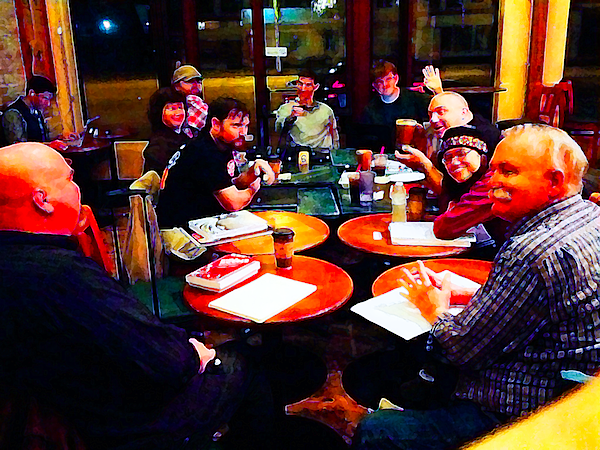
For those of us who are hermits, it’s sometimes good to get a reminder of the great things that can happen via social support. At the recent Write to the End meeting, I stepped up as facilitator when Keiko O’Leary was delayed on a plane flight - but when she showed up, after an offhanded comment by one of the members, we all decided to pretended that she was new to the group! We asked her to introduce herself, welcomed her warmly, and explained everything as we went, which she found hilarious - and comforting, since she didn’t have to do any work handing out prompts or monitoring the time. It was a great writing session for all, and couldn’t have happened without the happy synergy of all the different people working together.
I had a similar experience at lunch at work recently - I’m a loner, and normally go off on my own to read or write my books, but I do try to join the team a few times a week. At the lunch table, thinking of one of my problems, I said: “Wouldn’t it be neat if we could apply X technology to Y”? Suddenly, EVERYONE was chiming in: one TL scoped out the problem, another coworker had great suggestions, and after twenty minutes of discussion I offered to go write it up. But I didn’t have time before I had to interview a candidate, so when I came back I found a one-pager written by a coworker. I sat down to expand it, realized my coworker had a key insight, and ended up producing a half-dozen page design doc. I may have been the first person to utter “apply X to Y” but the final idea was very much a joint product of every person at the table - and could NOT have been done alone.
As an on-again, off-again follower of Ayn Rand, I guess this is exposes one of the many flaws of traditional Objectivist thinking: its black and white nature, particularly with regards to committees. Several of Ayn Rand’s books lambast the work produced by committees, and I indeed have seen horrors produced by them - but call a committee a “brainstorming session”, and you can literally produce things which no-one could have produced alone. Of course, a single person or small group must then refine and focus the ideas so they can be implemented, or everyone will go driving in different directions - but even that seeming aimless search can be a success if you’ve got a large technology space to explore and a diverse group of committed, dedicated engineers to explore it.
But the possibility of brainstorming is not really what I want to focus on: it’s the great things that come out of treating your fellow people right. Being nice to each other greases the wheel, sharing your ideas and being open to theirs improves intellectual debate, and treating one person as special on a special occasion can really lift their day - whether it’s a thank you card and gift to a former manager, a day off for the facilitator of a group, or just giving a friend who’s into centaurs a centaur statuette that you happened to pick up two of by accident. These little things don’t just brighten our day - they change it, making the world a better place, one small act of kindness at a time.
-the Centaur
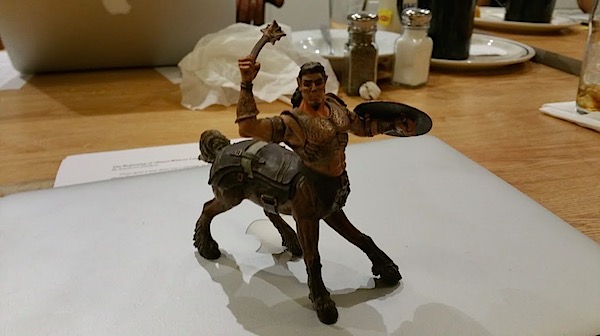
Pictured: a gift of a friend, via a friend, the first of whom professionally collects genre materials and ended up with two of the same statuette, and the second of whom brought it to the writing group for me because she knew I liked centaurs.
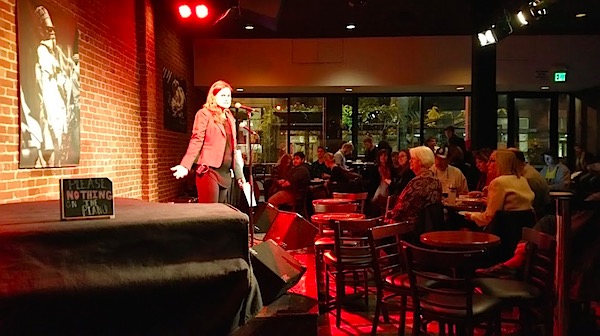
Play on Words is a great event which features short fiction performed by actors in front of a live audience. I’ve attended a couple of them since several of my fellows in Thinking Ink Press and the Write to the End group got their works performed at Play on Words.
Wednesday night, the Play on Words troupe performed short fiction by Keiko O’Leary, Betsy Miller and Marilyn Horn-Fahey; if you have a time machine, set the wayback to 7pm at Cafe Stritch (which incidentally has great jambalaya!), or, if your navigation circuit’s knackered, check out the live stream provided courtesy of South Bay Pulse magazine.
If you don’t have a time machine, there’s always YouTube! Find the link here.
And check it out! Next one is about three months out.
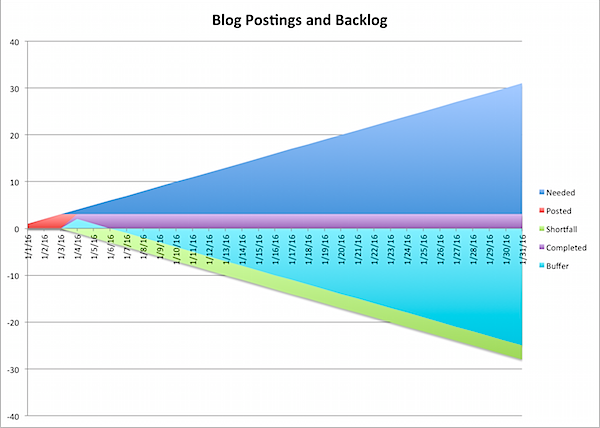
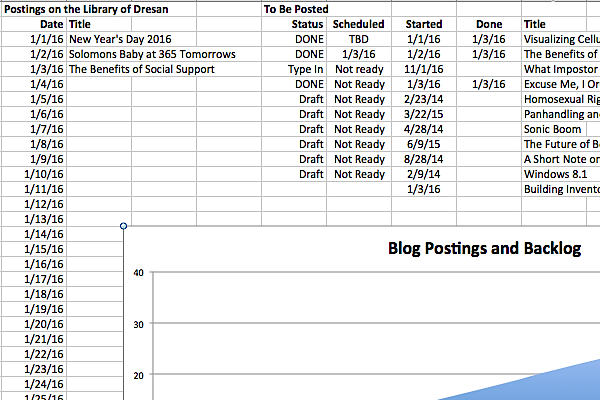
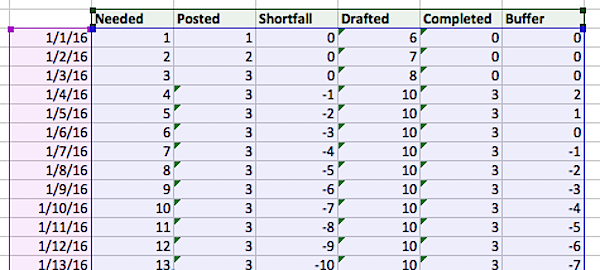
I’m taking on a new writing project - posting once a day on this blog this year - and, naturally, the first thing I open when i start a writing project - after Word or Ecto, to write the text - is Microsoft Excel, to track what I’m doing. Maybe that’s a sign of my so-called “left brain analytical tendencies” (NOTE: the left brained / right brained nonsense is a MYTH, used here for entertainment value only); after all, Quentin Tarantino once said “you can’t write poetry on a computer” and I doubt he spins up Excel on his yellow notepads. But a lot of successful cartoonists I know, like Bill Holbrook of Kevin and Kell, got their start on their most successful projects by getting an inventory - a month or two of backlog that they could use to prevent themselves from getting behind, and the only way I know to get that far ahead is to actually track what you’re doing.
It’s been a useful exercise so far. I found about half dozen old blog posts that never got posted (some quite stale now) and found many other ideas popping to mind just by writing them down. I also realized the limits of my Excel-fu, as the nice diagrams I generate for my Nanowrimo progress are actually the outcome of a lot of careful tweaking which I can’t easily replicate quickly.
But the exercise is really helpful. Just like all the other things in my life I’ve gotten more disciplined about tracking - my Nanowrimo progress, my word count, my short stories, my TODOs, my office piles - I’ve found great benefits come quickly, and it brings clarity, focus … and a great feeling of relief when you hit Save and are one more unit ahead of the onrushing wolf.
One of the things I’ve noticed is that its a lot easier to do things with social support. "Back in the day we used to call that peer pressure, son.” - but not so fast, Tex; hold on. When you try to do something for yourself, by yourself, it’s easier to give up; but when you involve another person, it’s far easier to hold yourself accountable.
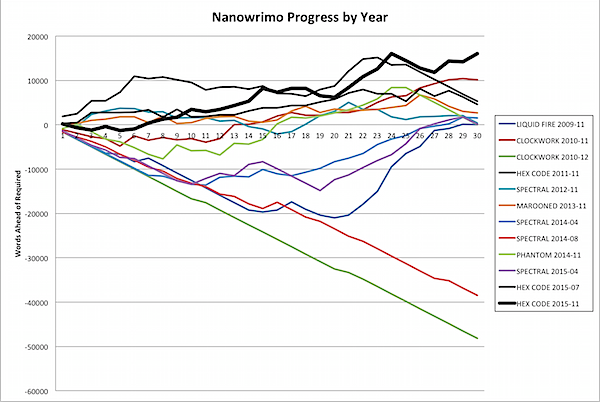
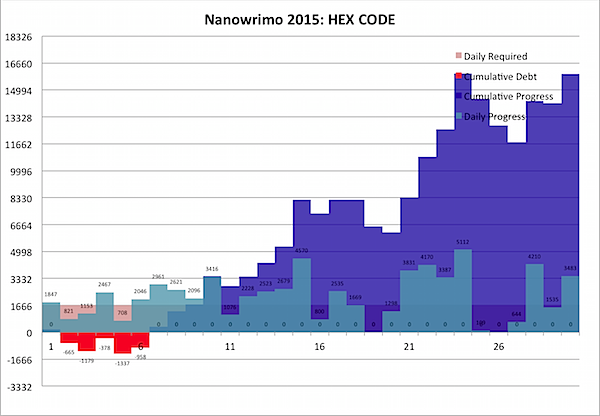
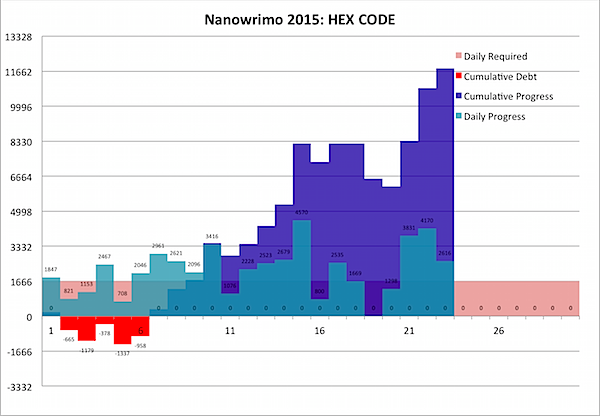
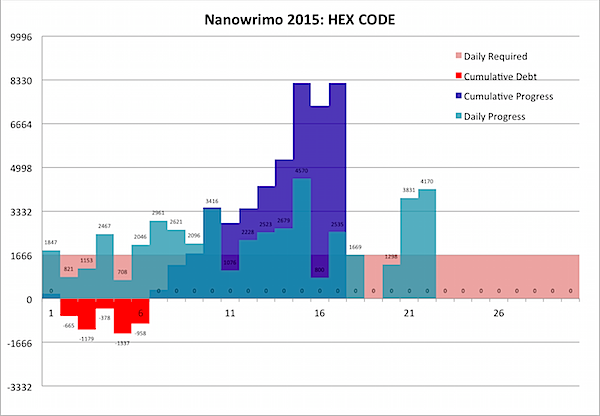
Now, I think there’s some actual scientific studies on this, but that’s not what I’m referring to: I think I have directly observed this in my own life. You are the easiest person to fool, of course, but I am trained as a scientist, which means, in part, that I observe the world, that I record what I observe, and I analyze it, looking for patterns. And above, you can see that the only two times I failed at a National Novel Writing Month like challenge were the two months I didn’t do it with the social support of the formal challenges - when I tried it in the off months of August and December.
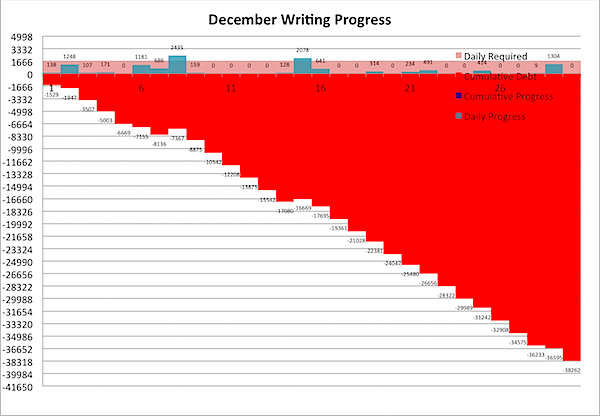
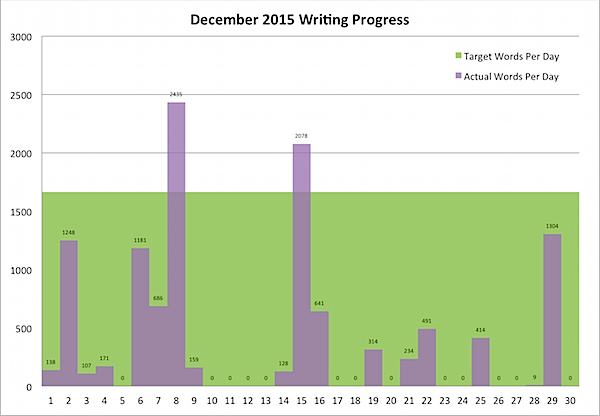
The same thing happened this year: my December writing, which I’ve consciously tried to keep up each day, has in truth been quite spotty. Now, there are vacations, holidays, and the year end crunch in there, but it’s surprising that I got so little done - and perhaps NOT surprising that the days I did best were the regular writing group days of the 29th, the 22nd, the 15th, the 8th, and the 2nd (at least best compared to the days immediately around them; the 22nd was thin).
So I got a little over 1/5th of the writing done in December than my typical November (and a lot less than in this previous November, which was epic). Perhaps that’s because in Nano I’m writing new material, and in December I also edit, but still, the social support - a group of peers who are trying to accomplish the same goal - really seems to help.
My wife and I have noticed the same thing at the gym; so has my friend Gordon. Jim Davies and Lou Fasulo do the same thing with their epic New Year’s resolutions. Agile development is a mixed bag at best and active, harmful voodoo at worst, but its daily standups nonetheless have the same kind of social effect.
So if you want to do something … consider finding a friend who wants to do it too.
Hi, I’m Anthony! I love to write books and eat food, activities that I power by fiddling with computers. Welcome to 2016! It’s a year. I hope it’s a good one, but hope is not a strategy, so here’s what I’m going to do to make 2016 better for you.
First, I’m writing books. I’ve got a nearly-complete manuscript of a steampunk novel JEREMIAH WILLSTONE AND THE CLOCKWORK TIME MACHINE which I’m wrangling with the very excellent editor Debra Dixon at Bell Bridge Books. God willing, you’ll see this come out this year. Jeremiah appears in a lot of short stories in the anthologies UnCONventional, 12 HOURS LATER, and 30 DAYS LATER - more on that one in a bit.
I also have completed drafts of the urban fantasy novels SPECTRAL IRON and HEX CODE, starring Dakota Frost and her adopted daughter Cinnamon Frost, respectively. If you like magical tattoos, precocious weretigers, and the trouble they can get into, look for these books coming soon - or check out FROST MOON, BLOOD ROCK and LIQUID FIRE, the first three Dakota books. (They’re all still on sale, by the way).
Second, I’m publishing books. I and some author/artist friends in the Bay Area founded Thinking Ink Press, and we are publishing the steampunk anthology 30 DAYS LATER edited by Belinda Sikes, AJ Sikes and Dover Whitecliff. We’re hoping to also re-release their earlier anthology 12 HOURS LATER; both of these were done for the Clockwork Alchemy conference, and we’re proud to have them.
We’re also publishing a lot more - FlashCards and InstantBooks and SnapBooks and possibly even a reprint of a novel which recently went out of print. Go to Thinking Ink Press for more news; for things I’m an editor/author on I’ll also announce them here.
Third, I’m doing more computing. Cinnamon Frost is supposed to be a mathematical genius, so to simulate her thought process I write computer programs (no joke). I’ve written up some few articles on this for publication on this blog, and hope to do more over the year to come.
Fourth, I’m going to keep doing art. Most of my art is done in preparation for either book frontispieces or for 24-Hour Comics Day, but I’m going to step that up a bit this year - I have to, if I’m going to get (ulp) three frontispieces done over the next year. Must draw faster!
Finally, I’m going to blog more. I’m already doing it, right now, but one way I’m trying to get ahead is to write two blog posts at a time, publishing one and saving one in reserve. This way I can keep getting ahead, but if I fall behind I’ve got some backlog to fall back on. I feel hounded by all the ideas in my head, so I’m going to loose them on all of you.
As for New Year’s Resolutions? Fah. I could say “exercise more, blog every day, and clean up the piles of papers” but we all know New Year’s Resolution’s are a joke, unless your name is Jim Davies, in which case they’re performance art.
SO ANYWAY, 2016. It’s going to be a year. I hope we can make it a great one!
Recently a colleague asked me if I had any advice on being a better writer. I thought I’d posted about that, but it appears that I hadn’t, so I tried writing up my thoughts. That was too much, so I summarized. That was too much, so I summarized it AGAIN. And then it was short enough to share with you:
The super short version is to be a better writer, just write!
I often recommend morning pages - writing three pages about random topics at the start of your day, even "bla bla bla" if you have to - you'll get tired of writing “bla bla bla" quickly, and this will help cure you of the feeling you need to wait for your muse.
This advice comes from the book The Artist's Way, which is a great course to take; I also recommend Strunk and White's The Elements of Style and Brooks Landon's Building Great Sentences on grammar and style, Ayn Rand's The Art of Fiction and The Art of Nonfiction on writing and structure, and The Elements of Editing and Self-Editing for Fiction Writers on editing.
I also recommend that you read a lot more than you write, especially writing of the kind you want to emulate; take a look at it and see what makes it tick.
For fiction and other similar writing I recommend finding a writing group first, not a critique group; there are several good ones in the Bay Area including Write to the End and Shut Up and Write.
For the kind of internal communications you're talking about, you might try looking at marketing and documentation literature or the great writers internally that you admire - also popular writers, technical and nontechnical, in the computer field.
As for blogging, my recommendation is to just blog - try to do it regularly, at least once a week or so, about whatever comes to your mind, so that you create both a growing store of content - and again, a habit that helps you just write.
I’ll try to expand on these recommendations, but if I had to boil it down even further, I’d say: just write!
So another Nanowrimo draws to a close. The title says HEX CODE, but today’s writing was finishing out a few details in scenes in BOT NET (the second part of the Spellpunk trilogy manuscript I’m working on) and then a new beginning for ROOT USER (book 3). That new beginning, which played out a scene I’ve had in my head a long time, was very easy to write.
“That’s a damn shame,” says a distant voice, “so large an animal, in so small a cage.”
Muzzily, I grogs awake. What the fuck? Can’t they see I’m sleepin’? But then the words they’ve spoken starts to set in, balls in a Pachinko machine, rattlin’ in through the Pascal’s Triangle patterns in my brain to rack up a score of maximum annoyance.
The cage, you see, is large, for its type—a safety cage. Eight by thirty, made of elaborate wrought-iron vines, fashioned special from a welder we knows in Little Five Points, the safety cage is the largest and nicest I’ve ever been in—and the largest we could fit on our front porch.
The porch is big, and Southern, in front of a house big, and Southern, a third of the way down Fairview from Moreland, not three blocks from L5P. Pretty big even by Atlanta standards, but county code sez leave the front door unblocked, so thirty feet wide is was the cage limit.
Not that it feels limiting; there’s lamps and books and ferns and an ahw-SOOOME sectional sofa we found at an outdoor patio store, which stretches almost from the porch door on the left to the <regulation width with code #> stair down to my den.
It’s a full fourteen feet of sofa, fully twelve feet of it usable—which is a good thing, because stretched over it right now, covering just about its full length this very instant, is the enormous animal that the annoying interpopers have named.
Me.
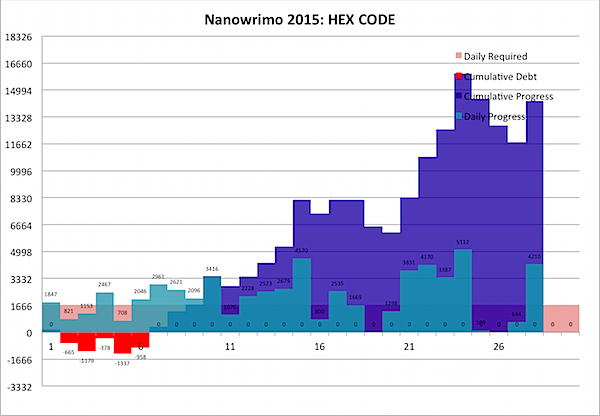
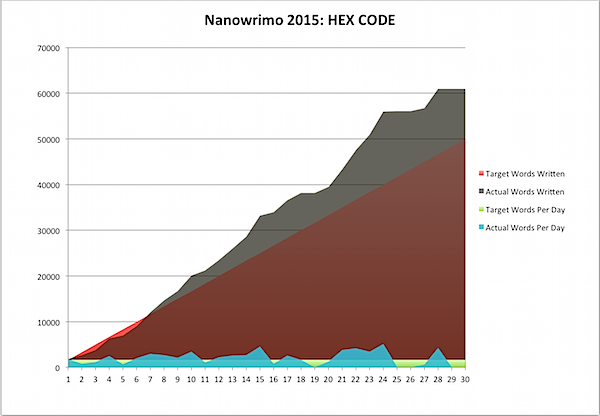
That’s why the last day of Nano has that spike: let your inspiration flow!
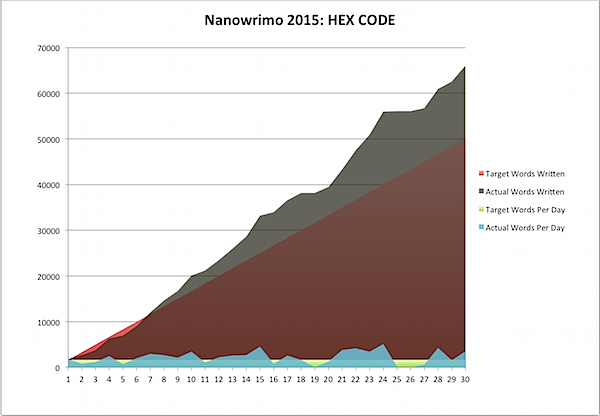
That brought me to over 65,000 words, the most I’ve done in Nano, as far as I know, ever:
SO I have a new record to beat. But I also cracked 700,000 words on my spreadsheet … which means, since I’ve done Nano at least three times before, my total Nano total is 850,000 words.
I feel pretty happy about that. Nano has brought so many creative ideas to the table, I can’t even begin to describe it. Easily a half dozen completely new ideas came to me this month - one even within the final writing session just before midnight tonight. I have to credit Nano for giving me this inspiration.
Now, onward to the next round of edits on THE CLOCKWORK TIME MACHINE … and the 50,000 other projects I’ve been putting off, like my library … though I *might* take out a little time to play a video game, or, perhaps, read a book … you never know ...
So today I passed my all-time record (for as long as I’ve kept records) at Nano, completing 60,900 words at Nanowrimo. The key I think is not just taking this week off, not just keeping going, but daydreaming about my characters—then, whenever I get inspired, writing that scene. Almost all of the huge spurts you see below came out of that:
Today, it was pretty easy to write. I got about 500 words finishing up a few loose ends. Then I wrote a longer scene with Cinnamon and her fae mentor the Huntswoman, and almost a day’s worth of writing popped out of my keyboard. Then I decided to write another scene, one from ROOT USER (the third book in the trilogy, of the large manuscript I’m working on) and got 2000 words in about 30 minutes (!), all from choosing to write this:
But no matter how I tries to ignore it … I can’t ignore what they says next.
“And if they lose a hunt,” the jerkboy says, “guess what? They eat the loser—”
“You take that back!” I shouts, poppin’ to my feet. I hops over the nearest table and barrels down on the boy, who’s hoppin’ to his feet as well, his buddies standin’ to come to his aid, actin’ like I’m neither a girl he should play nice with nor a monster who could rip his throat out. “You take that back this instant!”
“What?” the boy says, eyes gleaming at me. “The part where they eat the loser—”
“We are not cannibals!” I screeches, snarlin,’ my whiskers comin’ in, my fur comin’ out.
“I bet she’s eaten her share,” one of the other boys says. “Like, weregazelles and shit—”
“The herbivores are our friends! We runs together! Nobody eats nobody on my hunt!”
“Your hunt,” he says. Everyone’s circled around us now, the boy standin’ out front. He’s big, so, I guesses, he guesses he can take me in a fight. Good fuckin’ luck. He grins with a nasty smile. “Like anyone would follow you—”
“I had twelve followin’ me on my last hunt,” I says. “Thirteen, actually—”
“I thought you could count,” he says. “What, you lose one? Eat one?”
I snarls and steps forward, and he leans back, fists up. I raises mine.
Then I turns away. “Not worth it,” I mutters, lookin’ at the huge crowd around us. He swings and clocks me behind the ear, and I kinda shrugs and shakes him off. “Not worth it at all,” I mutters, boltin’ through the crowd, walkin’ fast towards the exit. “At all—”
“Where are you going, Miss Frost,” says the proctor.
“The deans’s office,” I says. “I just picked a fight.”
“Wait just a minute,” he says, hand reachin’ for me, but I shrugs him off.
“Get off me, or I go to the safety cage,” I says, snarlin. “And call for my Mom.”
“Yeah, call your mother,” says the jerkboy, who followed me.
“Christopher, I see your mouth is open,” the proctor says coolly. “Close it.”
And the scene which follows, in which Cinnamon goes to see the Dean of the Claremont Academy, who’s more cool than even I anticipated — I mean, drill sergeant in a former life? Really? Makes sense. And helped me crack 60,000 words:
But the point is, never give up on Nano. It will continue to reward you, all the way to the end.
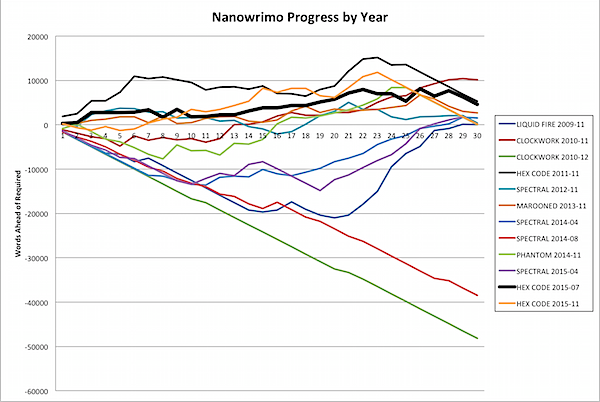
I normally take off the week of Thanksgiving to finish Nanowrimo, and if you look at the stack of seven hundred thousand words that I’ve written in Nanowrimos, you can see the surge there clearly. (I bet it would be even more clear if I only counted the November Nanos, but I’m doing this graph in Excel, not Mathematica or Processing or R, so sue me for laziness).
But even so, it’s easy to see (if you are me) that I’m perilously close to beating my all time record for November, set in 2010 with THE CLOCKWORK TIME MACHINE with 60,164 words. And there ARE four days of Nano left, so I just may keep pushing on. My record per day that I’ve kept records is over 7000 words (almost certainly the mad scramble to finish LIQUID FIRE in 2009 after getting edits on BLOOD ROCK early in the month), so that’s easily doable. And my average for these four days is close to 4000 words. One year I even made 5300 words today, on the 27th, so keep your fingers crossed.
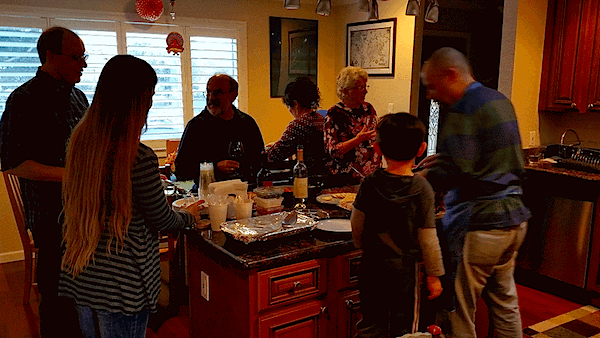
But as much as I like to take this week off - as much as antisocial me doesn’t want to accumulate obligations on my time, which I freely admit made the first half of this week miserable from the temporal anticipation - I really do enjoy hanging out with my friends and family, and even though I don’t get the chance to fly home to see my blood family over this holiday, I loved having the chance to get together at the house of my “brother from another mother” and his wife and to join them on their Thanksgiving.
Family, friends, and good times aren’t the only important things in life. But they sure do make life a lot better.
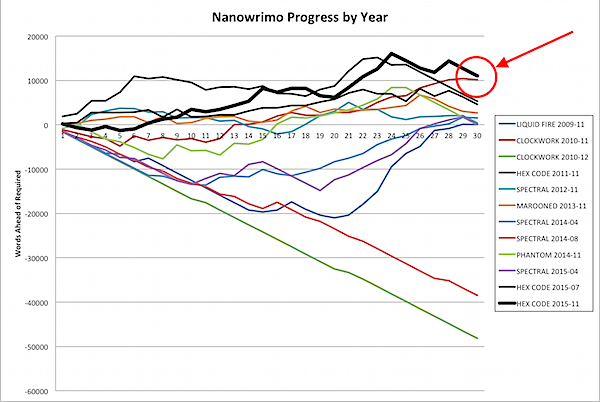
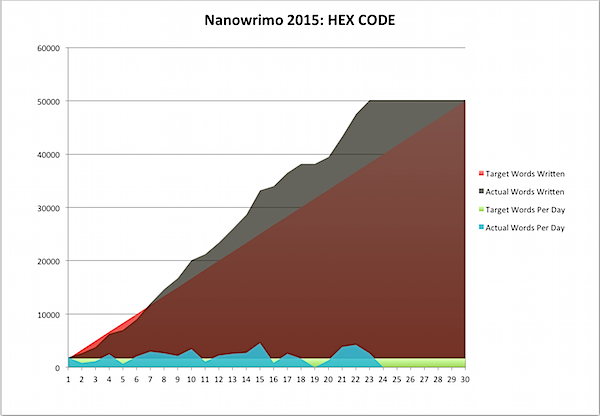
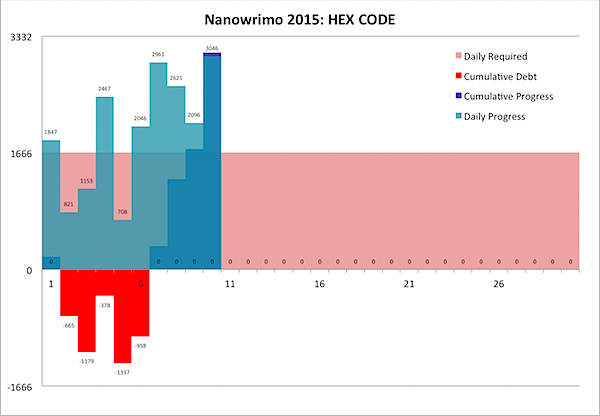
At last, I’ve completed my 15th National Novel Writing Month challenge successfully! Victory, for the thirteenth time!
The graph says “HEX CODE”, but as I’ve said before, I discovered in July’s Nano that the manuscript I was working on was actually a trilogy - I already knew that Cinnamon appeared in a trilogy of books called HEX CODE, BOT NET and ROOT USER, but I was puzzled as to why the HEX CODE manuscript seemed both so cramped and so overstuffed. The reason? I was already writing the trilogy, with a discernible “hex code” appearing first, followed by a “bot net” then a “root user”. So I split the manuscript up … and just kept writing, until, earlier this month, I rolled over the end of HEX CODE.
Perhaps that’s why I was doing so well this year, or perhaps it’s because I’ve written almost seven hundred thousand words in National Novel Writing months at this point. But regardless, I had some real bursts of creativity in there. But even then, I have to tell you: it was always hard. The hardest words on this one were the last 8 … when I thought I was done. But you have to keep going! And the scene that popped out after that is beautiful.
Regardless, National Novel Writing Month is a joy to participate in, and I’m glad to have done it. The people and the connections I’ve made, the friendships I’ve built, the fantastic events like the Night of Writing Dangerously, the great writing programs that Nano supports, and the worldwide outbursts of creativity have made it all so worthwhile I plan to do it again and again.
So, for now, I leave you with one last excerpt, from BOT NET … containing something I learned about my world of werekindred tonight, when I had to write … and let my creativity take over. As always, excerpts from Nano are first draft material, so, consider yourself advised … but I love what I discovered about Cinnamon’s warehouse tonight.
I looks down at them. All their eyes are glowin. The moon’s gotten into them. It will be up soon. I gots to go take them runnin’ now, or they’ll go crazy. I stands before them, rearin’ up a little, puffin’ my tiger cheeks, lookin’ down at them, and they gets the hint, and steps back from the wall, towards me, towards me, the tiger.
“Alrright,” I snarls. “None of ya get killed, or, as Mom would say, you’re grrrounded. ”
They all laughs, and I grins and stamps a paw.
“You feel the moon?” I says.
“We feel the moon!” they all shouts back. Whoa. Better response then I expected.
“I said, do you feel the moon!” I roars.
“We feel the moon!” the hunt screams.
“Then show me your beasts!” I snarls.
The lawyer strips off his jacket, his shirt, snarling, his head poppin’ out wolf so fast even Tully would have been proud of it. Hanser is a lynx before I’ve gotten a chance to look over at her, and the rest are poppin’ and changing. One buck is havin’ trouble, horns comin’ out of his head, fur crawlin’ over his body, but still no quad form, and I nods to Hanser, who pads over and licks at him playfully as he falls to the ground, crosseyed, eyes half pulled back like a buck’s.
But Willard, man, Willard’s havin’ real trouble. He’s bulked up, six and a half feet tall now, a black fur rug rippling out of his back, and oh-my-bod, what delicious muscles. But the shag carpet, it’s as far as he goes. He grunts, strains, then shakes his head.
He ain’t even taken his shorts off. He knows this is as far as he can go. Personally, I’m glad to have a half-human in the pack—easier to get feedback. He’s obviously got control, or they wouldn’t have given him to me, but is also obviously new to the Life. He needs help.
I prowls up to him.
“This your limit?” I asks, starin’ him in the eye. He nods, embarrassed, and looks away, but I raises a paw and catches him under the chin with the curved side of one of my claws, lookin’ at his head. “Listen to me: there’s no shame in our affliction. Repeat it.”
“Therrre’s no shame in ourrr aff—affl—affliction,” he says.
“Only prrride in our powerrr,” I says. “All of ya. Repeat it.”
“There’s no shame in our affliction,” the lawyer says, like, real articulate, even though he’s on all fours now, and his head’s all wolf. When’s this lack of concentration supposed to kick in? He shakes that wolf head back and forth, then howls, “Only prrride in our powerrrr!”
“Therrre’s no shame in ourrr affliction,” I roars, “only prrride in our powerrr!”
I prowls back and forth in front of them, listenin’ to them repeat it, those that can. The rest yip and yap and bark … except for the buck, who’s sittin’ there, dazed. His eyes are stuck halfway between human and stag, and he looks winded and dazed.
“But never rushin’ the hardest job any human ever has to do: controllin’ their own beast,” I says, steppin’ up to him. “You ain’t ready. There’s no shame; there’s always next moon. But this one, you ain’t ready. You relax, let the elders care for ya.”
The buck nods, still crosseyed, lickin’ his lips.
“Yyyouw waaant meeee,” Hanser yips, then goes quiet.
I looks back to see Fischer, standin’ there, under his broadbrimmed hat. He’s got the doc with him, black bag under his arm, I mean, seriously, cliché! But he nods to us, and they goes and sits with the buck as the rest of my hunt firms up before me.
“Four in front of you, Willard,” I snarls. “Or anyone else wanna sit this moon out?”
The pack howls and yips and brays, crowdin’ forward.
“Nnnever!” Willard says, beatin’ his chest.
“Yall wanna run?” I snarls.
The pack makes a yippin’. Weak.
“Eye said, y’all wanna run?” I roars.
And my whole hunt howls at the top of their lungs.
“Then let’s rrrun,” I roars, and Hanser at my side, bolts off into the forest.
Oh, wait, most of you don’t know me. Well, some of you may know me from “when the APD almost got its ass sued off” or “that time I saved the DWA's ass in the tunnels,” but for the rest, uh, Hi! I’m Cinnamon. I like to gnaw on things and do math.
SO ANYWAY, y’all have been botherin’ me a lot, so I hacked ya.
Hacking a government agency won’t have any negative repercussions, now will it? But very fun to write...
That’s why the last two days have been so productive! More tomorrow.
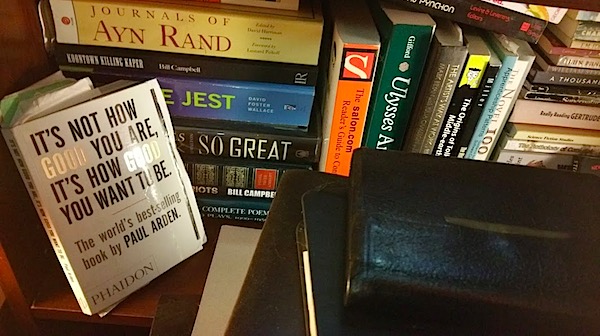
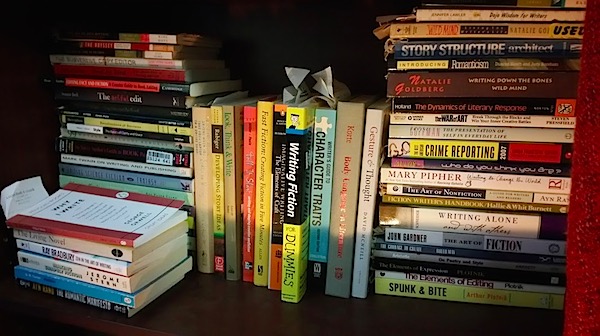
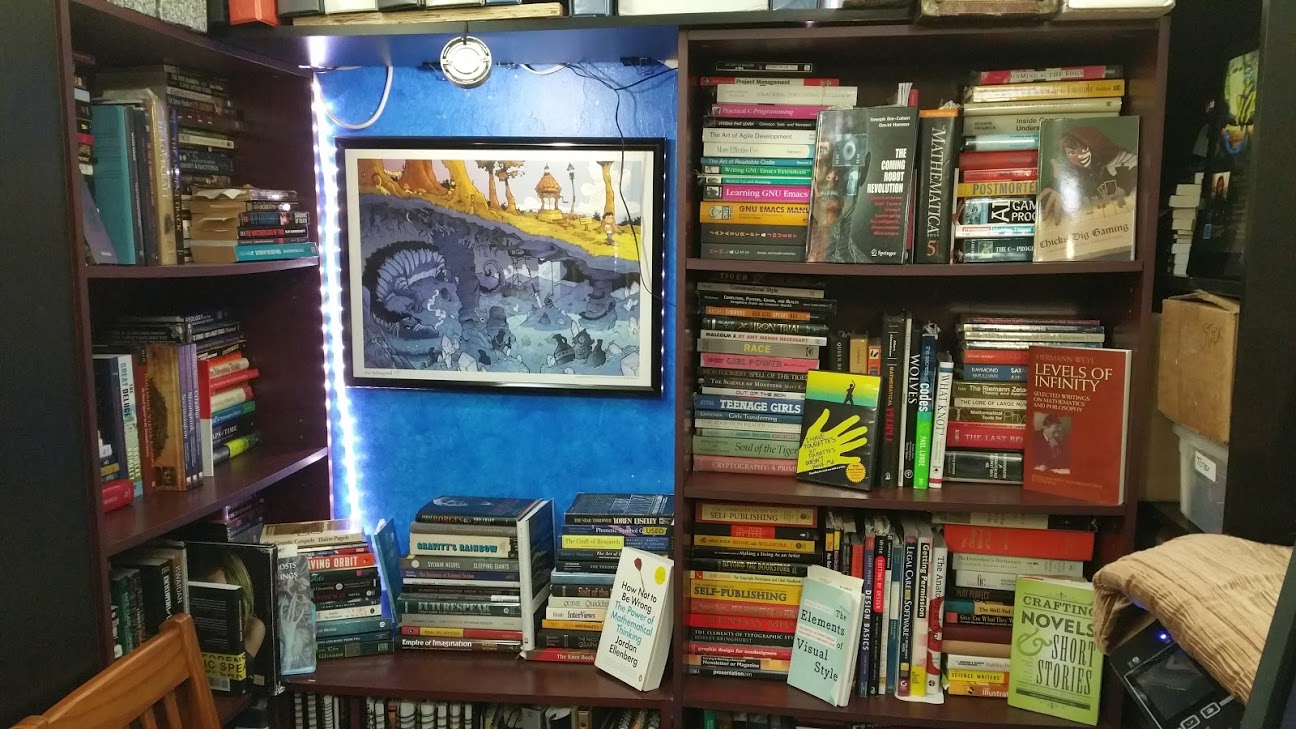
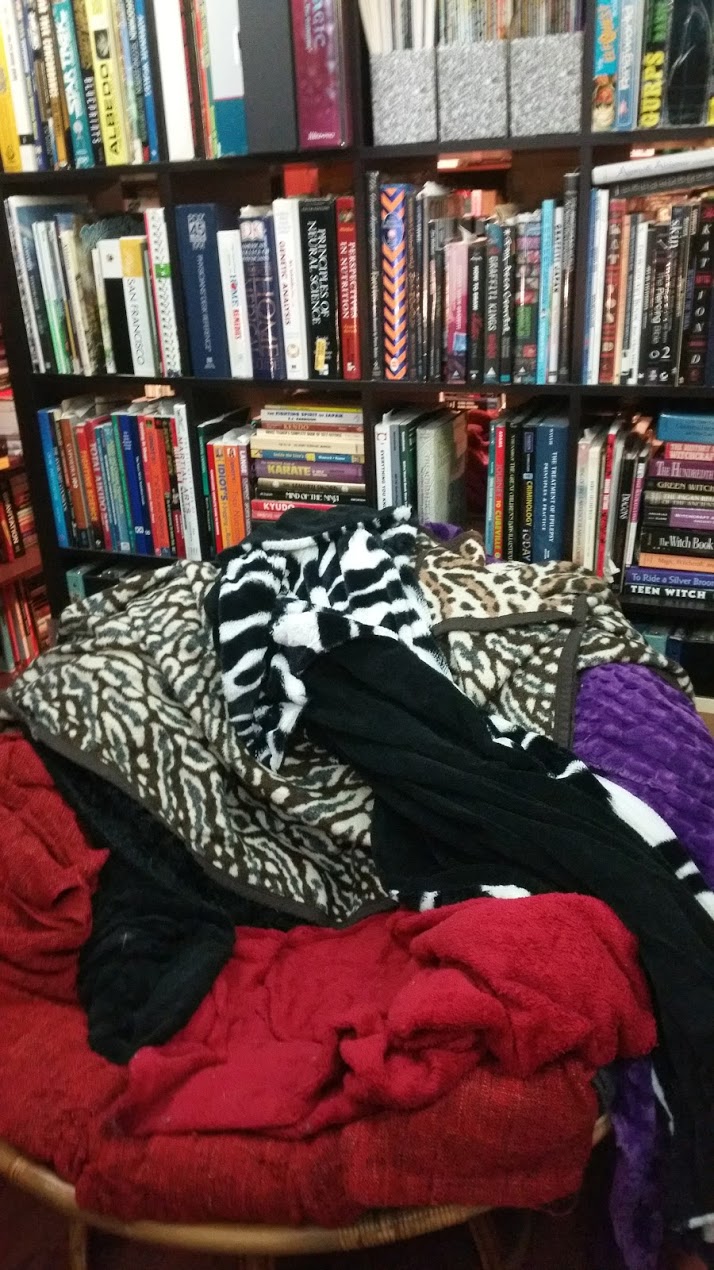
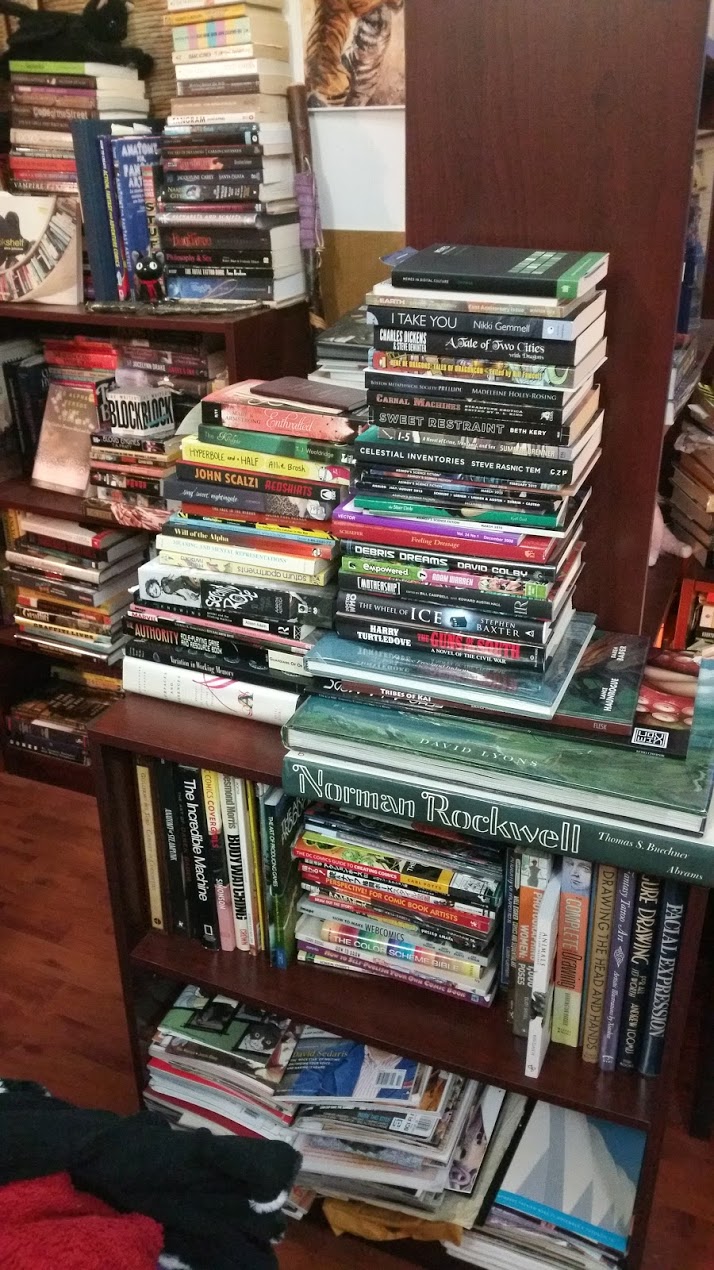
What you see there is my "working stack" at home ... the piles of books for my most active projects. These include Dakota Frost (shelves to the left and right that you can't quite see), Cinnamon Frost (middle shelf on the right, middle center shelf and others below), robotics at work (top shelf on the right), Thinking Ink Press (bottom visible shelf on the right and middle center shelf), Lovecraft studies (middle center shelf and top shelf on the left you can't quite see), and general writing (above, below, all around).
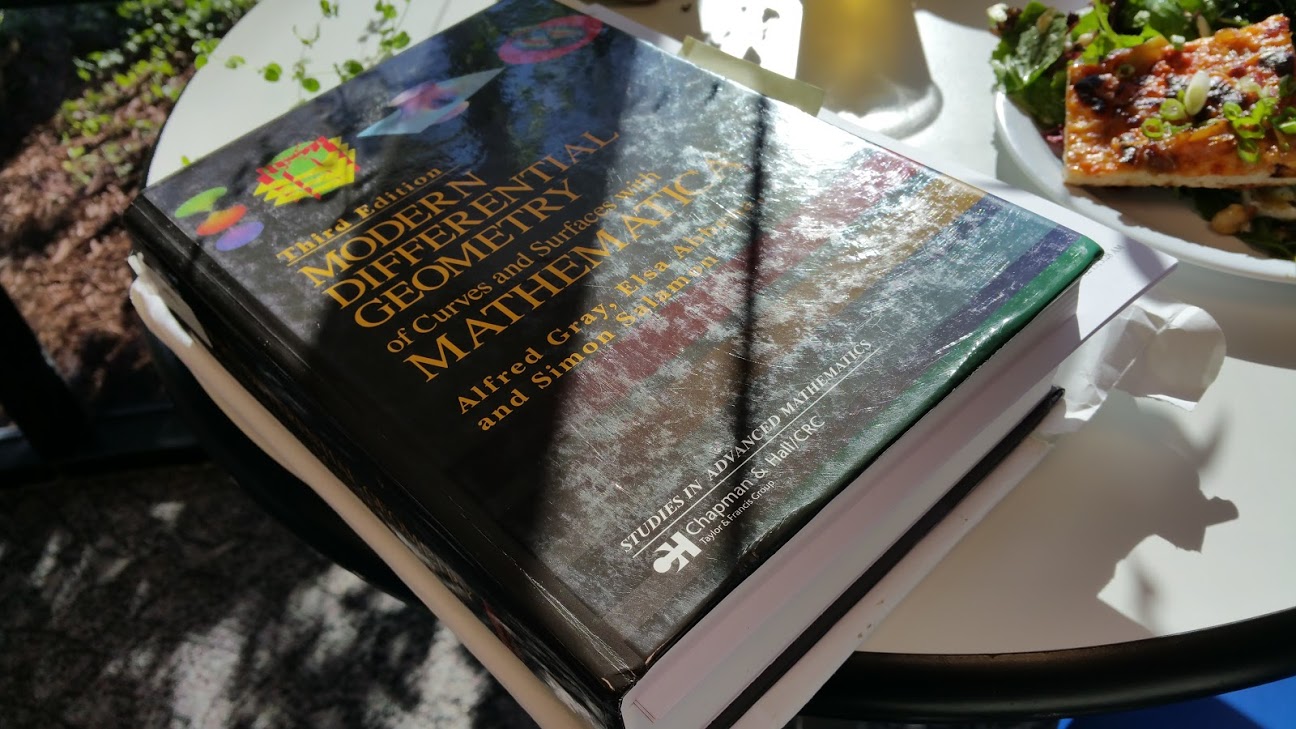
I accumulate lots and lots of books - too many, some people think - but there's a careful method to this madness, as most of these books are not recreational, but topical, filling out a library around things I'm trying to accomplish. This means that when I'm working on a problem on, say, a Cinnamon Frost novel, and get stumped, I can have the pleasant experience I had last night of glaring at a Wolfram MathWorld article, not finding all the info I needed, peering through the references ... and finding that the references pointed to a book I had on the topic, right in the Cinnamon shelf (pictured above).
For a long time I was terrified of my own library. Well, not terrified, but I'd piled up and accumulated so much stuff that I couldn't effectively use it. This has been accumulating since the days of my condo in Atlanta, which was approaching near gravitational collapse, but I've made two major pushes to clean up the library since I moved to California, which organized it usefully, as I've reported on previously, and since then two major pushes to clean up the files. I've still got a lot go go - you can see more piles below - but now I've got a better system for organizing paper, I am starting to develop a system to get things out of the library and back to used bookstores (slowly, grudgingly, occasionally) and ... I actually find myself wanting to go in here again.
The piles are still scary, but now I've got a nice reading area set up, which I can lean back and be cozy in...
My current reading pile and art projects are intimidating, but now organized and useful and even attractive ...
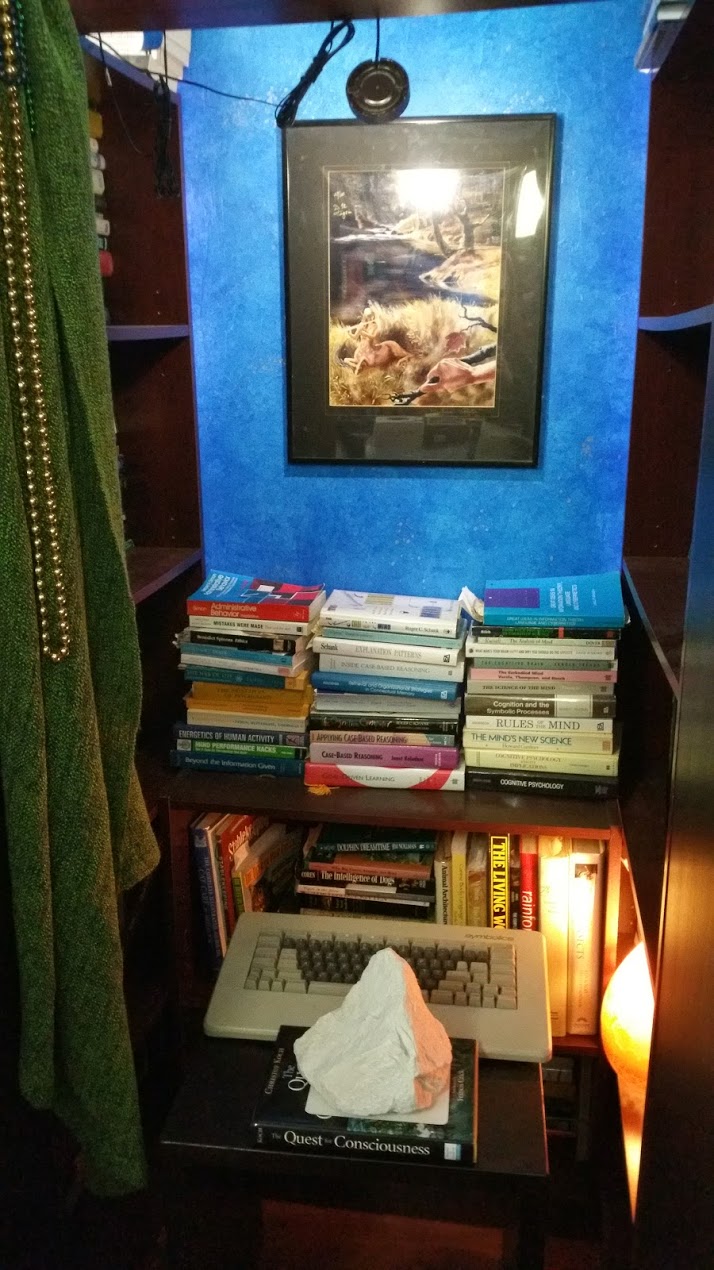
My cognitive science section has developed a cozy, hallowed feel, that makes me want to dig in more ...
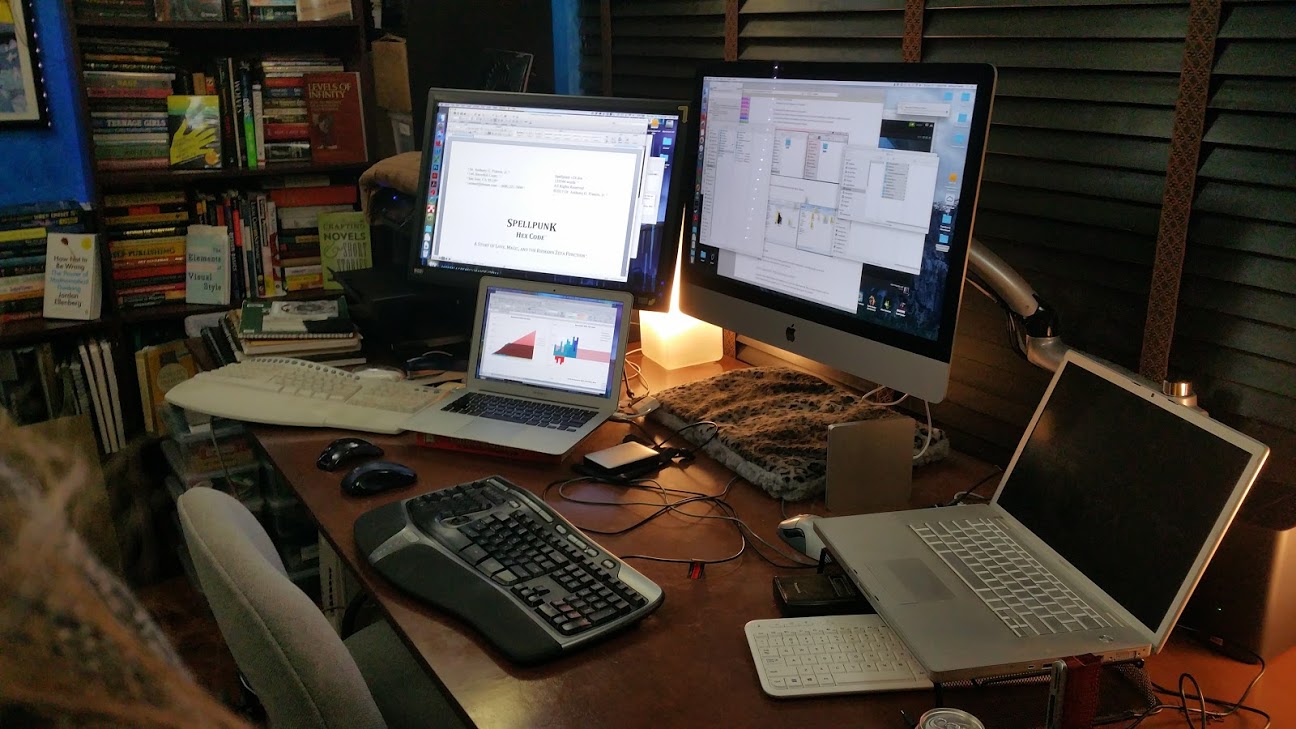
... and at last I once again have a workspace which makes me want to sit down and work, or write:
I can't tell you how healthy that feels. I need to stay on top of that. But for now ... time to get back to it.
-the Centaur
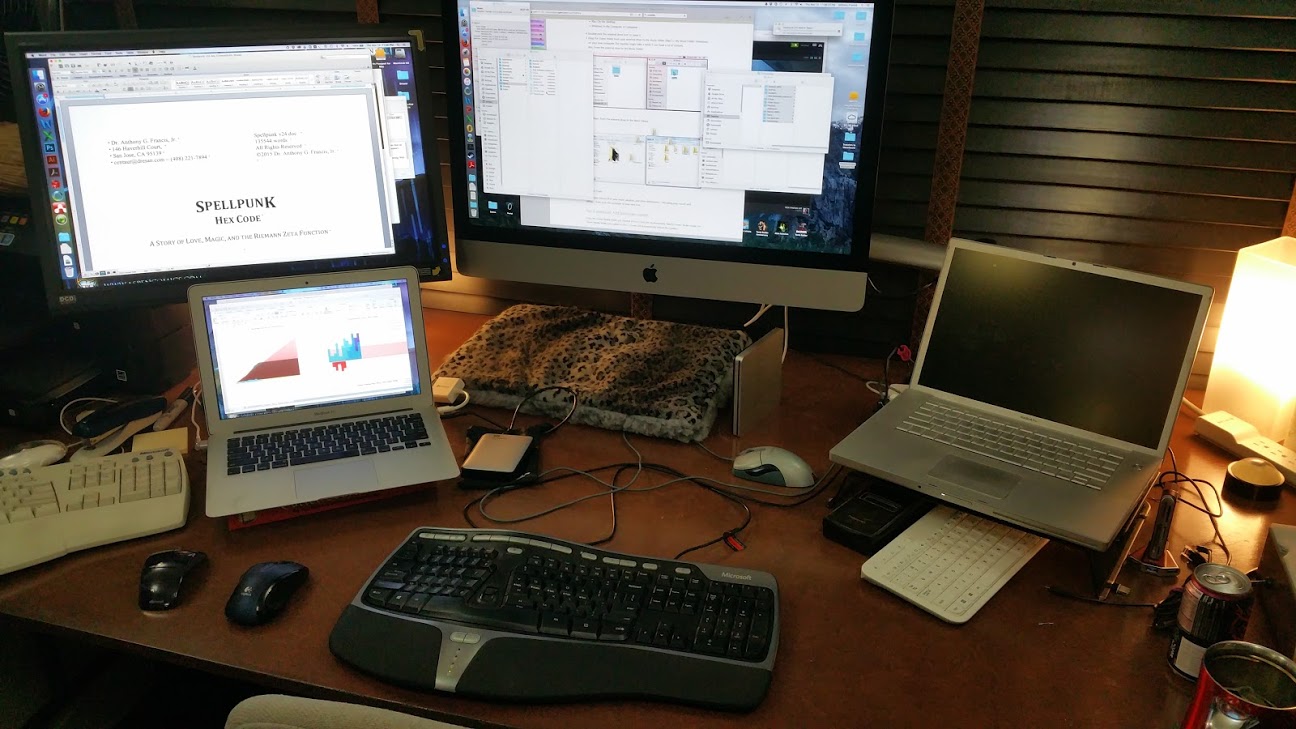
P.S. Yes, I do actually use all those computers and monitors, though the one on the far right is slowly getting replaced by the floating hoverboard of an iMac that is now struggling to supplant my MacBook Air as my primary computer (good luck, you'll need it). For reference, there's my ancient MacBook Pro on the left, which formerly served as my home server; the iMac that's replacing it, hovering over the desk, a MacBook Air which is my primary computer, and the secondary keyboard and monitor for my old Linux workstation, which is about to be replaced because it's not beefy enough for my experiments with ROS.
... why do you ask?
Technically, a Cinnamon Frost novel is an urban fantasy novel with a young adult protagonist. I am doing some work to make it young adult friendly, up to a point, but at some point you have to acknowledge that as much as we all love her, we've got a formerly homeless and abused teenage weretiger with behavior problems as our protagonist, in a world which is a "real" world, not a young adult friendly world - and she's supposed to be a math genius, and if I'm going to have a story with a math genius, dang it, I want the math to be real math, even if takes me a while to figure out how to coherently explain what the heck a "loxodrome" is.
It's the spiral you get if you run stairs up the side of a dome, but your architect was lazy and made the stairs cut a fixed angle to the meridians in their drawing, rather than a fixed angle that's useful for constant climbing. Sigh. That's not clear either. Needs more work. Back to it ...
-the Centaur
P.S. And yes, I'm still on track for Nano.
… just now getting to the point where I can think clearly. For a refresher, I’m working on the Spellpunk series, finishing up HEX CODE … and, since I discovered last time that I was actually writing all three Spellpunks in the same manuscript, there’s a small chance I’ll finish HEX CODE itself this month and move on to BOT NET. More news in a bit. That is all.
Hoisted from the archives … it was National Novel Writing Month 2013, and I was at the Write to the End writing group in IHOP and should have been writing on my book MAROONED, but I was very near my goal for the month, I had an idea, and was depressed about various feedback I'd gotten from work and life and editors and AAARGH! so I wrote this anyway.
SO anyway, IHOP. The Write to the End writing group normally meets in the side room, but not that night, and it’s because another group was meeting there. Presumably, they paid for that. Which is sad, because as a volunteer drop-in group we can’t pay for rooms. Nonetheless, IHOP feels like home moreso than most places we have met, even though it isn’t a coffeehouse and doesn’t have an attached bookstore. But I’ve learned, from the writing group, not to assume anything is permanent.
Write to the End has met in places that should have lasted forever, but didn't. Maybe we should have expected the small indie coffeshop Snake and Butterfly to dial back their hours (since they opened later as an experiment, for us), but who’d expect that Mission Coffee would come to an end? It was up the street from a college. People came in there all the time. But the signs were there, literally: walls and walls of pictures of a live music group that no longer met on the night we wrote.
But why should it be this way? We once met at Barnes and Noble, which was in the Bay Area before I came out here, which outlasted Borders, which might be out here after I leave (here’s hoping I don’t). Why couldn't we have been meeting at Café Borrone, which was running long before I came out to the Bay the first time, when I fell in love with writing in quirky coffeehouses?
But things change. Who could predict that physical books themselves might implode? If the bookstore next to Café Borrone, Kepler’s, disappears, so might Café Borrone. That’s why Barnes and Noble didn’t let us keep meeting there: B&N's business model changed, and they needed fewer community programs and more space for toys.
Even coffeehouses might end. Coffee could be made illegal. Alcohol was once. Seriously. Some people think that coffee is simply a drug with no stimulus benefits—the buzz you get off coffee is just withdrawal relief, and coffee has all sorts of health problems. I’m not sure the epidemiology supports that, but the researchers are out there that think that in all seriousness.
Perhaps there will be a new Prohibition. Maybe one day our grandchildren will look back on this and say, oh, how terrible it was that, during the Health Pogroms, coffee was outlawed for ten years. "Of course, we have coffee back now, but think of all the old historic coffeehouses were destroyed." Or even if coffee is not outlawed, we could have a Nazi takeover or a Soviet revolution or a Cultural Revolution that wipes out all of these types of meeting places.
So there are no firm places to stand.
But in Japan, there’s a hotel that’s been running for something like 1500 years — 400 generations in the same family. I know it’s a small bed and breakfast like hotel, but there are taverns in England that have stood since the 1500s. Think of it: we could have been meeting there, for the last two hundred years.
And that gives me hope, that we’re writing in the first two hundred years of the Write to the End group.