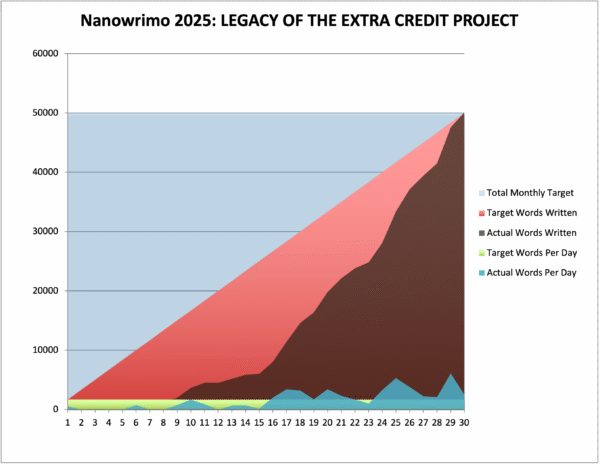
Into roughly 240,000 words of LEGACY OF THE EXTRA CREDIT PROJECT.
As I mentioned back in November and December, I've been working on a "cozy fantasy" called LEGACY OF THE EXTRA CREDIT PROJECT that I first started writing in roughly February of 2010 (under the title "The Eternal Crypt of Endless Night: An Oakholme Properties Dungeon"), but which, according to my notebooks, I apparently put aside when I received edits on my second Dakota Frost novel, BLOOD ROCK.
Life got away from me at that point. FROST MOON came out right around the time I put LEGACY OF THE EXTRA CREDIT PROJECT down, and in addition to its publicity, I was hard at work at Google on a major project that itself soon got sidelined when I had a chance to join Google's first Robotics effort.
FROST MOON. BLOOD ROCK. "Steampunk Fairly Chick", the first Jeremiah Willstone story. The Google Scanned Objects effort, and the DOORWAYS TO EXTRA TIME anthology. Then LIQUID FIRE, the Replicant robotics effort, THE CLOCKWORK TIME MACHINE, and Robotics at Google proper. All good times.
By 2012, I had completely stopped revisiting THE LEGACY OF THE EXTRA CREDIT PROJECT, and by the end of the decade, I had aaalmost forgotten about the stories of Q'yagon the zebra elf and Darina his spidaur girl ... until 2022, when Travis Baldree's cozy fantasy novel LEGENDS AND LATTES came out.
LEGENDS AND LATTES wasn't the first cozy fantasy, which in a sense goes all the way back to THE HOBBIT, but it is the lightning bolt that revitalized the genre. An orc swordswoman retires and opens a coffee shop. That's the whole book; that's all that it needs. The sequels, BOOKSHOPS AND BONEDUST and BRIGANDS AND BREADKNIVES, are even better; but there's a simple perfection in a giant barbarian swordswoman realizing that she's going to need to put up a "Seating reserved for paying customers" sign.
So, for my November Nanowrimo project (that challenge to write 50,000 words in the month of November, formerly shepherded by the now-defunct nanowrimo.org organization and now loosely led by nano2.org ) I restarted LEGACY OF THE EXTRA CREDIT PROJECT ... and didn't stop at the end.
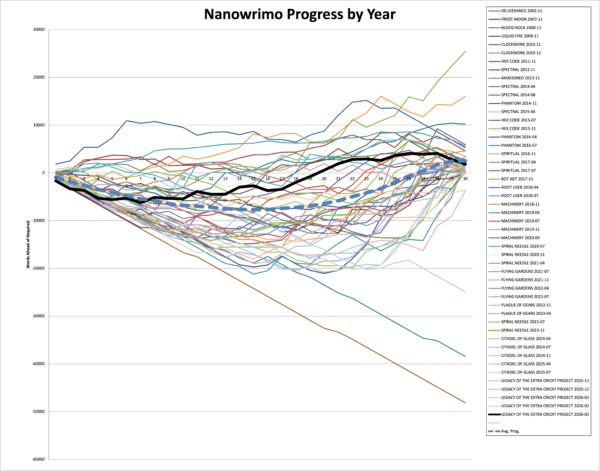
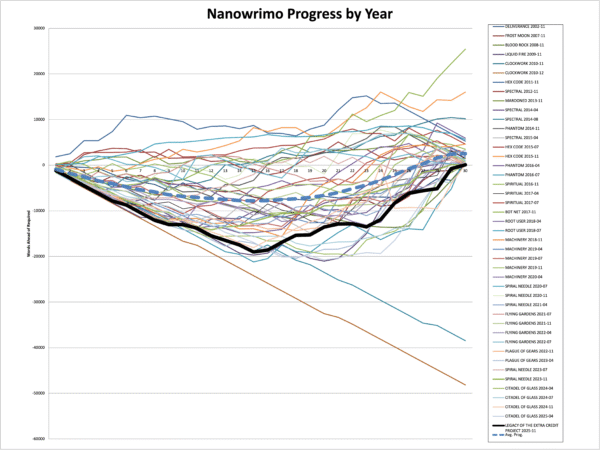
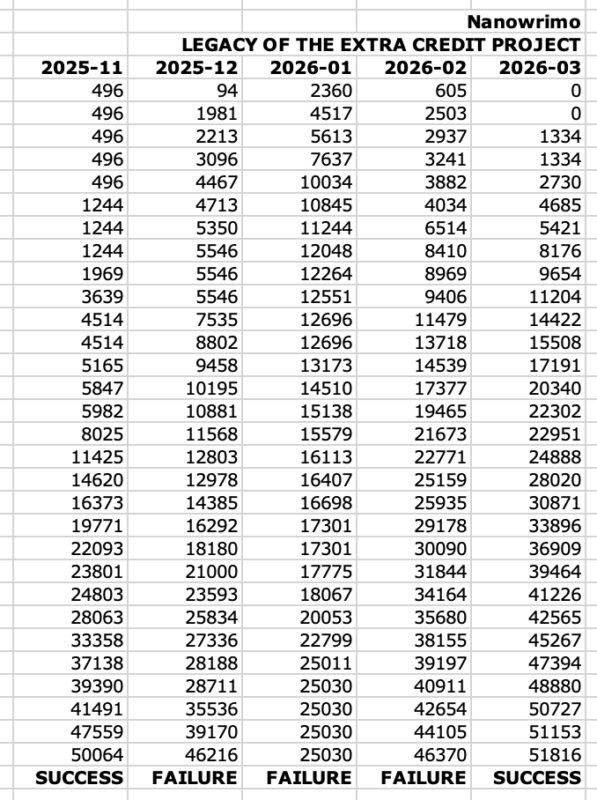
Now, I had never successfully completed a Nanowrimo-like challenge except in the official months of the challenge - November (Nanowrimo), April and July (Camp Nanowrimo). You can see my first two attempts, in December of 2010 (on THE CLOCKWORK TIME MACHINE) and August of 2014 (on SPECTRAL IRON).
At first, this time was no exception. December was decent, until I stalled out in the holidays. January was much worse because I had a scientific paper (and the underlying code and experiments) to develop in a very short time frame (I had done six months of prep, but eventually, the rubber meets the road).
But I was very happy with that progress; I was even planning on writing a blogpost on "85,000 words of successful failures". But, instead, I deliberately chose to buckle down and to try to "finish" THE LEGACY OF THE EXTRA CREDIT PROJECT, which I was confident I would be able to finish in a month or two.
That was before I discovered I was writing a trilogy.
Or whatever the hell it is. I'm structuring LOTECP as a sequence of novellas, each roughly 20,000-30,000 words long, which I hope to release as separate volumes; very roughly speaking, four of those novellas are roughly novel length, and it looks like I'm going to have about 12 or so of them by the time I'm done.
Another darn trilogy.
But I pushed through, and got close to my 50,000 words in February (a short month at that!) and nailed it in March. As of tonight, the last day in the 30-day challenge, I have written 51816 words on LEGACY in March and 242038 words (counting outline, notes, and such) in total.
So, as much as I love blogging, I think that's a fair exchange.
And now! A brief excerpt, from the very beginning of the project:
The Problem with Prologues
“In a time before the story started,” intoned the wild-eyed, wild-haired sage, “in a land far from those we shall travel—” he glanced around the faces lit by the flickering fire: fighter, mage, healer, rogue “—among a people whose deeds are spoken of only in legend—”
And in an accent so thick, thought a figure in the dark, it could be used as plate armor—
“—events transpired so portentous, so critical to our quest,” the wizened sage said, gesturing expansively to suggest realms and vistas of staggering, nay, even plot-significant importance, “that we cannot even begin without an accounting of them … in full.”
The fighter carelessly spat her chewed gristle into the magical fire. The rogue leaned against the corridor wall, slender ears carefully listening. The healer carefully applied a bandage to the mage’s hand, where he’d carelessly burned himself trying his turn at the cooking.
The sage boomed, “And so—”
“What are you doing?” asked the striped shape emerging from the dark.
“Drakespit!” The rogue jerked back, drew his knife, and tripped over a rock.
“This is a corridor, friends,” the striped shape said—and what a strange person: an elf, clearly, in the dark leather armor of a low-level minion, but his mane of hair and even skin were striped like a zebra—and did his stripes glow? “Camping here is an OSHER violation.”
I'm having a lot of fun with this one.
Hopefully, I'll finish this in 2-3 months, then start releasing the chapters on my Patreon.
Oh. A Patreon is coming. Just thought you'd like to know.
Onward!
-the Centaur
Pictured: the word count table for LOTECP, and the nano yearly comparisons for the past 24 years.