
Another key concept that I think is critically important for science and life is “getting traction.” A lot of things we do as humans simply don’t get us anywhere – for example, most work in philosophy. That may sound like I’m being snarky, and maybe I am, but it’s a common trope that we’ve been discussing things like free will, the nature of time, and Zeno’s paradox for thousands of years with no real resolution.
But the problem is that, contra Immanuel Kant, philosophy cannot be reduced to an enterprise that tries to answer “What can I know?” “What should I do?”, “What can I hope?” and “What is a human being?” – though those questions are critically important to philosophy. Similarly, contra Ayn Rand, philosophy cannot be reduced to “Where am I?” (metaphysics), “How do I know?” (epistemology), and “What should I do?” (ethics) – though these disciplines are critically important to philosophy.
No, philosophy’s job is to map the options of thought. Perennial questions like free will remain perennial because there are many ways to think about the problem and a responsible philosopher won’t just attempt to “solve” it, they’ll outline the different ways that we can think about it (as Daniel Dennett tried to do in Elbow Room: The Varieties of Free Will Worth Having). Like Saint Thomas Aquinas, I believe that you have free will whether you want it or not – though my argument is based on the Halting Problem – but even Aquinas admits that if your definition of free will excludes the possibility of a mechanism by which the will works, then he can’t help you. So even if we reached a definitive answer to the question of free will eight hundred years ago, modern treatments cannot resist revisiting the entirety of the argument.
Leaving us feeling like we’re getting nowhere.
To make progress, we need some way of moving on – some way of selecting an idea as the right one. And that can’t happen from within philosophy itself – not just because I argue that “solving” isn’t it’s job, but because of a deeper problem that Ayn Rand calls the Primacy of Consciousness Fallacy – the idea that ideas are more important than reality. The way we think about problems does not change what is. For example, the Ship of Theseus is a famous “thought experiment in identity metaphysics” (according to Vision in the Marvel Universe) about a boat whose timbers are replaced one by one until nothing of the originals remain, raising question: is it the same boat or not? There are strong reasons to say that is, and that it isn’t – but those are just options for thinking about it. It doesn’t change the actual physical nature of the boat.
To get anywhere with these questions, we need to get evidence. To take a hypothetical example, if we were in a horror movie, and the fully-gutted Ship of Theseus started chasing people down to reclaim its lost timbers, we might start to suspect that it was, indeed, the same ship. Conversely, if we were in a science fiction movie, and no-one who went through a transporter ever remembered who they were, we might start to suspect that their identity was not preserved, and that a matter-energy scrambler was not a good way to transport people from point A to B no matter how much money it saved on the show’s budget.
But these are hypotheticals. To really get anywhere with a real question – to get traction in the space of ideas that moves us from a set of options on to a definitive answer – you need more than an argument that convinces yourself; you to start looking for ways to get evidence that distinguishes between the options, evidence that can be shared with other people, or replicated by them, to help them make the same move.
You can see this clearly when looking at the philosophy of general relativity, which explores staggeringly speculative concepts like thunderbolts (fractures in spacetime that spread at the speed of light) and supertasks (performing infinite tasks like computing the digits of pi in one part of spacetime and reading them off in another, dilated part of spacetime, hoping to find that elusive last digit). These questions involve scenarios we can’t set up and tasks we cannot perform, and it’s difficult to see how they could be resolved.
But these mental explorations help us understand what directions to take in our scientific explorations. The philosopher Mach wondered whether a rotating object in an empty universe could really be said to spin. It’s a challenge to set up an entire universe just to answer a hypothetical – but Mach’s exploration of the problem helped Einstein formulate his theory of general relativity, which in turn had consequences that were tested the scientist Eddington in a famous expedition. Eddington traveled to photograph a solar eclipse, which showed that starlight around the sun was bent the way Einstein predicted – in turn, giving us a probable answer to Mach’s question that, yes, the object would rotate with respect to itself.
Getting traction is an important part of not just science but our everyday lives. I always get suspicious when I go to the doctor and they purport to make a diagnosis without running tests to verify whether they’re right. Once, when my arm was broken and the bone plate was slow to heal, I went to a parade of doctors who failed to resolve the problem over a 2 year period. Doctors at the SOAR group ordered a CAT scan, identified a gap in the bone, and scheduled an exploratory surgery, during which they found a suture left from the original surgery that had caused a bulge in the bone and the appearance of a gap. My arm was fine, and likely had been fine for 2 years – but the other doctors didn’t find this out because they didn’t run the test.
The necessity of getting traction is why, in programming, I hate nondeterministic builds (where sometimes it works and sometimes it doesn’t) and hate debugging heisenbugs (where sometimes it fails and sometimes it doesnt). Stochastic failures – failures which happen randomly – lead you to trying things over and over again, hoping to get different results. Doing something again and expecting different results may not be the definition of insanity, and Einstein certainly didn’t say it, but it’s not great, and it trains you to flail.
Once I encountered this as a real debugging issue – resolving a problem with a robotic device driver for a lidar sensor (a laser radar, used to tell how close objects were to the robot). I was frustrated and thrashing with non-repeatable bugs in my program, and eventually cracked out the manufacturer’s diagnostic program to see if I had a bad sensor. But the manufacturer’s diagnostic also had the same problems, on more than one lidar unit, and I realized that correctly working sensors of that make and model were actually unreliable when connected to the computer we were using!
So how did I get traction when I literally couldn’t trust the data coming from the sensor?
With a spreadsheet.
For each variant of the program that I tried – the original, and various fixes – I ran the program ten times, counted the successes and failures, and entered them into my spreadsheet. It very quickly became apparent that the original program almost never, whereas the best of my fixes worked seventy percent of the time. Since our experimental robots frequently needed to be rebooted multiple times on startup to fix other race conditions, we had no problem shipping “seventy percent success” as an improvement over ten percent.
Getting traction is a key part of science, engineering, and life. We can even apply it to philosophy, if we ask ourselves whether there are actual facts that help us choose between the options, or whether there are values that we hold that lead us to prefer one option over the other. In fact, many of the best philosophers produced their greatest work by taking definitive stands on one or more philosophical questions and then pursuing the implications rigorously. Some would even argue that modern physics is a kind of natural philosophy which took the stance of materialism to its logical conclusion – and then started producing fantastic empirical results by building on that stance.
So what problems in your life could you improve on if you found a way to push off from where you are?
-the Centaur
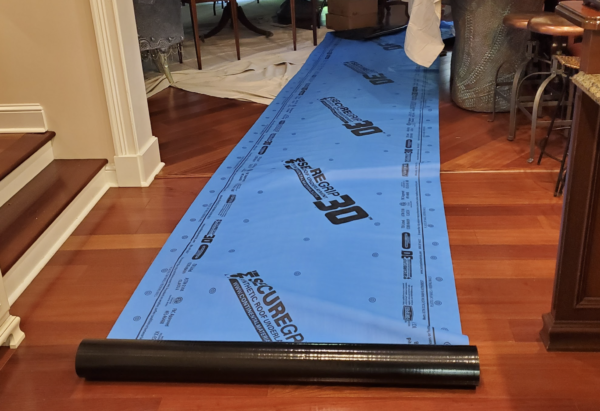
Pictured: We’re fixing our roof, so we have to protect our floor. This floorpaper is actually to help our interior repair team move equipment without damaging our hardwoods, and does not have anything to do with traction, regardless of whether it looks like it’s something used for that purpose.
