

So you may have noticed the blog theme and settings changing recently; that's because I'm trying to get some kind of slider or visual image above the fold. I love the look of the blog with the big banner image, but I'm concerned that people just won't scroll down to see what's in the blog if there's nothing on the first page which says what I do.
So I'll be experimenting. Stay tuned!
-the Centaur
Pictured: Yeah, this isn't the only renovation going on.
Posts published by “centaur”

So I read a lot and write a lot and occasionally edit what I write and even more rarely, something gets sent to an editor and turned into a publication. But this seems slow, for always there are more thoughts that I have in my head than I seem to have time to put onto a page and share.
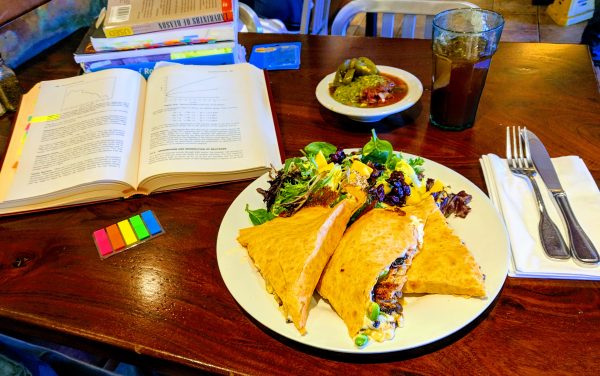
Also I seem to get stuck in ruts. Actually I like ruts - I’m in one now, eating near my house and bank and pet food store at a restaurant with really good iced tea - but only ruts that are good for getting things done, like ruts in a well-trodden road.
When ruts leave you spinning your wheels in the mud, it’s time for a change. This can be as simple as engaging the locking hubs on your stuck all-wheel drive truck to get out of the mud, but you have to know that those locks are there to engage them. (True story).
So in order to grow, you need to learn. But if you learn, and you don’t tell anyone, then when you die, what you learn is gone. Fortunately, at the dawn of history humans learned how to speak to the dead, if only the dead are first willing to share, through their stories.
I don’t recommend waiting until you’re dead to tell your story. (Most people find that disturbing). Instead, it’s better to organize your thoughts - to reflect on what happened, what you’ve learned, and to package it the lesson with its context so it’s easy to share, like knowledge in a little case.
But I don’t do that all that well. I read for entertainment, and I occasionally write things down, but I rarely reflect, and I even more rarely share. But in my attempt to grow, I’ve read some things that made me think, and it made me want to find a way to make me share.
I like to LEARN, of course, usually some technical material related to writing or my job, and I’m now consciously reading books to GROW, like Art Matters by Neil Gaiman or It’s Not How Good You Are but How Good You Want To Be by Paul Arden. But I don’t take time to ORGANIZE those thoughts, nor do I seem to take time to SHARE them. That made me think.
I already take time to LEARN and GROW. I’ve already decided I need to take more time to ORGANIZE my thoughts, to be a better scientist. Can I also take some time to SHARE? Maybe I can put all those together into, like, an acronym! And that acronym will help me do it!
Okay, then, let’s go: LEARN-GROW-ORGANIZE-SHARE. LGOS!
Well.
That’s a terrible acronym.
Alright, alright, if first you don’t succeed, go home and rethink your life. Or something like that, like rethink your acronym. LEARN and GROW need to come before ORGANIZE and SHARE, but G is a better thing to start a word with, as GL or GR is a more common start than LG.
And I’m doing it to GROW. So perhaps it could be GROW LEARN, or GROW READ, naturally followed by ORGANIZE. That gets us GRO, which followed by S for SHARE is one letter short of GROSS; but what if instead we got to the point, and said what we have to do: WRITE.
So, here’s what I recommend to you (well, actually, to me): take some time every day to
- GROW yourself by
- READing to learn,
- ORGANIZing your thoughts, and share them by
- WRITING
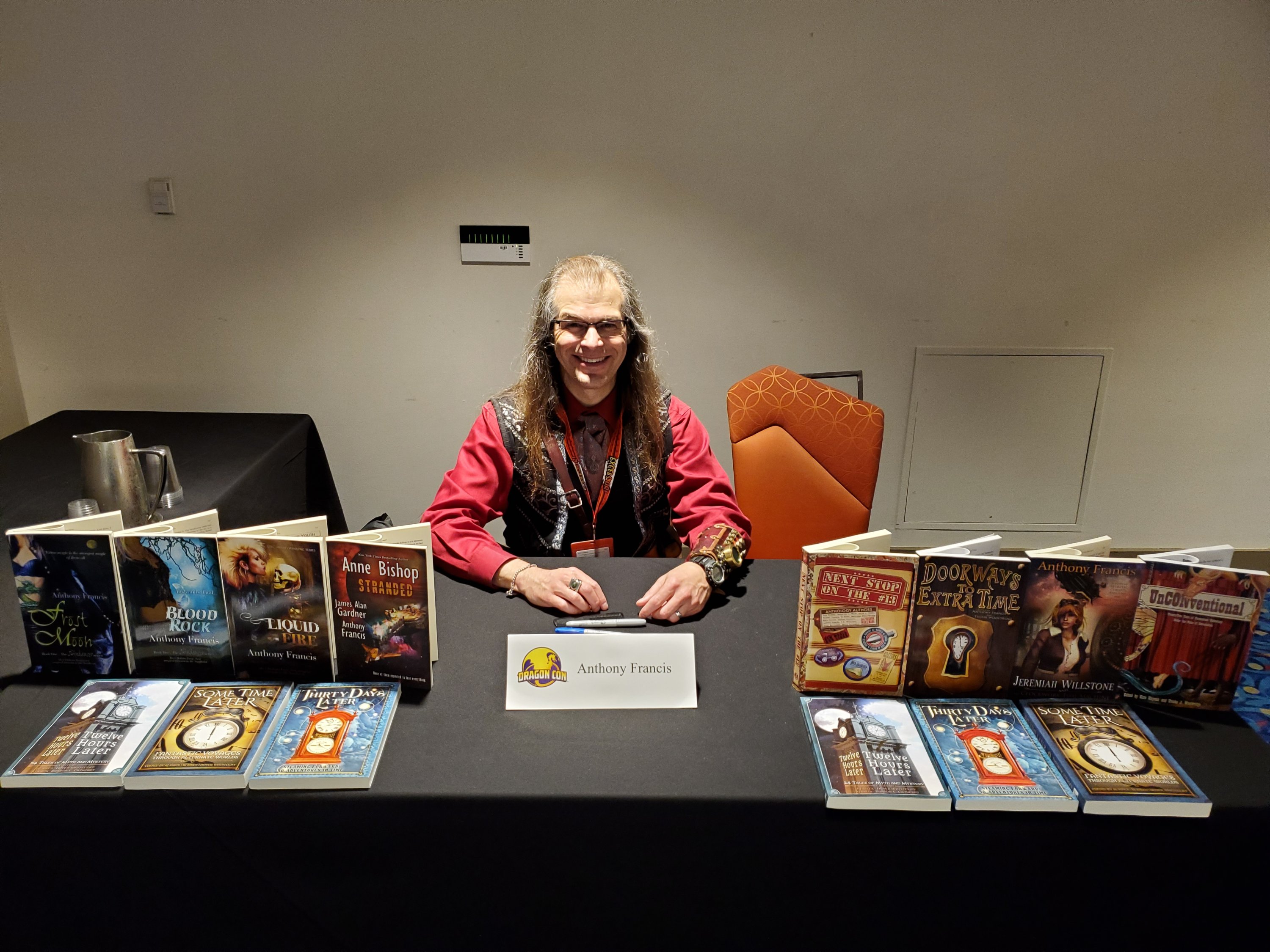 Marriott, bottom floor, International Hall South. Follow the signs for the author signing, you can't miss it!
  So my author reading IS on tomorrow, though you can't search for it by name (my name appears in the panel description, but not in the panelists), it does show up on the list at 11:30 tomorrow (um, today, Saturday):
Reading Session: Anthony Francis Time: Sat 11:30 am Location: Marietta - Hyatt (Length: 1 Hour) (Tentative Panelists: Anthony Francis)I'll be reading from a mixture of my fiction and nonfiction, urban fantasy and steampunk, published works and unpublished works, and maybe even a preview of the Jeremiah Willstone radio drama! Or, since this got finalized on the schedule at the last minute, I might just be reading a book by myself in a quiet room. Either way, so full of win! :-D -the Centaur
P.S. It appears my author signing is still on the schedule, so I will also be appearing at 2:30 on Sunday: Title: Author Signings Time: Sun 02:30 pm Location: International Hall South 4-5 - Marriott (Length: 1 Hour) (Tentative Panelists: Anthony Francis)Don't miss it! (I won't.)
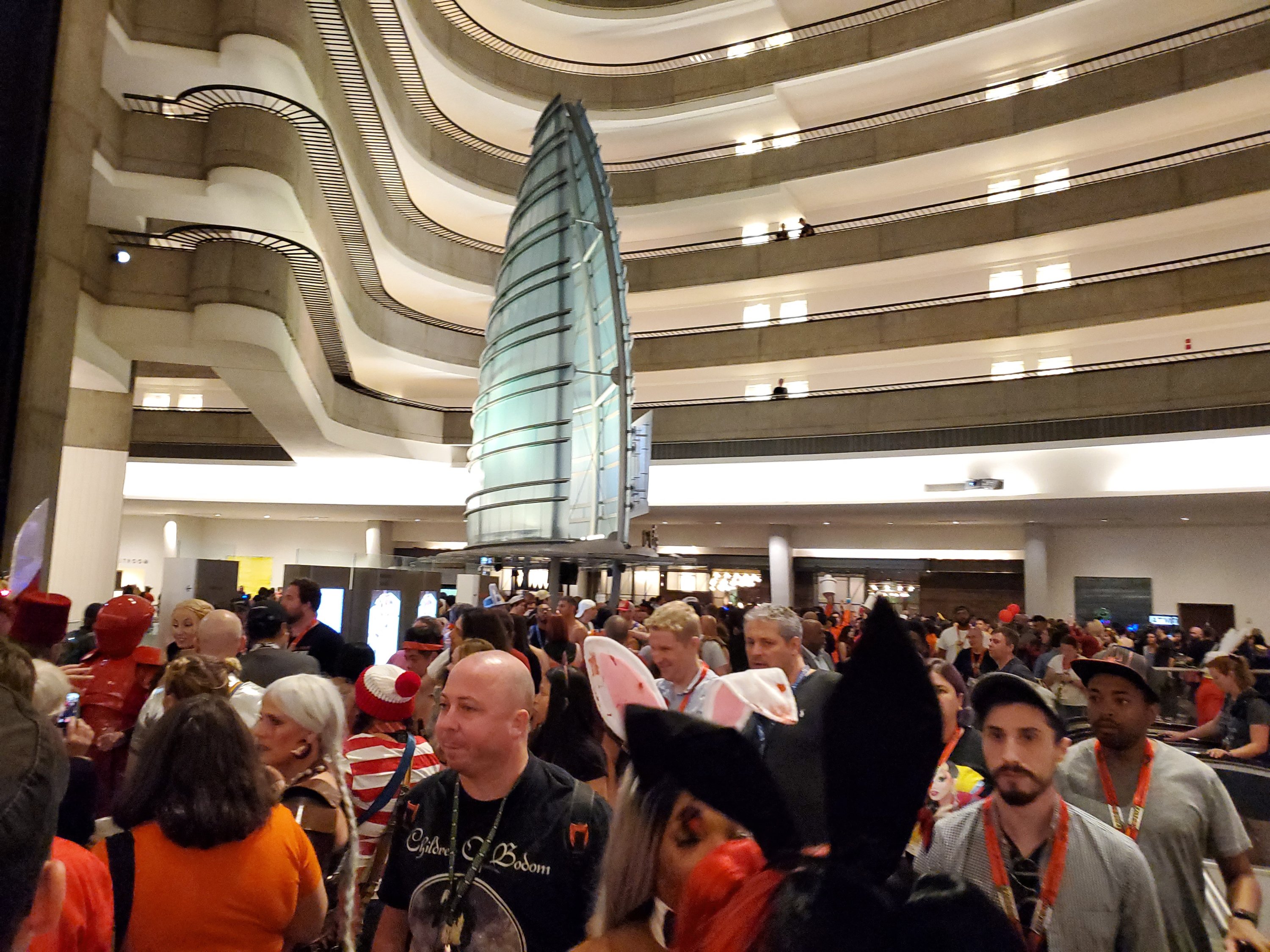 So I will be appearing at "Social Media for Authors" at 4pm at Hyatt Embassy CD. Perhaps they're including me as the counterexample. Here's my advice to you on social media for authors: if you get into it, consistently engage it, and don't let anyone bait you into being a jerk. Imagine anything you say could end up on the front page of the New York Times, and you'll be fine.
-the Centaur
So I will be appearing at "Social Media for Authors" at 4pm at Hyatt Embassy CD. Perhaps they're including me as the counterexample. Here's my advice to you on social media for authors: if you get into it, consistently engage it, and don't let anyone bait you into being a jerk. Imagine anything you say could end up on the front page of the New York Times, and you'll be fine.
-the Centaur 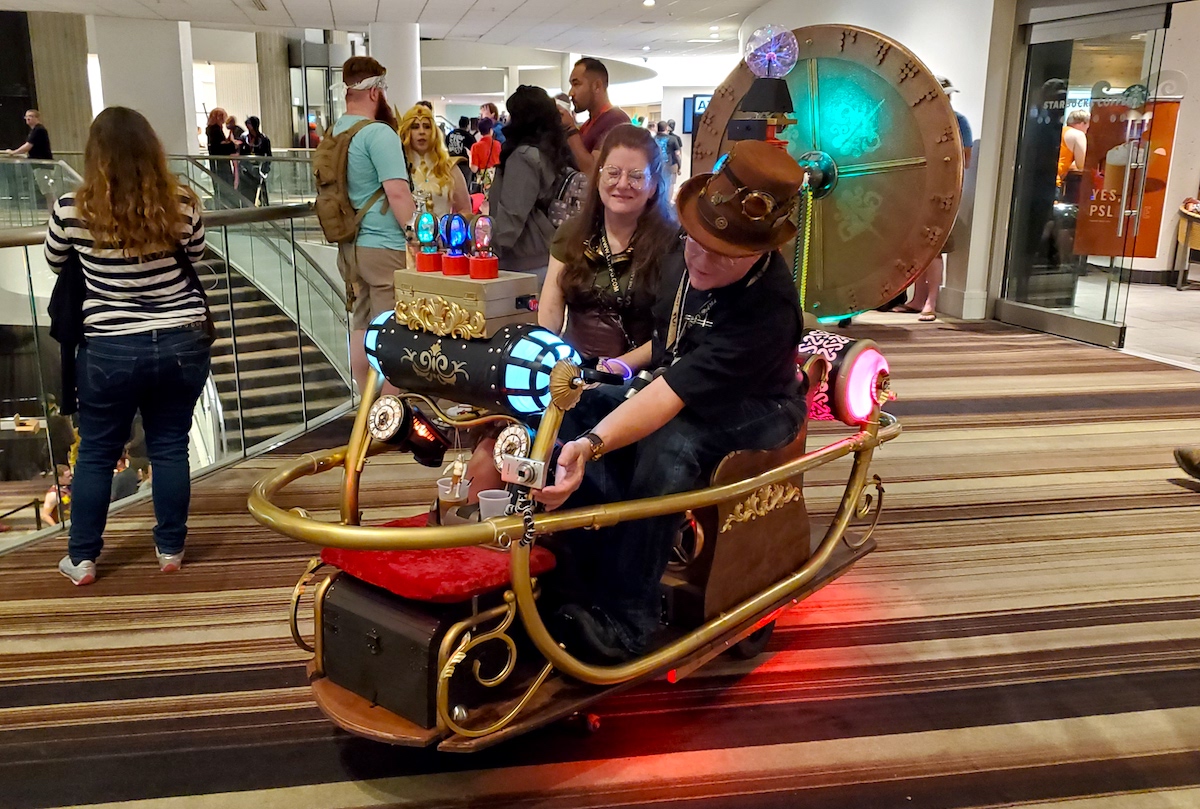 Woohoo, I made it! After what seems like a year and a day of foo, I am finally back at Dragon Con! I had a wonderful dinner with writer friends, wandered the show floor seeing all the great costumes on the moral equivalent of Preview Night, and had a nice cocktail in the hotel bar, where I apparently sold two Muggles on Doctor Who! (We also talked about the Three Stooges, Wayne's World, and bingewatching Agents of SHIELD).
My reading session this year is in theory Saturday at 11:30 in Marietta [Hyatt] though it for some reason hasn't shown up on the schedule (and they have an author signing listed for Sunday instead). Investigating. In the meantime, my schedule this year is moderate:
Woohoo, I made it! After what seems like a year and a day of foo, I am finally back at Dragon Con! I had a wonderful dinner with writer friends, wandered the show floor seeing all the great costumes on the moral equivalent of Preview Night, and had a nice cocktail in the hotel bar, where I apparently sold two Muggles on Doctor Who! (We also talked about the Three Stooges, Wayne's World, and bingewatching Agents of SHIELD).
My reading session this year is in theory Saturday at 11:30 in Marietta [Hyatt] though it for some reason hasn't shown up on the schedule (and they have an author signing listed for Sunday instead). Investigating. In the meantime, my schedule this year is moderate:
Social Media as an Effective Tool for Authors Social Media is an author's best friend/worst enemy. This panel discusses how to maximize the benefits without the side effects. Time: Fri 04:00 pm Location: Embassy CD - Hyatt (Length: 1 Hour) (Tentative Panelists:Moderator: Bill Fawcett, Anthony Francis, Tyra A Burton, Anya Martin, Trisha J. Wooldridge, James Nettles) When Life Intrudes Writers often seem impervious to their surroundings. But occasionally life throws us a problem we have to face head on. How do we manage career & crisis at the same time? Time: Fri 10:00 pm Location: Embassy CD - Hyatt (Length: 1 Hour) (Tentative Panelists: Holly Sullivan McClure, Katherine Kurtz, Nancy Knight, Anthony Francis) Reading Session: Anthony Francis Time: Sat 11:30 am Location: Marietta - Hyatt (Length: 1 Hour) (Tentative Panelists: Anthony Francis) Fightin' 'n' Writin' How to write realistic fight scenes--whether utilizing guns, edged weapons, martial arts...or something not yet invented. Time: Sat 10:00 pm Location: Embassy CD - Hyatt (Length: 1 Hour) (Tentative Panelists: John D. Ringo, Clay and Susan Griffith, Anthony Francis, Alison Sky Richards, R M Meluch) Stitch & Witch We are getting crafty for a bit. Feel free to bring projects to share or work on! While we explore the role that art, crafts, & hobbies play for characters & worlds. Time: Sun 11:30 am Location: Embassy EF - Hyatt (Length: 1 Hour) (Tentative Panelists: Jody Lynn Nye, Anthony Francis) Transformations: Shapeshifter Magic Urban Fantasy features many types of shapeshifters. Our panel of authors will discuss the type of magic used by their characters & where their inspiration regarding it is rooted. Time: Mon 11:30 am Location: Chastain 1-2 - Westin (Length: 1 Hour) (Tentative Panelists: D.R. Perry, Tina Glasneck, Jennifer St. Giles, Aaron Crash, Anthony Francis)When life intrudes? Oh, I got this. -the Centaur

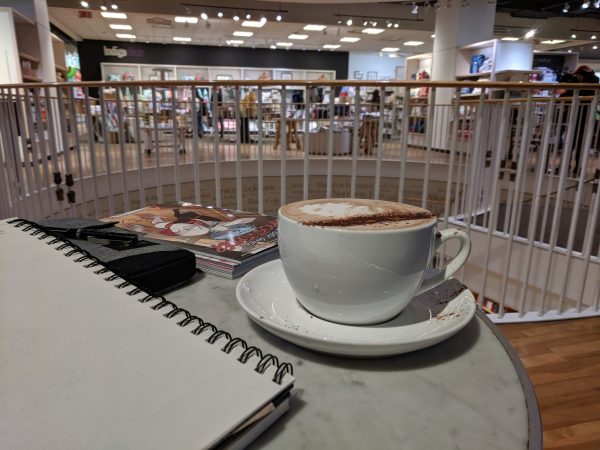 About four years ago, one of my colleagues at work found out I was a writer and asked, "So, tell me Anthony, how can I be a better writer?"
I don't claim any special wisdom in this department, but I do claim two things: first, that I have opinions about the matter, and second, that I wrote a long email to my friend about it, an email which I thought I'd posted on my blog. Unfortunately, after an extensive search, I wasn't able to find the post.
Now, I could attempt to clean this email up prior to posting it here, but I'm afraid that if I do that, I'll just end up going several years without posting it.
SO! Here's that email, largely unedited, on "How to be a better writer!"
Sorry it took so long to respond to your question about how to be a better writer - I thought I wrote an article on this on my blog, or perhaps in an email to a friend, but if so, I couldn't find it. Then I tried to write a long response, but that turned into something book length. So let me give you the short version.
About four years ago, one of my colleagues at work found out I was a writer and asked, "So, tell me Anthony, how can I be a better writer?"
I don't claim any special wisdom in this department, but I do claim two things: first, that I have opinions about the matter, and second, that I wrote a long email to my friend about it, an email which I thought I'd posted on my blog. Unfortunately, after an extensive search, I wasn't able to find the post.
Now, I could attempt to clean this email up prior to posting it here, but I'm afraid that if I do that, I'll just end up going several years without posting it.
SO! Here's that email, largely unedited, on "How to be a better writer!"
Sorry it took so long to respond to your question about how to be a better writer - I thought I wrote an article on this on my blog, or perhaps in an email to a friend, but if so, I couldn't find it. Then I tried to write a long response, but that turned into something book length. So let me give you the short version.
- First, just write! That's the best thing anyone can do to become a better writer. Ten thousand hours of practice can build mastery in almost any skill, so the first thing you can do to help yourself is to write regularly - preferably, about whatever comes to mind, so you're not trying to practice when you're on the spot.
- Try morning pages. The best tool I know to help people get into the habit of writing is to write morning pages - writing, each day, ideally when you get up, three pages in a notebook. Write bla bla bla if you have to - you'll get bored of it quickly, and will write what comes to mind.
- Take a creativity course. The book The Artist's Way is one of the most famous of these, and it's what inspires me to suggest morning pages. Actually, I've never finished this course - I always get so energized just trying it that I get sucked off into my own projects. Try one that works for you.
- Read more than you write. You can't consciously choose the words that come out as you write them; they come from your subconscious. So it's important to feed your subconscious with a lot of interesting material to help you generate a lot of interesting material of your own.
- Read great writing of the type you want to create. What you enjoy reading most might not be the writing you want to emulate most, so hunt down the great writers of the type of writing you're aiming for, read them, and try to figure out what you like about them - and what makes them tick.
- Read great books on writing. The first two I always recommend to people are Ayn Rand's (yes, that Ayn Rand) The Art of Fiction and The Art of Nonfiction. More than any book I've ever read, the Art of Fiction boils down what makes good fiction writing. John Gardner's On Being a Novelist is another great, but there are so many of these it's hard to pick one.
- Read great books on style. The two I recommend to people the most are The Elements of Style by Strunk and White and Building Great Sentences by Brooks Landon. Strunk and White is the classic, and Building Great Sentences is its antidote. If you have to pick one, pick Building Great Sentences - hands down.
- Do writing exercises. There are many, many of these - The Artist's Way has some, at Barnes and Noble you can find dozens of books like 500 Writing Prompts or Creativity Bootcamp that have others; the important thing is to try different writing styles on.
- Try timed challenges. Write to the End (writetotheend.com) tries 20 minute writing challenges; Shut Up and Write ( meetup.com/shutupandwritesfo
) tries (I think) an hour; National Novel Writing Month (nanowrimo.org) tries 50,000 words in a month. These cure you of the notion you need to wait for your muse. - Join a writing group. Not a critique group - those are dangerous until you get more confidence in and acceptance of your own writing (and a thicker skin). I already mentioned Write to the End and Shut Up and Write, but there are many more (even some at Google, such as the Creative Writing Lunch).
- Take on writing projects. Write novels, write stories, write essays, write memoirs, write documentation, write songs, write plays, write poetry, write haiku, write impenetrable postmodern explorations of what it means for something to be writing - but take on a writing project that has a beginning, middle, and end ...
- Finish what you write! This is so important I wanted to write this earlier, but the problem is, it depends on what you're writing for. If you just want to improve your skill, reading Strunk and White might do it - but if you want your writing to go further, you need to finish what you write.
- Don't edit while you write! Some people do this very well, but most people have two modes: producing text, and refining text. Unless you're very confident in your ability to not rework the first paragraph of something forever, make sure you first finish, then edit. But before you do that ...
- Let your manuscripts cool off. It's hard to have perspective right after you've finished something. At least sleep on it, if you have time; ideally, come back to a story after a week or two and see if what you wrote before still makes sense to you and does what you wanted it to. In the meantime ...
- Work on something else. Start something new. Creating a new work has an almost magical way of solving problems you have in the work you have cooling on the back burner. Your skills improve, you're not invested in your old ideas, and you come back with a fresh start.
- Revise your work! Give your manuscript at least a once over. I guarantee, it's not perfect. The books Self Editing for Fiction Writers or The Elements of Editing can help you with this task. It's worth working on something a bit until you can't see anything obviously wrong to it.
- Share your work with a friendly audience. You're not ready for a critique group yet; they're often way too harsh. What you want are three friendly reviewers: a coach to help with your skills, a critic to help find flaws, and a cheerleader to praise goodness - and if the cheerleader complains, listen very closely to them.
- Revise your work again before sending it out. Listen to your friendly critics. Revise your work. Make it the best it can be. Then you're ready to send it out - to a critique group if you have to and if you have one, but ideally, to where you want the work received or published.
- Keep your work circulating until sold. This may not apply to bloggers, writers of memoirs, and internal communications, but if you've got something you want to send to an external audience, send it to as many places as you can. Some great books went to dozens of publishers before getting accepted.
- Don't argue with your critics. Whether it's a friend, a critique group, or an editor, they're not critiquing you to hurt your feelings. Listen carefully, and perhaps if there's some small misconception, feel free to clear it up, but ask yourself - why wasn't your story so clear that they got it the first time?
- Solve the problems your critics raise, but don't feel compelled to use their solutions. Humans are great at confabulating fake reasons for the feelings they have. Don't feel the need to use every suggestion your critics raise - but if two or more have problems at the same spot, listen closely.
- Learn from your genre. Whether it's writing a thesis, writing documentation, or writing science fiction stories, there are documents out there on the pitfalls of the genre and the techniques from success, from How to Complete and Survive a Doctoral Dissertation to the Evil Overlord List.
- Learn from the style guide. If you're aimed at a particular market, whether it's a science fiction magazine accepting William Shunn's document format, or a book publisher who wants the Chicago Manual of Style, or it's the American Psychological Association, read the style book. With a grain of salt, of course.
- Learn from publication. Once something is published, take a look at the published work. I can guarantee you, you'll find something about it you'd do differently now, whether it's a typo or a new way to phrase things. Think carefully about this difference and what it can teach you.
- Find a great critique group. By this point, you've been exposed to enough information to have your own opinions and to make up your own mind - and that's the right time to engage a whole bunch of other opinionated, thoughtful people to get their ideas of how to improve your work.
- Find a great workshop. These are harder to get into, but put you in touch with great writers of your particular genre or style and can really take you to the next level, if that's what you want.
- Find a great program - or embark on a great project. If you really want to be a writer, some people suggest a MFA program or other longer-term, intensive course. I simply prefer to take on little projects like 21 book urban fantasy series; these force you to learn some of the same things. :-D
Well, that's about it for the short version. As I said ... the long version's probably a book. :-) I hope this helps! Please feel free to ask me more questions!
And there you have it. I hope that's not a repeat!
-the Centaur
So, March was pretty bad: I had to fly back East because Mom ended up in the hospital, we had a mad rush to finish a paper which both screwed up my time at GDC and Clockwork Alchemy AND failed to get in on time, and I found out I was suffering from chronic sinusitis.
Not to be outdone, however, June decided to throw me a bigger one.
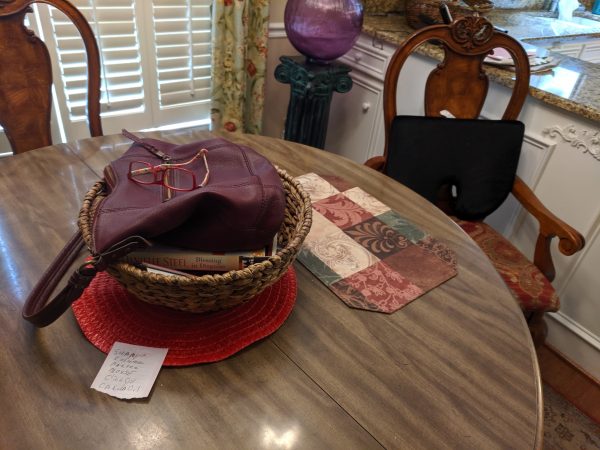
So, Mom's gone. She passed after what sounds like a beautiful week with friends and family - I spoke to her the day before she died, and she went to visit the neighbors and swing on their back porch until almost nine - and then collapsed while changing the bed linens in her own bedroom in the house she'd lived in for forty years. Of ways to go, that's a good one.
Regularly scheduled blogging will resume ... sometime.
Goodbye, Mom.

-the Centaur


"Robots in Montreal," eh? Sounds like the title of a Steven Moffat Doctor Who episode. But it's really ICRA 2019 - the IEEE Conference on Robotics and Automation, and, yes, there are quite a few robots!
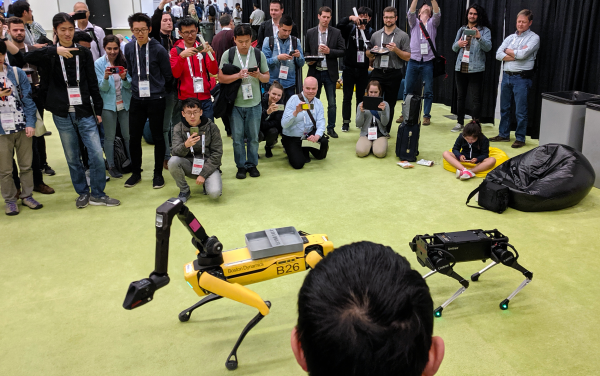
My team presented our work on evolutionary learning of rewards for deep reinforcement learning, AutoRL, on Monday. In an hour or so, I'll be giving a keynote on "Systematizing Robot Navigation with AutoRL":
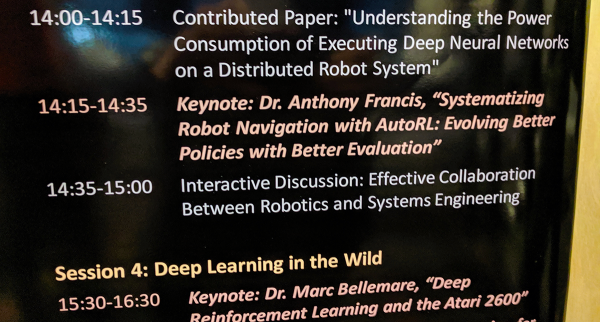
Keynote: Dr. Anthony Francis
Systematizing Robot Navigation with AutoRL: Evolving Better Policies with Better Evaluation
Abstract: Rigorous scientific evaluation of robot control methods helps the field progress towards better solutions, but deploying methods on robots requires its own kind of rigor. A systematic approach to deployment can do more than just make robots safer, more reliable, and more debuggable; with appropriate machine learning support, it can also improve robot control algorithms themselves. In this talk, we describe our evolutionary reward learning framework AutoRL and our evaluation framework for navigation tasks, and show how improving evaluation of navigation systems can measurably improve the performance of both our evolutionary learner and the navigation policies that it produces. We hope that this starts a conversation about how robotic deployment and scientific advancement can become better mutually reinforcing partners.
Bio: Dr. Anthony G. Francis, Jr. is a Senior Software Engineer at Google Brain Robotics specializing in reinforcement learning for robot navigation. Previously, he worked on emotional long-term memory for robot pets at Georgia Tech's PEPE robot pet project, on models of human memory for information retrieval at Enkia Corporation, and on large-scale metadata search and 3D object visualization at Google. He earned his B.S. (1991), M.S. (1996) and Ph.D. (2000) in Computer Science from Georgia Tech, along with a Certificate in Cognitive Science (1999). He and his colleagues won the ICRA 2018 Best Paper Award for Service Robotics for their paper "PRM-RL: Long-range Robotic Navigation Tasks by Combining Reinforcement Learning and Sampling-based Planning". He's the author of over a dozen peer-reviewed publications and is an inventor on over a half-dozen patents. He's published over a dozen short stories and four novels, including the EPIC eBook Award-winning Frost Moon; his popular writing on robotics includes articles in the books Star Trek Psychology and Westworld Psychology. as well as a Google AI blog article titled Maybe your computer just needs a hug. He lives in San Jose with his wife and cats, but his heart will always belong in Atlanta. You can find out more about his writing at his website.
Looks like I'm on in 15 minutes! Wish me luck.
-the Centaur

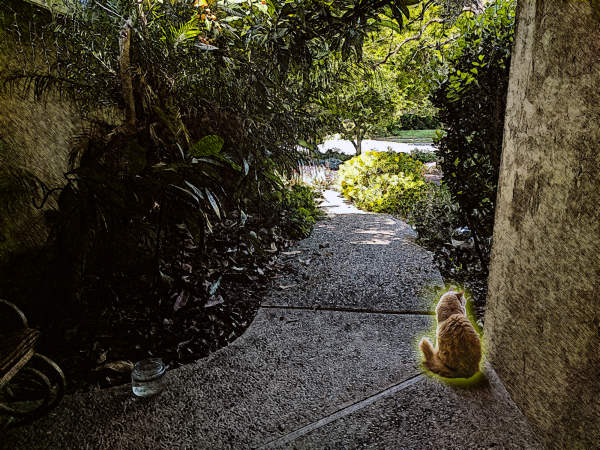
In the words attributed to Trevor Noah, "Why do you invite a tiny lion into your house to pee in your box of sand?" Well, he's small, cute, and furry, and emits calming noises. Kind of like an animate stuffed animal. After years of exile during his Yellow Years, Gabby is once again an inside cat, and this morning he crawled atop the bed and fell asleep atop me.
Here's hoping he keeps up his good behavior. I need a little something that takes the edge off the stress. Not that I have existential worries to stress about; humans adjust to set-points, so my main stress is figuring out how to make my very good job become a slightly better job, or how to prevent it from becoming a slightly worse job, all while still having time to write.
Not that I have enough time to do that either, but at least I can blog again.
-the Centaur
Wow, I just won {Nanowrimo|Camp Nanowrimo} for the twenty-third time!
For readers of this blog who have missed, like, 75% of my posts over the years, National Novel Writing Month is a challenge to write 50,000 words of a new novel in the month of November, and Camp Nanowrimo is its sister challenge in April and July. I adapt this to write 50,000 words on top of whatever I'm currently working on, and have been doing it since 2002.
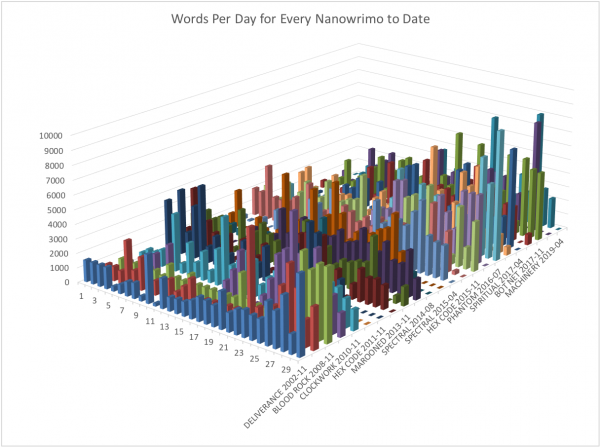
This is my 25th Nano or Nano-like attempt, and my 23rd victory. (Interestingly, my two failures were times that I tried Nano on my own, without the motivation of the Nano "Validate your Project" button).
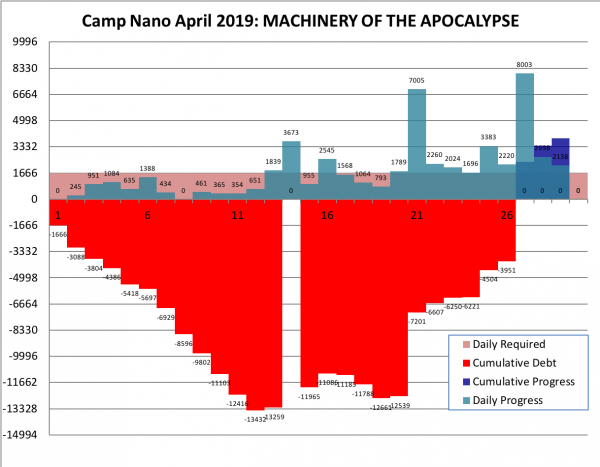
This month, because of friggin' March, man, I started out pretty far behind, compounded by my robot work and the fact that I was working on JEREMIAH WILLSTONE AND THE MACHINERY OF THE APOCALYPSE. This is less a novel than a series of loosely connected novellas, each slightly different in setting and tone, and has been my most research-heavy project to date. But, nevertheless, I got back on track and climbed the mountain.
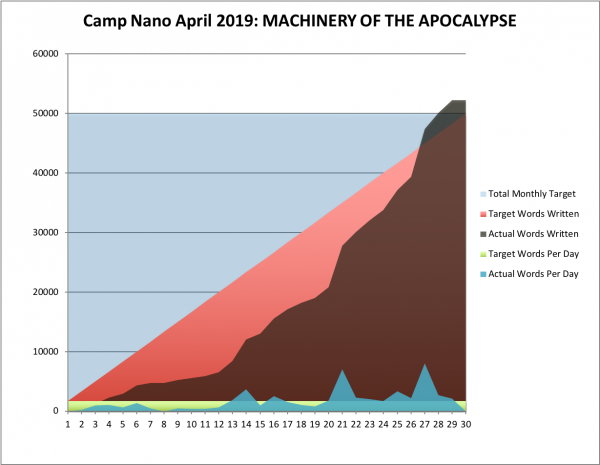
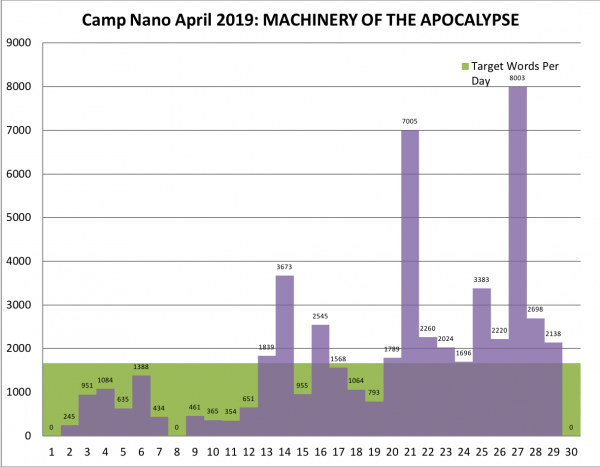
Interestingly, a couple of the days in there were my most productive writing days ever - 7,000 and 8,000 word days, right up with the 9,014 word day that I did once on the last day of Nano. I didn't want to do that again - I wanted to take today off - so I powered through 8000 words on Saturday, finished with 2,600 words on Sunday, and leisurely wrote 2,000 words today unpacking a few of the ideas I had that were still fresh.
And now, the traditional excerpt:
“So,” General Weiss said, sitting down. “You desire to become one of my acolytes?”
Jeremiah glanced over at him, trying to contain her glare. “I desire to learn, sir.”
“What I have to teach is not easy to learn,” Weiss said, patting her leg. “It requires long-term commitment, supreme dedication, self-sacrifice—”
“Are …” Jeremiah felt her brow furrow, tried to control it. “Are you aware of—”
“The nature of your injuries?” Weiss said. “Yes, I heard you were reckless.”
“No, sir,” Jeremiah said. She hit the switch to raise her bed until she could look the man more closely in the eye. “I have been injured, repeatedly, because I have been sent into the line of fire without adequate support, repeatedly, and I did my duty, repeatedly.”
“The story goes is that you tried to leap across a city street, four stories up.”
“No, sir,” Jeremiah said. “A monster that had killed dozens was about to make its escape, and I leapt for it, sir, dragging it down to the street, possibly saving hundreds more lives—well, that’s debatable, but I definitively stopped it, at least that is not in dispute—”
“No, no, you’re quite right about the outcome of the operation.” Weiss rubbed his hands together. “And whether I think you’re reckless in the large, I would never dispute the actions of a operative in the clinch. But do you know why the enemy exposed itself to you?”
“I …” Jeremiah said. “But it didn’t. We caught it, and tracked it—”
“Yes, yes, and let’s not dispute that either,” Weiss said, leaning forward. “A hypothetical. Imagine you had two operations running, physically separated, one large and important, one … less so. To protect them, you can run recon missions looking for the enemy, but the enemy might find them. You can run ten recces in the operation period. Where do you put them?”
“Er, well,” Jeremiah said. “Proportionally on the more important—”
“No,” Weiss said. “You run five. All around the least important one. Why?”
“Er …” What clues had he given? “The larger force, is well, larger. It can defend itself.”“Yes. And?”
Jeremiah’s eyes narrowed. “You want the recces caught?”
“No, not really, but I do, yes.”
“But the smaller force, exposed—”
“And overwhelmed,” Weiss said, “by a mass mobilization of the enemy. Away from my primary force. Now the other five recces probe ahead of the main op, clearing the way while the decoy fights for its life. If done properly—if the decoy force is given both a true objective and the best chance of success, their fight for their lives will only attract more enemy forces. If they win, you have a true two-front victory. If they fail, you don’t even need to send reinforcements—the moment the main force engages the enemy, the enemy will naturally pull back.”
Jeremiah’s brow furrowed.
“Yes, yes, there are many specifics which would make this kind of plan succeed or fail,” Weiss said. “To truly instruct you, we’d need to work through many more patterns, then make them concrete for the kind of forces you will end up commanding—”
“All of them,” Jeremiah said.
“What?”
“I’m going to command all of them,” Jeremiah said. “My aim is to be Minister of War.”
“Oho,” the general said. “Then we have a lot of work to do. Tell me why the thing exposed itself to you. Quick, now.”
"They're—" Jeremiah's mouth fell open. "The things are wearing us down."
Sounds like they have a lot of problems on that boat. The first of the stories in THE MACHINERY OF THE APOCALYPSE is already out: A Choir of Demons, at Aurora Wolf. For the rest ... well, you'll have to wait a bit. Enjoy!
-the Centaur
Wow, it's been February since I posted. I mean, I knew February was busy working on robots, and that slowed me down some, but March, man. I found out my long-running cold was actually chronic sinusitis, my Mom ended up in the hospital and I had to fly back to see her, and then we had another big robot push, right in the middle of the back-to-back Game Developer's Conference and Clockwork Alchemy steampunk convention. The robot push didn't work, necessitating another solid month of work.
SO, yeah, March, man.
Now, at last, things seem to be chilling out. Let's see if we can get to that blog backlog ...
-the Centaur
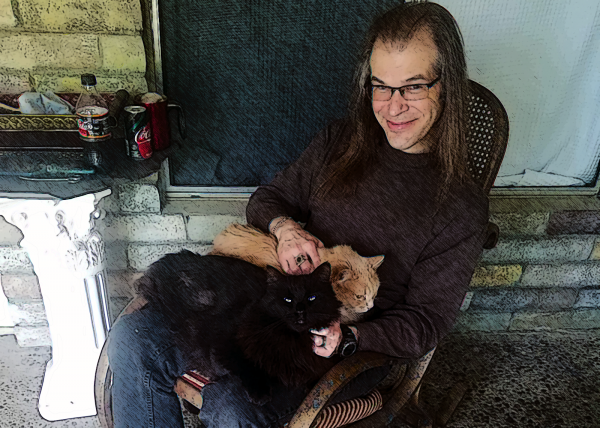
Pictured: Gabby and Loki, mortal enemies, chilling with me on my lap on my front porch. They got up there by themselves, I swear.
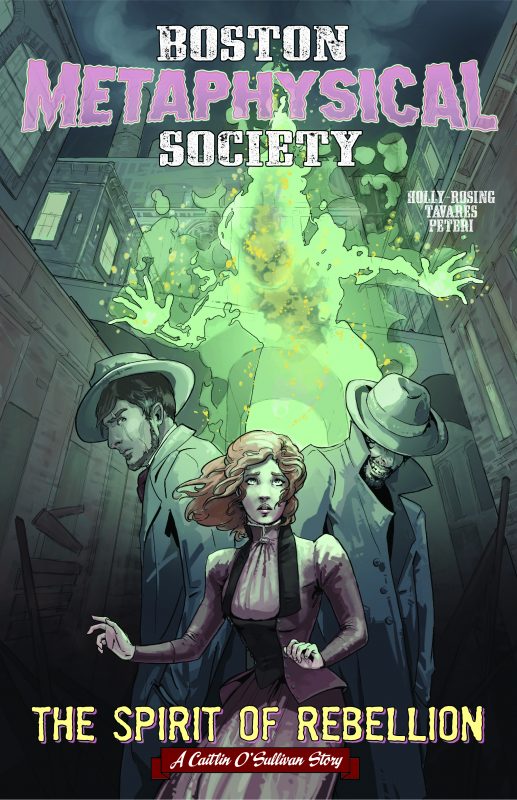
Madeline Holly-Rosing's Boston Metaphysical Society has another Kickstarter for "The Spirit of Rebellion"! It's running for about one more day, so if you want to jump on board this train, now's the time to do it!
Our world is big. Big, and complicated, filled with many more things than any one person can know. We rely on each other to find out things beyond our individual capacities and to share them so we can succeed as a species: there's water over the next hill, hard red berries are poisonous, and the man in the trading village called Honest Sam is not to be trusted.
To survive, we must constantly take information, just as we must eat to live. But just like eating, consuming information indiscriminately can make us sick. Even when we eat good food, we must clean our teeth and got to the bathroom - and bad food should be avoided. In the same way, we have to digest information to make it useful, we need to discard information that's no longer relevant, and we need to avoid misinformation so we don't pick up false beliefs. We need habits of information hygiene.
Whenever you listen to someone, you absorb some of their thought process and make it your own. You can't help it: that the purpose of language, and that's what understanding someone means. The downside is your brain is a mess of different overlapping modules all working together, and not all of them can distinguish between what's logically true and false. This means learning about the beliefs of someone you violently disagree with can make you start to believe in them, even if you consciously think they're wrong. One acquaintance I knew started studying a religion with the intent of exposing it. He thought it was a cult, and his opinion about that never changed. But at one point, he found himself starting to believe what he read, even though, then and now, he found their beliefs logically ridiculous.
This doesn't mean we need to shut out information from people we disagree with - but it does mean we can't uncritically accept information from people we agree with. You are the easiest person for yourself to fool: we have a cognitive flaw called confirmation bias which makes us more willing to accept information that confirms our prior beliefs rather than ones that deny it. Another flaw called cognitive dissonance makes us want to actively resolve conflicts between our beliefs and new information, leading to a rush of relief when they are reconciled; combined with confirmation bias, people's beliefs can actually be strengthened by contradictory information.
So, as an exercise in information hygiene for those involved in one of those charged political conversations that dominate our modern landscape, try this. Take one piece of information that you've gotten from a trusted source, and ask yourself: how might this be wrong? Take one piece of information from an untrusted source, and ask yourself, how might this be right? Then take it one step further: research those chinks in your armor, or those sparks of light in your opponent's darkness, and see if you can find evidence pro or con. Try to keep an open mind: no-one's asking you to actually change your mind, just to see if you can tell whether the situation is actually as black and white as you thought.
-the Centaur
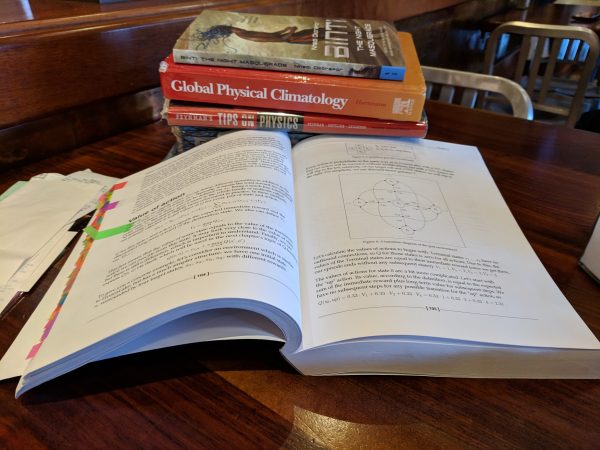
Pictured: the book pile, containing some books I'm reading to answer a skeptical friend's questions, and other books for my own interest.

So the new Doctor Who has finished her historic first season, which I found had its ups and downs: episodes like Arachnids in the UK, Kerblam! and The Witchfinders really resonated with me, whereas The Tsuranga Conundrum, The Woman Who Fell to Earth and Rosa really did not. Episodes like Rosa, Arachnids and The Battle of Ranskoor Av Kolos wrestled with great ideas and even reached for greatness at points but had baffling lapses in logic, whereas some of the most iconic images and ideas, like the crane leap and the "I'm the Doctor, sorting out fair play throughout the universe" came from episodes I find myself the least interested in rewatching.
But leave all that aside: from th beginning, this Doctor caused a sharp divide among fans, there's a huge gap between audience and critic ratings, and there's a persistent rumor about this Doctor being a failure because of low ratings. Go out into the blogosphere, and you'll see conspiracy theories of a particular blogger telling his fans to downvote Series 11, and other conspiracy theories by these fans that the viewing numbers of the series are somehow inflated because people just can't possibly be watching it.
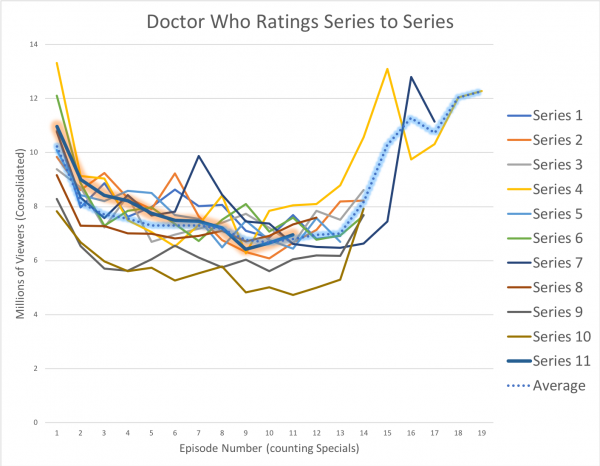
I won't dignify conspiracy theories about reviews or ratings: there's a lot of genuine fans unhappy with the new Doctor, and there are millions of people watching it, more in my circle than have ever watched it before. But I can address one question solidly with real data: is Jodie Whittaker's Doctor doing worse in the ratings than the Doctors who came before her?
No, she's not doing worse; she's doing just fine.
Taken from the Wikipedia articles on this series and its predecessors, along with the Doctor Who Guide, I was able to put to rest the conspiracy theories about Jodie Whittaker having some kind of ratings dropoff compared to the other Doctors. Nope. All of the recent Doctors start well, drop off, and rise near the end of the season. Jodie is right on track - in fact, slightly better than average for 11 episodes into the season. True, she hasn't had the insane spikes in ratings that David Tennant and Matt Smith got near the end of their runs, but those were series of highly promoted event specials.
I rather like Jodie Whittaker's Doctor, and I love the emotional arcs of the new series, and Bradley Walsh is so damn good I could probably enjoy watching him watch paint dry, but the stories in the new season need a little work on basic logic and truly threatening monsters. Logic in the new Who was always a bit dodgy, but it's getting worse, and the lack of series-long arcs and recurring monsters is doing the Doctor no favors.
Here's hoping in the 2020 season the Who team keeps doing what they're doing well, while also finding ways to do more of the things that made classic, um, New Who great.
-The Centaur
Good news, Edgeworlders! FROST MOON is on sale through the 15th!

FROST MOON is my first novel, the tale of Dakota Frost, a woman who can bring her tattoos to life, and her very first encounter with the sharp edges of the Edgeworld she's been dancing around all her adult life. She meets vampires and werewolves, weretigers and faerie, and soon is on the ride of her life when the police warn her about a serial killer attacking the magically tattooed near the full moon ... right when a werewolf asks her to tattoo a design on him. Is he the killer ... or the next victim?
Go check it out on Amazon, Kobo, Nook or wherever fine ebooks are sold!
-the Centaur
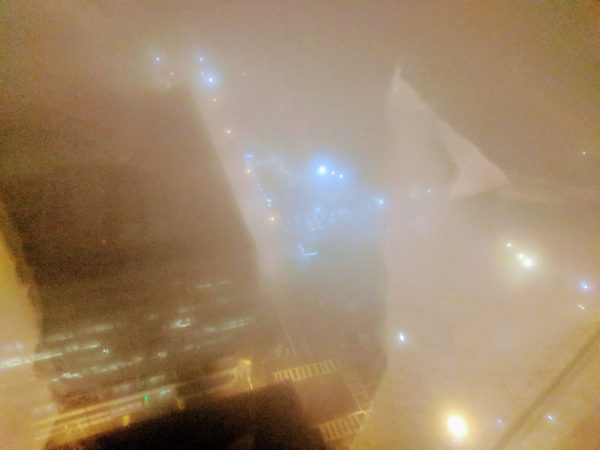
So my latest adventure was a true comedy of errors - but turned into an unexpected visit to Atlanta with an old friend. As the years pass and I get busier I have less and less time to take anything short of a redeye back to the East Coast, yet my tolerance for them has dropped. So, on the principle that a luxury once enjoyed is a necessity, I've started flying First Class.
Not that I really want to - I mean, I enjoy it, but it's expensive. First Class on some recent flights overseas, which I did NOT get, was in the range of ten thousand dollars. But if I can find a reasonable ticket back to my hometown, I'll take it. (Rarely, I've even found cheaper First Class than normal flights).
One of the perks, apparently, of First Class is that they will call you if your flight connection is delayed. Because of fog, rain and mechanical issues, my plane to Atlanta was delayed, so Delta called me up and alerted me that if I headed to the airport RIGHT NOW, they'd get me on an earlier flight so I could make my connection. Mom and I were already on the way to the airport, so we asked for the check and motored.
I waved to one of my high school buddies in the airport bar - we'd originally been on the same flight - and made my new connection with moments to spare. We pulled back from the gate aaaaand ... sat there. And sat there. And sat there, as the minutes ticked down. Finally, the pilot told us that the plane was off balance because it was underweight, the computer was confused, and they were having to reset everything manually. Finally, at the time the plane was originally supposed to have departed, we taxied out.
But then stopped on the runway. I and my buddy texted from two different planes that each was in trouble - ours had no gate to land, his, my original plane, had mechanical trouble and had rolled back to the gate, no mechanic in sight. I said, "screw it", and in moments had reservations for the spectacular Atlanta Marriott Marquis hotel for only $50 bucks using Expedia points. I almost made reservations for my favorite restaurant, then rethought and texted my buddy: "Hey, you've missed your connection too, right?"
Yep. He sure had.
When he landed, I already a car, had upgraded the room for free to get an extra bed, and had a list of places to eat that were still open. We hit Manuel's Tavern, one of our old favorites from back in the day, and then crashlanded in the hotel bar for an hour before calling it a night.

The next day, we were out and rolling at the ungodly hour of 6:50am - what is that, I mean, is that even a thing? - and having breakfast at Gordon Biersch. Now it was his turn to wave to make his LA connection, and an hour later I followed on my own flight, with Danny Devito sitting in seat 1B only a few rows away from me during my LA connection. By 4pm, I was hugging my wife and heading back home to hug some cats.
I guess the point, and I do have one, is that I could have had a miserable time with a delayed flight. Instead I got to have a great mini-trip to Atlanta, caught up with an old friend, and had a great story to tell.
I guess attitude is everything.
-the Centaur

Happy New Year, y'all! And here's a productivity tip for all my fellow adventurers: a holiday or vacation is a great time to catch up on that illness you've been putting off.
Seriously, I've gotten sick something like three or four times in the last month: first a cold which canceled my trip to the WAFR conference in New Mexico, where I was a fricking invited speaker and couldn't go. That turned into a lingering sinus infection which just about went away by the time I returned to my home town of Greenville - but which then reared its ugly head again. Since my mother, my buddy Derek, and at least one other person fell ill to the same bug within a day or so (stuffiness, a 1-2 day period of severe lethargy, followed by lingering sniffles) I'm guessing this was an entirely new bug that I picked up at the airport. Again this disappeared, but after my return flight back, an adventure in and of itself because of weather delays, I got what appears to be a different bug, this one a slight sniffle plus lingering gastrointestinal distress. Fun! All clearing up in time for work.
So, what can I say? Computing continues its usability slide - I had to switch from Feedly to Innoreader, the Microsoft Word broke all my keystrokes, and the new WordPress editor sucks, making all common operations that much more difficult in favor of something "new" and "cool" that just adds a bunch of junk to what was a clean, simple and easy to use interface. WHAT? Oh, I was going to say something about taking care of yourself in winter colds, but WordPress's new editor decided to turn a carriage return into some strange modal event that absorbed all my keystrokes and threatened to post the page before I was ready. Where was I?
Oh! So! What can I say? To prevent propagation of infecftion, elbow bump or fist bump rather than shaking hands, don't touch the "T" - your eyes nose or mouth - and if you have to cough or sneeze, do so into your shirt, not into your hand or even a handkerchief (those spread infection to your hands). If you get infected, get plenty of rest, plenty of fluids, look up the appropriate treatment for your symptoms, and take your placebo of choice, because while placebos don't work, the placebo effect definitely does. No, it doesn't have to make sense; it's just the evidence. Suck it up, Chester.
So! All that stuff I wanted to blog over the holidays. <looks at list> Sigh.
Guess it will have to wait. Back to work!
-the Centaur
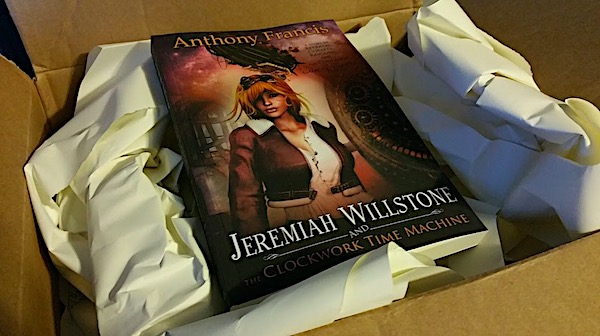
Hail fellow adventurers! My first steampunk novel, Jeremiah Willstone and the Clockwork Time Machine, is on sale through the end of the month! The Ebook is only $0.99, so now's a great time to instantly gift yourself with a trip to Victoriana! You can find it at Amazon, Nook, Kobo, Apple, Google Books, or wherever fine books are sold. If you like action, adventure, corsets, rayguns, or a peek at an alternate history where women's liberation happened a century early, check it out!