... if you have a blog draft hanging around for a long time in Blogger and finally publish it, it gets published at the date that you initially started it and not the date it was actually published. Interesting...
-Anthony
Words, Art & Science by Anthony Francis
... if you have a blog draft hanging around for a long time in Blogger and finally publish it, it gets published at the date that you initially started it and not the date it was actually published. Interesting...
-Anthony
Eyewitness Memory is Unreliable
Australian eyewitness expert Donald Thomson appeared on a live TV discussion about the unreliability of eyewitness memory. He was later arrested, placed in a lineup and identified by a victim as the man who had raped her. The police charged Thomson although the rape had occurred at the time he was on TV. They dismissed his alibi that he was in plain view of a TV audience and in the company of the other discussants, including an assistant commissioner of police. The policeman taking his statement sneered, "Yes, I suppose you've got Jesus Christ, and the Queen of England, too." Eventually, the investigators discovered that the rapist had attacked the woman as she was watching TV - the very program on which Thompson had appeared. Authorities eventually cleared Thomson. The woman had confused her rapist's face with the face the she had seen on TV. (quote taken from Baddeley's Your Memory: A User's Guide).
It simply staggers my imagination that someone testifying about unreliable eyewitnesses would then get accused of something by an unreliable witness ... who herself had been watching him talk about unreliable witnesses and got confused!
-Anthony
Qumana is a great blog post editor, but it has an interesting property that makes its posts appear weird on my web site.
If you hit return, it wraps the whole paragraph in a HTML "p" tag
like so
.Which is nice, in theory it's how you're supposed to use the "p" tag, but ...
It puts huge spaces between paragraphs in my blog.
I'm not sure why this is happening. Some CSS error in my stylesheet? Some translation ... WHOA!
I just did "view source" on the published blog, and found extra
tags after each paragraph in the published blog! So THAT's what is happening... now, of course, the question is WHY, since they don't show up on Qumana's Source View.
Here's seeing if switching from "Enter Starts A New Paragraph" to "Enter Starts A New Line" does the trick.
9:56pm hit return.
-the Centaur
Who am I? What do I do? Why?
I am an artificial intelligence researcher.
I study human and other minds to aid in the design of intelligent machines and emotional robots.
I believe emotions are particularly important for robots because, unlike intelligent machines which normally run as computational processes on a general computer maintained by some other agent, robots have physical bodies with physical needs that they themselves are in part responsible for - and an emotional system's functions are to evaluate how our current situation meets our needs, to trigger quick reactions to get us out of harm, and to motivate us to pursue long-term actions to improve our lot.
I pursue artificial intelligence because right here, right now its techniques help me construct better software artifacts and deepen my understanding of the human condition, and because I hope that creating human level intelligence and beyond will improve the lot of human kind and further the progress of sentient life.
I think these things often, but I never say them. Time to change that.
-Anthony
... does not constitute true "blogging," unless you really have something new to say about the topic. Same goes for the tip you just found on Lifehacker. Perhaps, the curmudgeon in me says, keep the "me too"s and "+1"s to yourselves?
But, I'm a hypocrite; half the tricks I learn and shiny sparklies I find, I only get because some other blogger has read it (out of the dozens of other blogs I don't subscribe to), decided it was good, and regurgitated it into my waiting Google Reader. So keep it coming ... I guess. But I still need something more than "check out what I saw on Slashdot."
-the Centaur
If you're going to blog once a day for a month, it's important not to get overly ambitious about the articles you're going to write each day. I started off with the idea I'd finish all the waiting blog posts I had sitting around, write down my definitive thoughts on several key topics, et cetera.
The outcome of this bright idea? Well, sitting "right next" to this article in Qumana is a blog entry on "delusionaries" which proved too big to chew in a couple of small bites. So I'm going to spit this one out, cut it up into smaller bits, and try again. Stay tuned.
-Anthony
Not even the first week and I skipped a blog entry. Shame on me - and I was even online yesterday.
It's very easy to "fall off the wagon" - to decide to change how we want to live our lives, but then let our day-to-day habits, plans, and interactions carry us through a course of actions that contradicts that. A Christian theologian would make some noise about the fallibility of man; a cognitive scientist would natter on about automatized behaviors, capture errors and the illusion of conscious will. But the long and the short of it is that we're really bad at this.
I can point to a number of wagons I've fallen off repeatedly: regular exercise, martial arts training, doing the physical therapy exercises for my knee, calling all my friends at the beginning of the month, taking the laundry out of the dryer as soon as it beeps. But other wagons I hang on to tenaciously: feeding the cats twice daily, watering the lawn, attending the weekly and monthly writing groups.
At first blush this is the diference between things that have immediate feedback (mewing cats, wilted plants, written stories) and those that don't (it can take months to notice changes in your waistline). But I find that this even applies to things that don't have immediate feedback - like writing my "weekly snippets" at the Search Engine That Starts With a G, a performance tool that I regularly use even though I'm the only one that apparently reads them. True, if you don't send snippets you get reminders about it; but most people ignore them, just like I ignore many, many other automated reminders I get. So that's not it either.
So some wagons are easy to fall off of and others are easy to hang on to. Why is that? I could go off and do a typical blogger speculation, but let's leave it at this for a moment: why are there some things that are so easy to decide to do (or not to do) regularly, while other habits are so hard to make or break that it seems nearly impossible?
'jes wonderin,
-the Centaur
Created via Automotivator, which I found after seeing a Livejournal post (itself found via Planet Lisp) in which its creator, Zach Beane, created a motivational poster for all the smug lisp weenies:
I may not program in Lisp much anymore - probably less than once a month or so, compared to my Top Five (currently Javascript, Java, C++, Bash and Python) - but I do now have this poster hanging in my office at the Search Engine That Starts With a G. Already it's gotten quite a few questions ... :-)
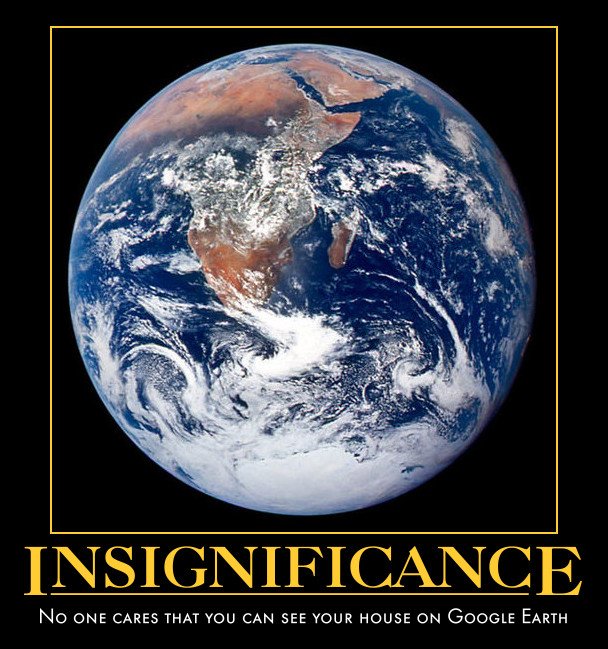
So, on the note of doing things wrong and personal insignificance ... here's some random bits about some changes in the works. This is one of the first blog posts I've done on my new Macintosh, which replaces my beloved but fried Blue Slab of Coolness and my beloved but stolen old Powerbook. Having used it for a month or two now, I do so wuv my my Mac and it's crappy user interface, which does just enough right to almost make me ignore its massive gaffes (like switching between two windows and the screen suddenly reshuffling the z-buffer heights of all open applications).
But it's really flipping over into usability thanks to a trick I learned combining Spaces and VMWare, letting me switch back and forth between Windows Vista and Mac OS X Leopard with ease. (Apparently the new MacBook Pros are some of the best laptops to run Windows Vista. Who knew?) VMWare is slick because it lets you run Windows Vista on your Macintosh in a virtual machine - it's even smart enough to use the partition set up by Apple's Boot Camp dual-boot solution - but it really didn't get hyper useful until I learned the Spaces trick. Spaces (a warmed over version of the virtual desktops feature popularized by the X Window System) lets you create several "virtual desktops" you can switch between via control arrows - and once you do that, you can give one of them to Vista in full screen mode.
I can't remember the blogger who recommended this trick to me (Mossberg? Some Lifehacker article?), but using Space's control-arrows to switch desktops actually has proven easier in practice than using VMWare's (admittedly hyper-slick) Unity mode. Unity, like Parallels' Coherence mode, sounds great because it puts your Windows windows on your Macintosh desktop like any other Mac app. However, using Spaces to put Vista on its own desktop means the Mac apps and the Windows apps get their own OS desktop features like the taskbar, destktop icons, etc. Looking at the Lifehacker article on Parallels I linked to above, I suspect that I could make Unity work much better; but this is working well enough for me to get stuff done now.
Also this is a first post using Qumana, new blogging software which narcissistically inserts some adware which you can see here to the lower right. --->
Powered by Qumana
Qumana has been so nice to me so far (WYSIWIG mode, automatically snarfing URLs out of the keyboard when you insert links, etc., etc.) I'll leave the ad in just this one time.
SO click on some links above and give our "sponsors" some love. :-)
-Anthony
Consider this election season. All along the campaign trail we have heard candidates' thoughts on the future of health care, the war in Iraq, and even each other. These debates have generated untold pages of commentary, and it's only too easy to lose track of original quotations. Unlike much of the surrounding rhetoric, these quotations cited in news articles are not conjectures but facts - transcriptions of actual words and thoughts - be they campaign promises, arguments or opinions. Wouldn't it be great if they were easily searchable?
Hillary Clinton: "I believe the potential for life begins at conception"
Barack Obama: "You go into those small towns in Pennsylvania and, like a lot of small towns in the Midwest, the jobs have been gone for 25 years and nothing's replaced them"
John McCain: "We need to make a clean break from the worst excesses of both political parties"
As long as I have an Internet connection, every change I make is saved to the cloud. When I lose my connection, I sacrifice some features, but I can still access my documents (for this initial release, you can view and edit word processing documents; right now we don't support offline access to presentations or spreadsheets - see our help center for details). Everything I need is saved locally. And I do everything through my web browser, even when I'm offline (the goodness that Google Gears provides). When my connection comes back, my documents sync up again with the server. It's all pretty seamless: I don't have to remember to save my documents locally before packing my laptop for a trip. I don't have to remember to save my changes as soon as I get back online. And I don't have to switch applications based on network connectivity. With the extra peace of mind, I can more fully rely on this tool for my important documents.
If you don't see an Offline link in your Google Docs account, don't worry, it's coming. We're releasing this feature on a rolling basis. You should see be able to enable the offline feature for Google Docs soon.
The first thing you need to run a web application offline is the ability to start it without an Internet connection. This is the purpose of the LocalServer module ... Applications that are more than just static files have data that is typically stored on the server. For the application to be useful offline, this data must be accessible locally. The Database module provides a relational database for storing data ... When synchronizing large amounts of data, you may find that the database operations begin to affect the responsiveness of the browser. The WorkerPool allows you to move your database operations to the background to keep the browser responsive.Very interesting...


Again, these two pairs of faces are the same, except the top two are negatives. The one on the top-left (a) is the pure negative, which Antis describes as being "analogous to an upside-down face." The one on the top-right (b) is negative except for the eyes and teeth, which are positive. This is analogous to the "Thatcherized" face (the one with the inverted mouth and eyes). The bottom two faces were created by reversing the contrast of the top two faces. Thus the bottom-left face (c) is normal, and the bottom-right face (d) is normal except for negative teeth and yes. Now the contrast between the positive face with two negative features makes for a hideous, zombie-like ex-PM (I keep waiting for lightning bolts to come out of his eyes), not unlike the upright Thatcherized face in its grotesqueness. And that's the Tony Blair illusion.
Look at the image below. You will notice some little differences, but they hardly trigger your brain to notice them... but wait! If we flip this same image, you will see the differences are anything, but "unnoticable"!
Run Away, The Ray Gun Is Coming:
In tests, even the most hardened Marines flee after a few seconds of exposure. It just isn't possible to tough it out. This machine has the ability to inflict limitless, unbearable pain. What makes it OK, says Raytheon, is that the pain stops as soon as you are out of the beam or the machine is turned off.
Agonizer
An agonizer was a small device worn on the belts of Imperial personnel in the mirror universe, used to inflict pain for minor transgressions. [Agonizers] needed physical contact with their victims to be effective. In the primary universe, the Klingons also used a similar device...