A quick sketch of Bishop Lucinda Ashby, done by roughing in ink and then tracing over my own roughs. I'm not going to share the source image - it was from a Zoom call, and I don't have permission to share - but comparing to a published picture of Lucinda, it's clear I dented her face a little bit. :-(
Ah, well. Sorry, Rev. Lucinda. Still ... drawing every day.
-the Centaur
Jesus is the focus of the Episcopal Church, so why not call us just Christian? Well, with a lot of Christian churches, we need qualifiers, usually theological: the Catholic Church is catholic, for all; the Presbyterian Church is governed by elders, or presbyters; and the Episcopal Church follows the Anglican tradition.
Wait, what? Well, Anglican is just a funny word for English, taken from a Latin phrase in the Magna Carta meaning The Church of England. But after the American Revolution, we wanted a church that retained the theology we believed in, but was independent from England, leading to the Episcopal Church.
Anglicanism has three key features. The most important theologically is the "three-legged stool" principle: the idea that decisions about the faith must be discerned using the three sources of Scripture (the Bible), Tradition (history and decisions of the Church) and Reason (an honest inquiry into the actual facts).
The most important pastorally is the Book of Common Prayer. The Anglican Church united Protestants ("low church", light on ritual) and ex-Catholics ("high church", very sacramental) using worship from the same book. You don't have to agree on doctrine if you can agree to pray together out of the same book.
The most important spiritually is the Apostolic Succession. When lay people think of bishops, we typically think of big league church people with funny hats - like Vice Presidents in Charge of Worship in Religion Incorporated. But bishops have their origin in Jesus's time: they're the successors of the Apostles.
Jesus picked twelve Apostles to fulfill his mission, and handpicked Peter to lead the Church after He was gone. But almost immediately after Jesus's death, the Apostles lost one of their own to betrayal: Judas. Saint Matthias was the first new Apostle, picked to fill Judas's role in the leadership of the Church.
This process continued with Paul, who was selected to be the Apostle to the Gentiles by Jesus himself during his conversion experience on the road to Damascus, and Barnabas, Paul's apprentice. After Paul and Barnabas, the term apostle starts to get fuzzy, starting to evolve into the term overseer, or bishop.
Bishops, as I mentioned earlier in the series, were intended to be upstanding: "A bishop then must be blameless, the husband of one wife, vigilant, sober, of good behaviour, given to hospitality, apt to teach; Not given to wine, no striker, not greedy of filthy lucre; but patient, not a brawler, not covetous ..."
This was important because bishops guided the Church. Since the Church lived under the Roman Empire, the Bishop of Rome was centrally important. Three early Church leaders - Peter, Linus and Clement - are mentioned in the Bible, and early Church tradition names them as Bishops of Rome.
Which, of course, we now call the Pope. From a historical perspective - that is, what we can justify based on written documents - the evidence for the early Popes is a bit thin, but from a realistic, scientific perspective - that is, making a best guess based on the evidence - they very probably existed.
Peter may have written at least one letter which is genuine; Clement also wrote a letter which is very likely genuine. Linus left us nothing, but as early as the mid-100's, Saint Irenaeus's writings identified Linus as the first Bishop of Rome.
Irenaeus, who also helped us define the early books of the Bible, was a bishop himself, so it's likely he knew what he was talking about. Sometimes skeptical people get confused about this, so it's important to distinguish between what we can historically and scientifically prove and what is actually true.
There are oak trees on the grounds of Saint Stephens in-the-Field, the Episcopal Church I attend in San Jose. Some are clearly very old, but others are newer. To my knowledge, there is no written record of how those trees got planted on the property.
But if you attend the Saint Stephen's Vestry meetings or coffee hours, you may hear the story of how Dan, one of the founding members of the parish. He and his wife had a very prolific oak tree, and for years they sowed the property with acorns, eventually leading to the trees we have decades later.
I heard this story from Dan himself in a Zoom "coffee hour" celebrating the "visit" of our bishop, Lucinda. After a few more decades, Dan may likely be gone, but the people who attended that Zoom meeting can continue to tell that story, until the oral tradition that "Dan planted the trees" one day finally disintegrates.
If, fifty years from now, someone connects the dots and says that "Dan the Acorn Man" is likely "Dan Name Withheld for Privacy" among the Church founders and writes it down, that statement isn't wrong just because it wasn't documented in primary source materials contemporary to the event.
We have to be aware that oral traditions are tentative, but that doesn't mean oral traditions aren't real. Scientists not engaged in active religious skepticism are comfortable suggesting that a 37,000 year old volcanic eruption is preserved in oral tradition, so we can trust a very early bishop to get the story right.
What's the point here? There almost certainly weren't monarchial bishops in Rome on the mold of the current Popes, but what we can say is that there are a number of Apostles mentioned in the Bible - some in letters we believe to be authentic - who anointed bishops, who anointed other bishops, and so on.
This process continued, and by a very early stage, bishops anointing bishops became formalized. By the time the Episcopal Church rolled around, each bishop is consecrated by three other bishops. The rationale behind this is even if one bishop isn't valid, the action of the others is likely to be.
This unbroken chain - from the bishops of today, through the early church bishops, to the Apostles being called by Jesus Himself - is called the Apostolic Succession. Churches governed by bishops believe this "episcopate" spiritually inherits the authority Jesus invested in Peter and the Apostles.
Because the Christian Church isn't a self-help scheme that's good for you, or an ethical teaching which is good for other people. Christians believe our faith is a true deposit of revealed information about the world, prompted by the actions of Jesus and guided by the Holy Spirit.
And if the important part of that teaching is to learn about, to come to believe in, and to choose to follow Jesus, it's important to know that the people overseeing the organization which teaches us about Him aren't simply spiritually inspired by a 2,000 year old compilation of books and letters.
The contemporary Christian Church is literally the same organization that Jesus founded. Our leaders, the bishops, are the successors of His Apostles. Our religious texts, the Bible, was written and collated and curated by the group of people Jesus entrusted to lead His Church - them, and their successors.
If you want to follow Jesus, you can't do much better than read the Bible that His followers and their successors assembled, to attend worship at one of the churches He founded, and to inquire what the leaders of those churches think about what it means to follow Him.
"Jesus is the reason for the season goes" the saying, and getting to know Jesus is the purpose of this Lenten series - and Lent itself is a tool to remind us of Jesus, to reacquaint us with His story, to help us reconsider our lives - dare I say repent - and to choose to follow His path to the Cross.
There's a lot to Christianity, and a lot that people who are into Christianity argue about. And so I've been talking a lot of theology, philosophy, history, science and more; but all that can be overwhelming if you're unfamiliar with it - heck, it can be overwhelming if you ARE familiar with it.
Why? Well, these are the first three theological steps on the road to becoming a Christian. First is awareness: you need to know about Jesus first. Second is belief: it's not enough just to know him, but to believe in him. And third is worship - but not just individually; communal worship, worship with others.
This is really important. Jesus didn't just preach on a mountaintop, though He certainly did that. He gathered apostles and sent out disciples who built communities. He once said "For where two or three gather in my name, there am I with them," which is why many believe it's important to worship together.
If you're learning about Jesus, and you're gathering with others trying to learn about Jesus, then the Holy Spirit can guide you the right way. I recommend a church you're comfortable with to reduce distractions like disagreements over doctrine, but I also recommend a Christian church focused on Jesus.
"Look, Centaur, can you actually just tell me how to get started without opening my phone book?" "What, you guys still use phone books?" Oh, nevermind - if you want me to summarize, sure, hey, I can do that. I've already told you the three most important practical steps. Now, epistemological, or, what's up?
Surely you've felt at some point a presence larger than yourself, be it the simple recognition that the room or outdoor place that you're in is bigger than you are, or be it a deep internal experience, hard to quantify, of something to the world that's more than what you see and feel.
To Christians, this realization is the first step on the path to realize we exist in a Creation made by God. We don't mean this in the sense of a scientific explanation, as you have to take it on faith; but we do mean it as a fact: you live in a world where God has to exist, and is the only thing that has to exist.
God is the "ground of being," the logical foundation of existence, and everything else - including you - is something contingent upon God - something He created - a part of "Creation," which God designed to fulfill His purpose. So the fact is, if you want to do well in the world, you should be aligned with His will.
Now, we suck at that. Traditional Christians chalk this up to the Fall of Adam and Original Sin; I think it's a inevitable consequence of God wanting us to choose Him freely, given the limitations of finite agents acting as partially ordered Markov decision processes. But, tl;dr: we depart from his will. We sin.
Traditional Christians think God is infinitely good, and created an just universe; and in a just universe, sin needs to be punished - departing from God's will should have an inevitable consequence. But it sucks to blame limited finite creatures for failing to follow the perfect designs of an infinite unlimited God.
So it seems like God put Himself in a bind. Greek philosopher Epicurius argued if God is good then evil should not exist, but Christian theology inverts this: arguing about a mythical disembodied "evil" diverts attention from our personal role creating evil through sin, which logically a good God should punish.
Fortunately, God gave Himself an out: Jesus. God, in Christian theology, is one singular "being" existing out of and prior to time and space. But God exists, or is perceived by human beings to exist, in the form of three persons: Father, Son, Holy Ghost, sometimes said: Creator, Redeemer, Sanctifier.
In abstract terms, the Creator made the world, but it could not be made perfect just by a sterile act of creation. The Redeemer fixed the flaws of the world by acting in it to perfect it, and the Sanctifier continues to act in the world to bring people closer to the Creator through the Redeemer.
In concrete terms, God the Father may have made the universe and us, but either we screwed it up or free will requires it to be screwable. To un-screw it, God the Son came to Earth as a human being, providing an example and taking on our punishment, sending the God the Spirit to guide us after.
In religious terms, Jesus is both divine and human - He's the incarnation of God trying to fix the world and take responsibility for our punishments. Jesus not only provided us instructions on how to live in life, and a concrete example of how to live through His life, He took on our punishment on the Cross.
Theologians call this the "superabundant merits" of Jesus's unjust crucifixion: the extralegal, unjust, torturous execution of an innocent man who was actually on a mission from God was not just enough to wipe out the sins of the world, but to wipe out the sins of everyone for all time.
But in practical terms, it means Jesus, acting on behalf of - acting as - God, took on responsibility for the punishment that we might be owed for any sins we committed by not following His will, and further, took on the responsibility of showing us an example of a good life and teaching us how to live that life.
After Jesus returned to the Father, He sent the Holy Spirit - He sent another aspect of Himself - to help guide us. At Pentecost, the Holy Spirit woke up Jesus's apostles, turning them from scared followers hiding after the gruesome execution of their leader into bold preachers of His word, unafraid of death.
That transformation is available to all of us. Learn more about Jesus, attend worship at the Christian church of your choice, read a translation of the Bible you understand - I recommend the Oxford Annotated Bible and the Interlinear, but there's also The Message in contemporary language.
But the Bible is long. The short version isJohn 3:16: "For God so loved the world, that he gave his only begotten Son, that whosoever believeth in him should not perish, but have everlasting life" and John 13:34: "I am giving a new commandment to you now—love each other just as much as I love you."
Pull on those threads, take a look at the Lord's Prayer, the Nicene Creed, and the Sermon on the Mount, and remember you must combine all three legs of the stool - Scripture, Tradition, and Reason, all of which have equal roles to play building our understanding - and you're well on your way.
Semi-quick sketch of David Hilbert. Face is a bit squnched to one side, and I could have put in more work on the wrinkles. But frankly, the original picture is dark enough under that hat that it's hard to interpret, and it's late and I'm tired, so I just went with it instead. More tomorrow.
Jesus frequently calls on His listeners to repent - to stop what they're doing, to undergo a change of heart, and to choose to do things that are better. But He also frequently exhorts His listeners to "Be Not Afraid", because He's there to help us follow Him: "My yoke is easy, and my burden is light."
That yoke doesn't feel so light if one is struggling with sins of addiction, or challenged by discrepancies between the traditional social mores expressed in the Bible and the truth of personal lived experience, or if one grows up in an environment that twists traditional Christianity into profound repression.
I have a close friend who struggled for years with post-traumatic stress disorder brought on by the stories told in his extreme Christian community - that salvation depended on a transformative "come to Jesus" moment which he had not yet had, and the Rapture was likely to happen at any moment.
Every time he came home from school and his parents were out at the store, he wondered whether the Rapture had happened and he'd been left behind. Well, the Rapture didn't happen, and isn't going to happen, because it's both bad cosmology and bad theology, but that was no help for my friend.
He couldn't talk to anyone about his feelings because his Christian group essentially held that people were saved, or not, and the people who were saved were predestined to be saved, and those who weren't, weren't - so if you didn't have your special mystical experience, you were a bad person.
Now theology is important - whether the person in question is a Christian or an atheist, it's at first sight hard to blame them for acting on what they believe. But, as my friend put it, imagine telling slaves brought to America that their abuse was OK because their abusers thought it was right.
It's a bit much to compare being raised within a repressive group and slavery: that fails to respect the real experiences of people who endure slavery, which is worse. But, the point is, in the end, we can't give people a walk on carrying out their sincere beliefs if those beliefs end up hurting other people.
That's why I try to follow Jesus's example of examining each situation anew, looking at how individual human beings are affected by the concrete actions being done in that situation. When we're trying to decide what we should do, it can be tricky; when we try to decide for others, we can lose perspective.
That's why I believe that self-righteousness is one of the most dangerous sins. Morals are important, of course, and we can't get away from the fact that if we believe Christianity to be real, that God's will is important, and that sins that depart from God's will should be avoided, then we must teach morals.
But teaching morals is one thing, and forcing morals on people around us is another, much less taking on the responsibility to enforce morals on a whole population. Enforcing morals with laws requires violence, and enforcing them at a social level leads to repression - and victimization, like that of my friend.
That's one reason Jesus suggested that his disciples shake the dust off their shoes if a town fail to listen to their message - rather than suggesting that his disciples call down fire from the sky as at Sodom and Gomorrah. Presumably God has the budget for that, but would fail to respect the people who are there.
When all filled with righteous indignation - let's say for ark of saguement, legitimately righteous - over something that someone has done wrong, when considering our response, we should ask: is the response I'm considering itself doing harm to this person?
It's all too easy to fire off insult to insult, tweet to tweet, snarky email to snarky email. It's all too easy to propose that people whose behavior we approve of be punished. And we can't get away from punishment of misbehavior if we want a stable society. But are we doing more harm than good?
Worse, are we forgetting that Jesus wasn't just asking us to reconsider our sins, but our lives?
Jesus doesn't just preach repentance, fearlessness and a new way of thinking. He doesn't just rework old rule-bound approaches to morality in favor of an analytical, reductionist, person-centered approach. He also preaches a gospel of radical kindness and support for each other.
He preaches it in "love your neighbor as yourself". He preaches this in "turn the other cheek". He preaches it in "give to all those who beg of you" and in the Sermon on the Mount, which begins with the Beatitudes, which bless the poor in spirit, mourners, the meek, the merciful, the pure, the peacemakers.
Jesus is making an argument for human goodness. Christians think of God as infinitely good - a troubling statement in the presence of evil, though we can chalk it up to praise for argument, a kind of performative Christian loyalty to God, in which believers commit to saying good things about Him in all circumstances.
Constructivist mathematics provides us an out here. Do infinities exist? Well, maybe, maybe not, but we certainly can't put infinity in our pockets. But we can conceive of a series whose elements always has a successor. There's always tomorrow after today. After every number, there's that number plus one.
And no matter where we are on our journey towards God, we can always get one step closer. So, in some sense, there's infinite room for us to improve our behavior. So even if we are actually not committing any sin, there must be ways that we can improve - by trying to make the world better.
Focusing on avoidance of sin as the core meaning of Christianity misses both its point and potential, and leads to self-righteousness in perfecting our own behavior and controlling the behavior of others; but Jesus calls upon us to do more: to love one another, to comfort the sick, to feed the hungry, to do good.
-the Centaur
Pictured: David Hilbert, whose finitism is a form of constructive mathematics, a formalist program which Kurt Godel ultimately proved impossible with his Incompleteness Theorem.
Quick sketch of Susan Francis. The head angle ain't bad, and the eyes aren't as oversized, but I'm still doing something wrong with the overall face landscape. Perhaps time to return to drawing the roughs upside down, or perhaps a few tracing exercises to help tune my perception of face feature sizes. Oh, and also, I think her hair got dented in the upper right, now that I look at it one more time. This was just a misstep of that particular hair feature - I intended it to go further out, but just gaffed it.
Drawing every day.
-the Centaur
Sometimes we can learn to do good by carefully considering its opposite. That's what C. S. Lewis does in The Screwtape Letters, a fiendishly clever little book in which an older demon advises a younger demon on how to damn a soul. Never stated to the reader: hey guys, you should, um, do the opposite.
One of the techniques that the older demon recommends is suggesting that a temptation will go away if the client gives in to it. You don't need to be a Christian theologian to recognize this is bunk, but it helps to know that behaviorist psychology has discovered a behavior that leads to a reward will be reinforced.
Well, this a problem, since the reward is produced by the behavior you're trying to extinguish, and so by the time you've done the behavior, it's too late to avoid the reward: the quick smoke, the second donut, that one more YouTube video when it's already time for bed.
But this is where the Christian concept of the "near occasion of sin". As fellow comic book artist Nathan Vargas once put it when we were getting coffee, people think they make decisions by themselves, but they don't: there were ten decisions that led to you standing here in that line, about to buy a mocha.
In the same way, ten steps lead to any given sin: driving to the convenience store to get a smoke, eating the first donut, opening the browser tab instead of closing the laptop. When the next video from Local 58 is sitting right there, man, in your queue, it's hard to resist; it's a lot easier if YouTube isn't even open.
If you really want to not do something, you should not do it: while a failure to yield a reward will at first lead to a flurry of behaviors that potentially lead to the reward - driving past the convenience store, looking longingly at the donuts, opening YouTube - eventually those behaviors will become extinct.
As comic satirist and idiosyncratic religious scholar Dave Sim once said - edited for language, Dave is not PG-13 - if you leave it alone, it will leave you alone. This is easier if the behavior is altogether bad - for example, if you've decided to quit smoking because it's addictive - so you can stop entirely.
But the donut or the YouTube video, now, that's a pickle. You can choose intellectually dishonesty and claim that the donut or the YouTube video is always bad, but that's the evil path towards Puritanism. Sins like theft are always wrong, but sins like gluttony aren't caused by eating per se, but eating too much.
So what can we do with sins of excess and similar behaviors that aren't always wrong? Another vaguely Christian concept to consider is the wages of sin. If ten acts lead up to any one choice, ten reactions will follow it. Considering the consequences of our choices can help us understand and control them.
Many Christian thinkers see sin as choosing our will over God's. But if God's is good, then God's will is what's good for us - the concept we've discussed a few times before, that things are not good because they are in the law, but they are in the law because they are good.
So if that's true, bad behaviors are likely to lead to bad outcomes. For me, the matter is pretty clear with the second donut: it won't taste as good as the first, and it adds to your indigestion and waistline. Similarly with the YouTube video: the later it gets, the more tired I am the next day.
For things we have less experience with, it's harder to make this judgment call. Another friend put it this way: "When faced with these choices, I don't think about how good it will feel when I am doing it. I try to think about how I will feel when it's over."
God's will isn't about arbitrary laws which are difficult for people to follow. It's about choosing things that are good for us and the people around us, and avoiding things that are harmful to us and others. My mother put it this way once: "Don't do anything to hurt yourself."
That's hard to judge in the moment, but if a sequence of actions leads you to unavoidable regret, it's worth considering: is this God's will? If that's too hard - and it often is - just ask yourself: "How will I feel about this when it is all over?"
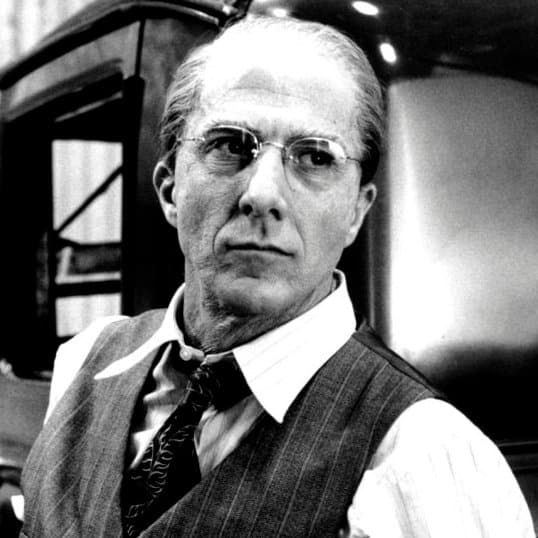
Quick sketch of Dustin Hoffman as Willy Loman. I got the head tilt right for once, but I seem to have exaggerated the size of the forehead with respect to the rest of the face, and perhaps widened the mouth / nose area, taking away from Hoffman's distinctive look. But it's late and I'm tired, so I rushed it.
Drawing every day.
-the Centaur
Pride. One of the "Seven Deadly Sins." Overweening confidence in one's accomplishments. Sooner or later, if you study Christian thought, you'll come across the idea that pride is one of the worst sins that you can fall into. I'd put self-righteousness over that, but, hey, the two go together.
Another common idea in Christian thought is the difference between Christian values - "the Kingdom" - and values in our society - "the World". We encounter this every year when Christians engage in performative lying about "the War on Christmas" every time someone says "Happy Holidays."
But the difference in the Kingdom and the World is important, even though hyped-up Christians imagine differences which are not there - for example, some say "Happy Holidays" just to change it up, or say "Holiday Party" because (a) the office party isn't on Christmas and (b) people of other faiths attend.
The difference is important because our society, while it might be a vast, distributed artificial intelligence of sorts, itself isn't a rational agent which follows God's will. That's up to us, as individual humans, and as we've talked about earlier in this series, us finite beings are always prone to messing it up.
So we're constantly called to rise above what our society does by default - to turn away from the values of the World, which develop through their own inertia - and to consciously choose to follow Jesus, exhibiting the kind of values He would exhibit if He were here among us.
On that note, one might imagine that Jesus wouldn't have been too wound up over whether the office end-of-year celebration was called a Christmas Party or a Holiday Party, but He might take offense at stripping Christ out of a personal Christmas Party, or - "You're celebrating my birthday in December?"
Another difference between the Kingdom and the World is the focus on self-actualization and pride in one's accomplishments. A lot of Christianity depends on overcoming our own worst impulses, which seems precisely opposite to our modern culture's increasing focus on self-acceptance.
These are not as incompatible as they seem. The world has engaged in spectacular, mind-numbing repression on a vast scale - most noticeable in totalitarian cultures, where even the language gets edited to reflect political authority - but down to the massive but almost invisible conformity forced upon us.
One of the arguments in Arthur Miller's Death of a Salesman is "You don't raise a guy to a responsible job who whistles in the elevator!", with one character getting fired over it. I and my father, a generation and a half apart, argued over this, and he said he'd reprimand a man who did that.
My father was a great man, and he built a great business, but I'm working in a great business too, and it's filled with responsible people doing excellent jobs who've named themselves after flowers, and once I saw a very serious presentation by a very serious person wearing a Pokemon onesie.
I could go on a riff here about how we've moved past the strict IBM business culture of the 1950's and discovered that most of those surface features don't matter for doing excellent work - they were holdovers from the Victorian era, perpetuated by anal-retentive power freaks. And I'd be right.
But something has entered here, subtly, trying not to get noticed: pride. Because being right about the job part misses the real point to be made: Whether someone should get reprimanded or not, whistling in an elevator makes a lot of noise in an enclosed space. It's arguably rude and shows little self-control.
But it's hard to be open to that point if you're only seeing your own side of the argument, which may be correct, but not complete. Recently, in a virtual meeting where I'm sure at least one person was wearing a funny hat, we had an argument over whether we should support one or two pieces of software.
A very senior executive argued we should push for one; I argued to keep two (or more broadly, as many as were needed). But the executive didn't stomp on my point; in the chat for the meeting, they pointed out they agreed for that particular topic, and outlined circumstances why we might choose either path.
They even used math to justify the argument - one of my arguments, simplex math, the notion that software complexity is the square of the size of the product, so if you can support two simple things, that can sometimes be cheaper than supporting one over-complex thing that tries to do it all.
We both learned something in that meeting, because we were both open to hear it. But if either of us had been caught up in the pride of our points, that understanding would not have been possible. And the executive would have won by default, since he'd accomplished way more than me.
Some Christians take it that all pride is bad. Sometimes it even gets capitalized, like Pride, and gets a corner office. That's useful: I distinguish between the English word "pride" - being rightfully happy we accomplished something - from Pride, in the sense of excess egotism about ourselves.
C. S. Lewis once said that if a Christian was the best in the world at something, he should honestly and sincerely acknowledge it - and then forget about it, as he moves on to the work to be done for the day. And that part of the Christian journey is constantly tamping down these self-aggrandizing impulses.
I think Pride does more than lead us down the wrong path. It leads us into a state of self-absorption, where we are so convinced of our own accomplishments - and maybe we have some - and of our own rightness - and maybe we are - that we can't see the accomplishments or rightness of others.
Christians say God is infinitely good. Constructivist mathematicians say there's really no such thing as "infinite", only series which expand without limit. There's no infinite number, just a number one larger than any number choose. In the same way, no matter how good we are, there's always a way to improve.
Pride isn't just placing our will over God's. Pride internalizes our accomplishments and so aggrandizes our selves. Furthermore, it's a particularly hard sin to overcome as that self-aggrandizement serves as a blinder to information that might contradict that inflated self-assessment.
Pride isn't just a sin. It's a distraction from turning towards the right path.
Fortunately, Jesus is always there for us to follow.
-the Centaur
Pictured: Dustin Hoffman as Willy Loman from Death of a Salesman.
Drawn from a small centaur statue I have in the genre toys / reference objects collection on my drawing desk. Didn't come out too bad, and the perspective and angle were an interesting challenge.
Drawing every day.
-the Centaur
One of the things I find about Christian media is that even a bad essay, story or movie is likely to have a kernel of truth in it. Not that Christian media can't be badly done or bad theology - far from it - but it's almost like, perhaps, the inspiration of the truth is likely to shine through into the text.
People who publish Christian literature encounter this all the time: many people who submit their writing feel that it is divinely inspired, down to the last word and letter, but the truth is, whether the authors are inspired or not, their texts are often filled with typos and bad grammar, or simply need development.
But there's still likely to be good stuff in there. In an earlier essay I mentioned The Last Temptation of Christ, which does a better job of anything I've seen of humanizing the struggle of Jesus, who was both divine and man. And that includes The Passion, described by Pope John Paul II as "it is as it was."
But The Last Temptation also has the character of Jesus uttering his "break the cycle of evil" speech to Judas, which is the best justification for "turn the other cheek" that I've seen, as well as a revisionist interpretation of Judas as the super-apostle whose betrayal of Jesus helped fulfill Jesus's mission.
That interpretation certainly isn't biblical, but in the context of the story, having two characters on opposite poles - Jesus, the uncertain Messiah, Judas, the certain Zealot - enabled the filmmakers to explore the heart of Jesus's teachings and his sacrifice in a very personal way.
Another example is The Passion, which feels like a live re-enactment of the Stations of the Cross. But knowing that the hand shown hammering the nails into Jesus's flesh is Mel Gibson's hand, the director, intended as a stand-in for all of us, reminds us of the purpose of Jesus's sacrifice for our sins.
Another such movie is Prince Caspian. I prefer The Lion, the Witch and the Wardrobe as a movie, but even though I liked it, the betrayal, sacrifice and resurrection depicted in that book or movie always struck me as a bit forced - C. S. Lewis being a bit too blatant about the allegory he wanted to convey.
The Chronicles of Narnia: Prince Caspian, has a similar flaw when one character says "Things never happen the same way twice," which might be news to the author of Ecclesiastes 1:9: "What has been will be again, what has been done will be done again; there is nothing new under the sun."
That was a transparent excuse for C. S. Lewis to write himself out of the plot hole where he'd created the same setup for a battle as the previous book but wanted it to be resolved a different way. From a craft perspective, the correct approach is to re-arrange the book's events to create a different climax.
But despite these flaws, the movie - I don't remember if this is in the book - has the brilliant line, "Exactly who are you doing this for, Peter?" when Peter makes a bad choice out of self-aggrandizement. Again, I felt like this was heavy handed - but it made an important point.
In Christian theology, God created the universe; God is infinitely good; and ultimately doing God's will, not our own, is the difference between doing good and falling into sin. Doing God's will doesn't mean you can't go get a drink of water when you're thirsty, but it does mean you need to think about your purpose.
We take on many projects in our lives - for me, building a robotic navigation stack, or working on a 21-book novel series, or completing a webcomic - or working on a Lenten series explaining my theology in terms that might possibly make sense to other human beings who don't live inside my head.
But these things are not God's will by themselves. Not that they can't be consistent with God's will - I use projects that have a religious nature, be it service on the church Vestry, writing a Lenten series, or writing books religious characters - as a way to expose me to and hopefully draw me to God.
But consistent with is not equal to. Take the Dakota Frost, Skindancer novel series, on the surface about a magical tattooist, but also about a Christian in a world of monsters and magic. I've learned a lot from the situations I put Dakota through, and developed my own ideas of radical forgiveness from that.
But finishing those 21 books - I've got 3 published, and 4 more written, with drafts going far out - is just a temporal task in this world. Even if it is a good work, that's not going to get you into heaven, and if you're doing a good work for a wrong reason, it will rapidly go bad on its own.
So "Who are you doing this for?" is a key question we should ask ourselves. Are the things we have committed to things that we're committed to for the right reasons? Because, no matter how far down the path we have gone, if it is the wrong path, Jesus will be waiting there to show us the right way.
-the Centaur
Pictured: A random centaur, because there are centaurs in Narnia.
Suuuper quick sketch of Gene Robinson, done by tracing over my own ink roughs.
As for the analysis, eyes off a bit, yeah, whatever, it's time for bed.
Drawing every day.
-the Centaur
So! The Catholic Church recently refused to bless gay unions on the excuse that "God can't bless sin." No big shock, if you've been following the development of Catholic theology over the last, say, 2000 years - which, of course, is an explanation, not an excuse; the decision was still wrong.
And it's wrong, from a Christian perspective, despite the Bible's condemnations of homosexuality. As Christians, we're obligated not just to read the Bible and take it out of context to support our social taboos, but to look at the traditions of the Church - and the findings of rationality.
In the case of homosexuality, reason speaks quite strongly: on the one hand, homosexual orientation appears to be very likely innate and is highly resistant to change; on the other, fundamental judgments on relations between individuals should be based on consent, respect, and mutual benefit.
This sounds very modern and utilitarian, and maybe it is, but it's derived from an understanding of the Christian faith as a Catholic faith, applicable to everyone, and from an understanding of morals as being derived from what is good for all the individuals involved - maybe all is lawful, but not all is expedient.
That last bit is important. While we've come to understand we need to treat all individuals with respect, and that just because a relationship fits traditional social norms doesn't mean it is healthy - sin exists in heterosexual relationships in the form of abuse - we shouldn't throw the baby out with the bathwater.
On the principle that things are not good because they are in the law, but they are in the law because they are good, many scholars think that Old Testament prohibitions against eating certain foods and injunctions to be clean were designed to prevent food poisoning.
In the same way, Old Testament prohibitions against sexual immorality reduced the spread of venereal disease and discouraged children being born outside of stable homes - which is why the Catholic Church's opposition to contraception is, in many ways, precisely backwards.
Speaking as a bisexual man, I'm glad that our modern model of sexual relations shows greater respect for each individual human being's sexual expression than the one expressed in the Old Testament, but I can't help but wonder whether those prohibitions were a crude hammer to stamp out a disease vector.
Our bodies are designed to work in certain ways by evolution; our human minds can hack this to enable two people with differently wired lovemaps to have fulfilling relationships. But doing that was harder, and more error-prone, in the days prior to modern medicine and modern contraception.
More generally, whenever we try a new way of doing things - be it as simple and uncontroversial as a new way of cutting bread, or as complicated as trying to provide adequate medical, social and relationship support to individuals with gender dysphoria - it takes time to get it right.
And religion hangs on to traditional 'truths'. That's what it does. That's what it's for. So it doesn't surprise me that the Catholic Church isn't quite ready to bless gay unions. Even though Pope Francis doesn't believe he should be judging gay people, actually blessing their unions would be a big change.
It reminds me of the controversy over the Episcopal Church's first gay bishop, Gene Robinson. This rocked the Episcopal Church in a split known as the Anglican Realignment. While the main Episcopal Church has continued in love and continues to bring people to Christ, at the time, however ...
One of my churches in Greenville considered splitting off. Most churches I attended discussed it. At one such meeting, my opinion was asked. And as you might expect, my opinion ain't that simple. Because a Bishop not just a priest with a funny hat - they're held to a higher standard.
Bishops are successors of the Apostles. They're expected to lead a faith community. And in 1 Timothy 3:2, Paul lays out a list of qualifications: "A bishop then must be blameless, the husband of one wife, vigilant, sober, of good behavior, given to hospitality, apt to teach; not given to wine, no striker ..."
The list goes on. It's all good stuff, suggesting that bishops should be people of morally upstanding character. And so what's the problem with making a gay man a bishop? Not, to me, the traditional prohibitions against homosexuality ... but that the Church hadn't figured out how to marry them yet.
Not that a bishop had to be married, of course, but at the time, gay people who wanted healthy fulfilling relationships had to go outside the relationship forms blessed by the Church. So consecrating a gay man at the time meant asking someone to take a vow which conflicted with their committed relationship.
I said as much to the priest I was talking to: that bishops were supposed to uphold higher standards of behavior, and if we wanted to elect a gay bishop who was in a committed relationship, we should develop an understanding which supported marriage rites for gay people and make sure the relationships work.
"So I'd wait until we'd worked out rites for gay marriage before electing a gay married bishop," I said ...a and then blurted, in a sudden flash of inspiration: "But Jesus wouldn't wait, of course. He'd just go ahead and do it, if it was a good thing. So maybe we should just go ahead and do it."
Yes, it makes a lot of sense - if you listen to Paul's very reasonable statements about bishops, if you come from our traditional background which not only didn't have support for homosexual relationships, but which only contained condemnation - to "wait" to "work out all the details."
But Jesus wouldn't wait: if it was good, he'd go ahead and do it. Jesus is the man who'd pull the oxen out of the well on the Sabbath day, who'd help the Samaritan woman despite the local prejudice, who'd tend to the wounded man on the road despite the religious differences.
And so, Jesus is the man who'd bless gay unions, or marry two gay people, or consecrate a gay bishop. Jesus would be completely comfortable doing this, because Jesus would also be completely comfortable calling out any of these people - or their straight counterparts - on bad behavior, asking them to repent.
It isn't the traditional forms of our society that determine whether a relationship is good or bad: it's our decision to follow Jesus, to turn to the good, and our recognition that, in the Catholic faith, we must treat each person with respect, to love them as we would be loved.
If an union is homosexual, and is a healthy source of strength and joy between two committed partners, then it's a good thing, and God can bless it. If an union is heterosexual, but is a diseased source of conflict between abused partners, then it isn't a good thing, and God is not likely to bless it.
Though Jesus will always be there, ready to point towards a better way.
He's just not going to wait for the rest of us to get started.
As it says on the tin: it's late and I'm tired, so here's a quick sketch with a big honking Sharpie on 9x12 Strathmore, no roughs whatsoever. Roughs would have helped correct a few errors of outline and proportion - I didn't quite get the roundness of gabby there on the left - but real roughs would have taken longer than 10-15 minutes, and I'd have been up to 3AM again when trying to get to bed early.
Drawing every day.
-the Centaur
Yeah, so that happened on my attempt to get some rest on my Sabbath day.
I'm not going to cite the book - I'm going to do the author the courtesy of re-reading the relevant passages to make sure I'm not misconstruing them, but I'm not going to wait to blog my reaction - but what caused me to throw this book, an analysis of the flaws of the scientific method, was this bit:
Imagine an experiment with two possible outcomes: the new theory (cough EINSTEIN) and the old one (cough NEWTON). Three instruments are set up. Two report numbers consistent with the new theory; the third one, missing parts, possibly configured improperly and producing noisy data, matches the old.
Wow! News flash: any responsible working scientist would say these results favored the new theory. In fact, if they were really experienced, they might have even thrown out the third instrument entirely - I've learned, based on red herrings from bad readings, that it's better not to look too closely at bad data.
What did the author say, however? Words to the effect: "The scientists ignored the results from the third instrument which disproved their theory and supported the original, and instead, pushing their agenda, wrote a paper claiming that the results of the experiment supported their idea."
Pushing an agenda? Wait, let me get this straight, Chester Chucklewhaite: we should throw out two results from well-functioning instruments that support theory A in favor of one result from an obviously messed-up instrument that support theory B - oh, hell, you're a relativity doubter, aren't you?
Chuck-toss.
I'll go back to this later, after I've read a few more sections of E. T. Jaynes's Probability Theory: The Logic of Science as an antidote.
-the Centaur
P. S. I am not saying relativity is right or wrong, friend. I'm saying the responsible interpretation of those experimental results as described would be precisely the interpretation those scientists put forward - though, in all fairness to the author of this book, the scientist involved appears to have been a super jerk.
As it says on the tin. I know this is riffing off some of my earlier titles, but even though I have a lot of work to do for the move, I made a deliberate effort to build the rocking chair and outdoor end tables I'd bought a week or so back, hose and mop off the courtyard porch, set them up, and chill out with a few books prior to dinner. It was only twenty minutes of "rest", but it sure did feel good.
Almost like there is something to this "the Sabbath was made for Man" idea.
-the Centaur
Pictured: A quick illustration. Nothing special. Illustrator remains harder to use than Photoshop.
Sharpie sketch of the Apostle Paul, interpolated from the earliest descriptions and paintings we have on record: "A man of middling size, and his hair was scanty, and his legs were a little crooked, and his knees were far apart; he had large eyes, and his eyebrows met, and his nose was somewhat long.” The joined eyebrow is from the description, but the pointy beard, sideburns and clothes come from these:
Drawing every day.
-the Centaur
The Old Testament is filled with rules and regulations - reams of them scattered through Exodus, Leviticus, and Numbers, and then fleshed out further in Deuteronomy. And Jesus said that He didn't come to abolish the law and the prophets, but to fulfill them.
But not so fast. Even though Jesus said in the Sermon on the Mount that nothing would be struck from the the law until "all was accomplished," elsewhere, He said the law and the prophets were proclaimed - past tense - until John, and since then the Gospel has been proclaimed, and everyone's trying to get in.
What's this mean? And how do we fit this in with the fact that Jesus reinterpreted the law all the time? The key comes from this comment by the Apostle Paul: "All things are lawful unto me, but all things are not expedient: all things are lawful for me, but I will not be brought under the power of any."
This phrase is part of a longer explanation by Paul of principles that Jesus demonstrates by example. Both Paul's arguments in Corinthians, and Jesus's frequent rebuttals of the Pharisees, both reject strict applications of the law in favor of appeals to focus on what's good for everyone involved.
I've argued before that Jesus's approach to the law is surprisingly modern and scientific, focusing not on whether someone is strictly obedient to the letter of the law but instead on what various acts do to people. Food passes through the body, and so doesn't make us unclean; but bad thoughts do.
Paul's approach is similar, suggesting that believers resolve disputes not with lawsuits but by arbitration by fellow Christians, and that people who are hurting themselves or others with greed, theft, idolatry, lust, or betrayal are committing sins against their own bodies, which should be sanctified for God.
While both Paul and Jesus condemn various behaviors, we shouldn't take those as an exhaustive list. That's the whole point of the passages: just because something isn't listed on that list doesn't make it right, and conversely, treating Paul or Jesus's examples as Pharisaical commands misses the point.
In Catholic theology, this kind of thinking is called having a "scrupulous conscience" - taking the law as a very literal set of rules which we should follow to the letter, like a roleplayer in a D&D game trying to argue with the gamemaster about whether a given spell would or would not slay a crystal dragon.
But what's printed in the rules of D&D - no matter how specific, regardless of edition - takes second place to what the gamemaster wants to run in his campaign. Similarly, Jesus and Paul want us to develop our own moral imagination, so we can decide, as Jesus did, that it's okay to rescue an ox on the Sabbath.
To unpack this, the laws of the Old Testament are ceremonial, civil and moral. Ceremonial law had to do with Israel's worship, which Christians think pointed ahead to Jesus's coming, became obsolete with his Resurrection, and were arguably - though disputedly - set aside in the Incident at Antioch.
The civil laws of the Old Testament, like the declaration of a jubilee year or the rules for managing slaves, had to do with a society which is very different from the one we have today, and even though they're described as being eternal laws, few Christians think we should apply them all strictly.
Moral laws, like the Ten Commandments and the Great Commandment (which is normally associated with Jesus, but is also present in the Old Testament) retain their force. Not coveting, lying, cheating, stealing, or murdering remain as problematic for us today as they were back in the day.
Jesus's ministry, especially the Sermons of the Mount and the Plain, both adds to and takes away from our understanding of these Old Testament laws. He reinforces some old laws, reinterprets laws like divorce, and provides new examples that set a higher standard.
And yet, He still says the law wasn't going to pass away until everything is fulfilled - a fulfillment which many people take to mean His Resurrection. But I think there's more to it than that. Jesus was God, and taught with authority, so for him to emphasize the law, even as he went beyond it, meant something.
Paul again provides us the key. Perhaps it is true that all things are lawful now, but not everything's good for us. And on the principle that things are not good because the law says so, but that the law says so because things are good for us - we should study the law and use it to guide our understanding.
Yes, we no longer celebrate a jubilee year. Yes, the Jewish dietary restrictions are no longer relevant. Yes, the Biblical attitude to homosexuality is grounded in the prejudices of the cultures at the time, and shows neither a correct understanding of human sexuality nor a Christian respect for individual persons.
But it's worth understanding why these were laws in the first place. It's worthwhile to consider canceling debts. It's worthwhile to consider whether our diets are healthy. It's worthwhile to consider our expression of our sexuality and ask whether it is building up our tearing down our lives and the lives of our partners.
All things may be lawful in the Christian faith if the most important point of Christianity is believing in Jesus and choosing to follow Him - but that can be a difficult path, so it's worth reviewing our lives and asking whether we're making it easy to follow Him, or throwing stumbling blocks down for ourselves.
-the Centaur
Pictured: the Apostle Paul, interpolated from three early paintings and the only physical description of him that I know of: of middling size, with scanty hair, large eyes, a long nose, and eyebrows that met.
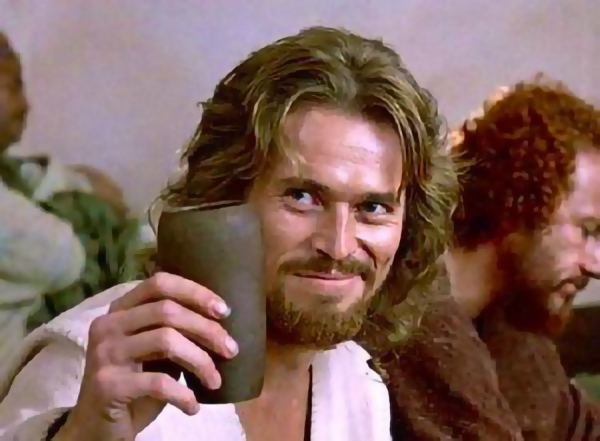
Suuuuper quick sketch of Willem Dafoe in The Last Temptation of Christ, done with a big honking Sharpie. My first failed drawing on Strathmore 9x12 served as a basis for a quick resketch on 9x12 tracing paper, again with the Sharpie - it has such a crystallizing effect on your drawing, as those huge darn lines cannot be taken back and you just gotta GO with it. Not altogether bad for 10 minutes, though that darn "head de-tiltification" thing is still working against me:
Drawing every day.
-the Centaur

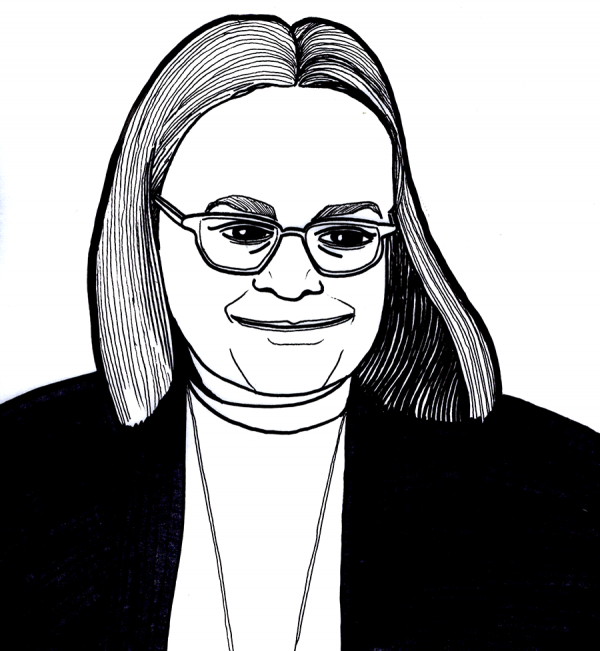 A quick sketch of Bishop Lucinda Ashby, done by roughing in ink and then tracing over my own roughs. I'm not going to share the source image - it was from a Zoom call, and I don't have permission to share - but comparing to a published picture of Lucinda, it's clear I dented her face a little bit. :-(
 Ah, well. Sorry, Rev. Lucinda. Still ... drawing every day.
-the Centaur
Ah, well. Sorry, Rev. Lucinda. Still ... drawing every day.
-the Centaur 
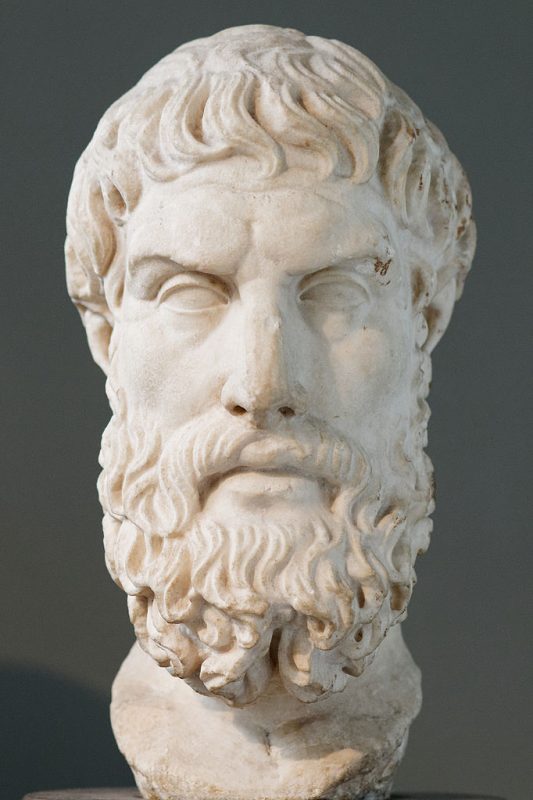
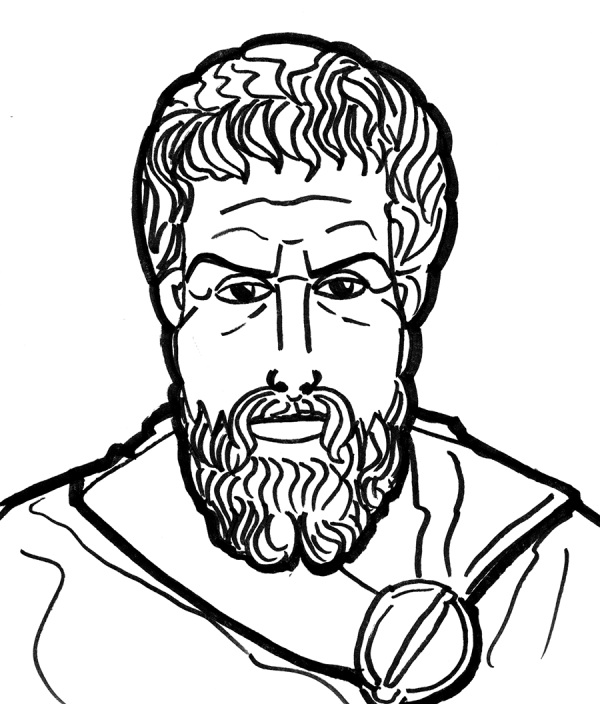 A no-regrets Sharpie sketch of Epicurus, from the following bust, allegedly of Epicurus.
 Drawing every day.
-the Centaur
Drawing every day.
-the Centaur 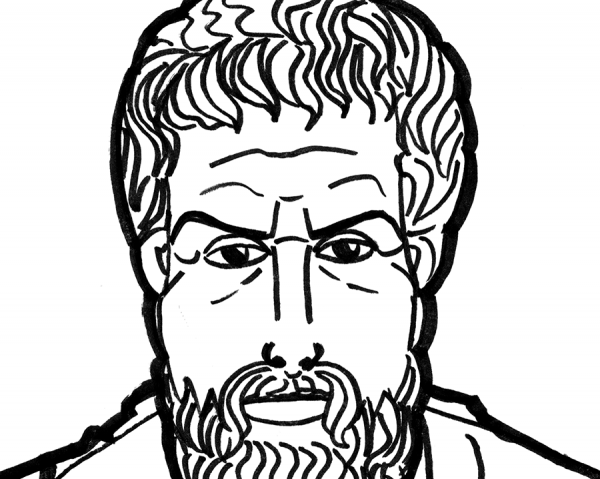
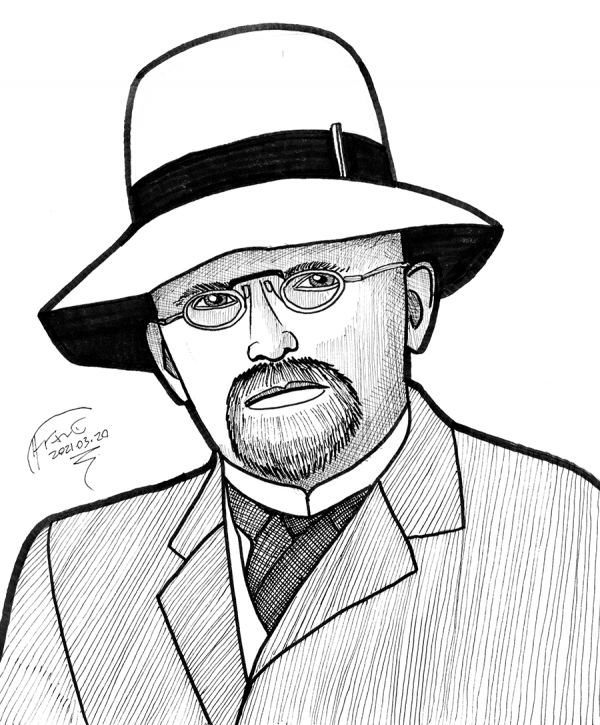 Semi-quick sketch of David Hilbert. Face is a bit squnched to one side, and I could have put in more work on the wrinkles. But frankly, the original picture is dark enough under that hat that it's hard to interpret, and it's late and I'm tired, so I just went with it instead. More tomorrow.
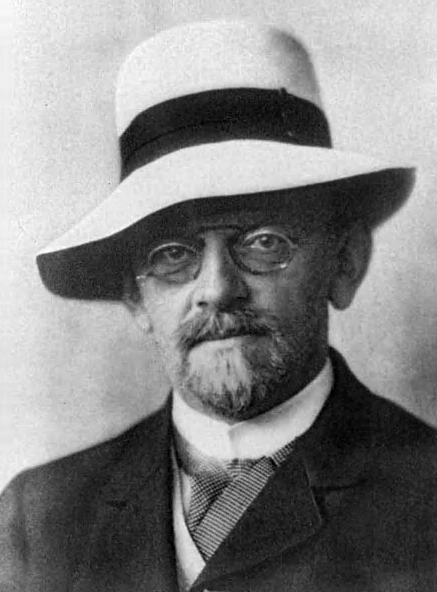

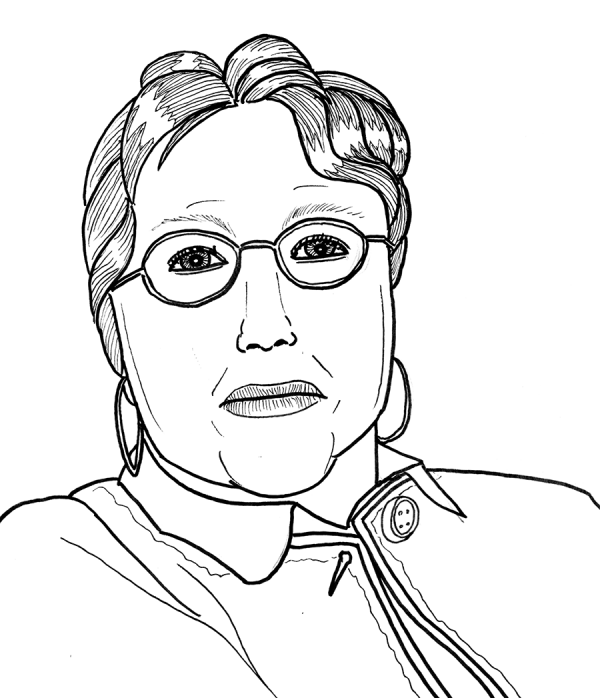 Quick sketch of Susan Francis. The head angle ain't bad, and the eyes aren't as oversized, but I'm still doing something wrong with the overall face landscape. Perhaps time to return to drawing the roughs upside down, or perhaps a few tracing exercises to help tune my perception of face feature sizes. Oh, and also, I think her hair got dented in the upper right, now that I look at it one more time. This was just a misstep of that particular hair feature - I intended it to go further out, but just gaffed it.
 Drawing every day.
-the Centaur
Drawing every day.
-the Centaur 
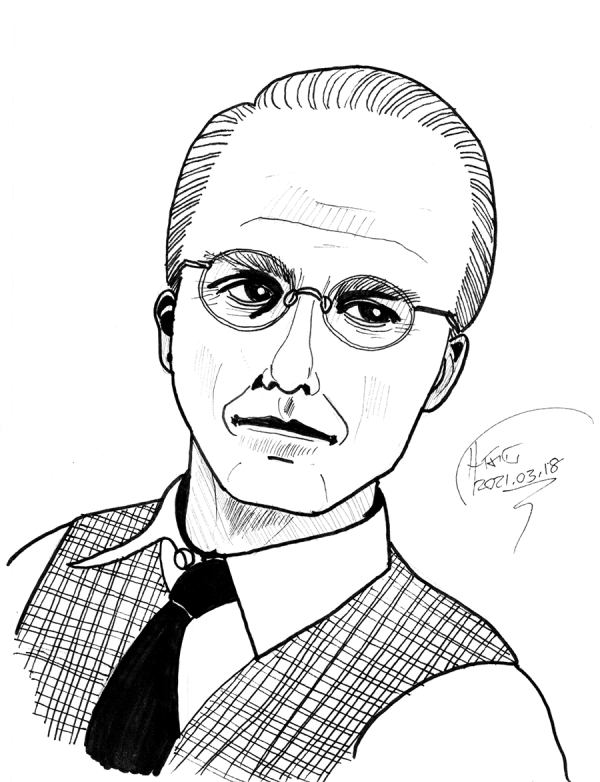 Quick sketch of Dustin Hoffman as Willy Loman. I got the head tilt right for once, but I seem to have exaggerated the size of the forehead with respect to the rest of the face, and perhaps widened the mouth / nose area, taking away from Hoffman's distinctive look. But it's late and I'm tired, so I rushed it.
 Drawing every day.
-the Centaur
Drawing every day.
-the Centaur 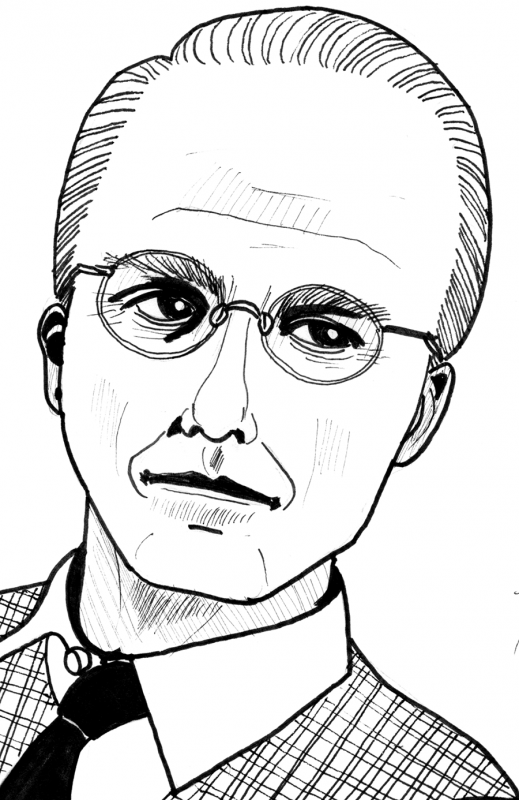
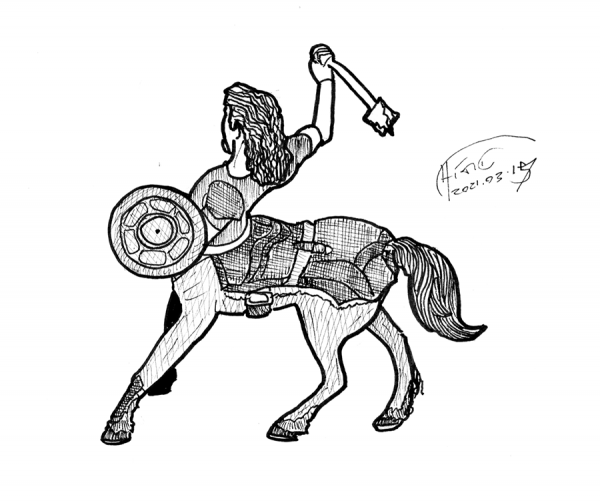 Drawn from a small centaur statue I have in the genre toys / reference objects collection on my drawing desk. Didn't come out too bad, and the perspective and angle were an interesting challenge.
 Drawing every day.
-the Centaur
Drawing every day.
-the Centaur 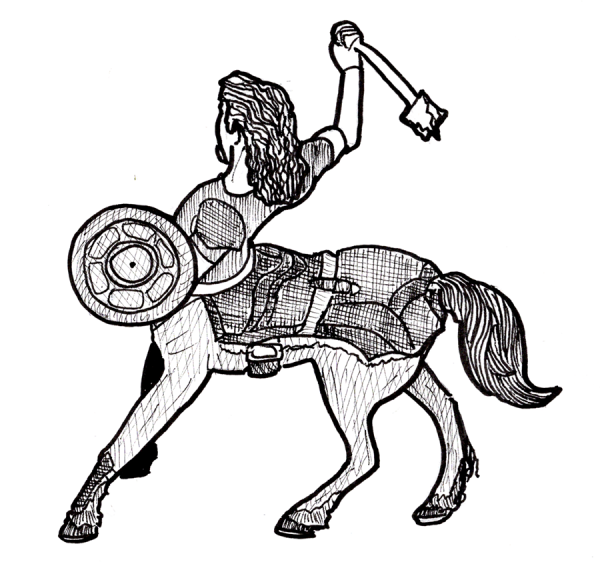
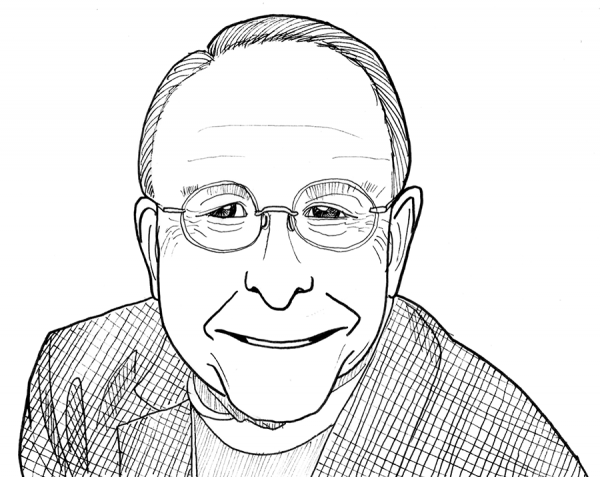 Suuuper quick sketch of Gene Robinson, done by tracing over my own ink roughs.
 As for the analysis, eyes off a bit, yeah, whatever, it's time for bed.
Drawing every day.
-the Centaur
As for the analysis, eyes off a bit, yeah, whatever, it's time for bed.
Drawing every day.
-the Centaur 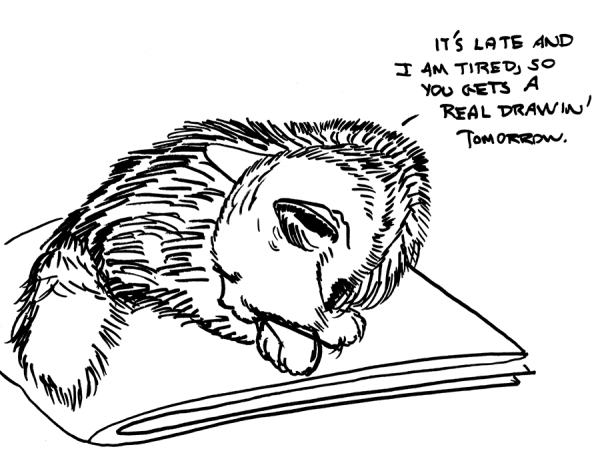 As it says on the tin: it's late and I'm tired, so here's a quick sketch with a big honking Sharpie on 9x12 Strathmore, no roughs whatsoever. Roughs would have helped correct a few errors of outline and proportion - I didn't quite get the roundness of gabby there on the left - but real roughs would have taken longer than 10-15 minutes, and I'd have been up to 3AM again when trying to get to bed early.
 Drawing every day.
-the Centaur
Drawing every day.
-the Centaur  Yeah, so that happened on my attempt to get some rest on my Sabbath day.
I'm not going to cite the book - I'm going to do the author the courtesy of re-reading the relevant passages to make sure I'm not misconstruing them, but I'm not going to wait to blog my reaction - but what caused me to throw this book, an analysis of the flaws of the scientific method, was this bit:
Imagine an experiment with two possible outcomes: the new theory (cough EINSTEIN) and the old one (cough NEWTON). Three instruments are set up. Two report numbers consistent with the new theory; the third one, missing parts, possibly configured improperly and producing noisy data, matches the old.
Wow! News flash: any responsible working scientist would say these results favored the new theory. In fact, if they were really experienced, they might have even thrown out the third instrument entirely - I've learned, based on red herrings from bad readings, that it's better not to look too closely at bad data.
What did the author say, however? Words to the effect: "The scientists ignored the results from the third instrument which disproved their theory and supported the original, and instead, pushing their agenda, wrote a paper claiming that the results of the experiment supported their idea."
Pushing an agenda? Wait, let me get this straight, Chester Chucklewhaite: we should throw out two results from well-functioning instruments that support theory A in favor of one result from an obviously messed-up instrument that support theory B - oh, hell, you're a relativity doubter, aren't you?
Chuck-toss.
I'll go back to this later, after I've read a few more sections of E. T. Jaynes's Probability Theory: The Logic of Science as an antidote.
-the Centaur
P. S. I am not saying relativity is right or wrong, friend. I'm saying the responsible interpretation of those experimental results as described would be precisely the interpretation those scientists put forward - though, in all fairness to the author of this book, the scientist involved appears to have been a super jerk.
Yeah, so that happened on my attempt to get some rest on my Sabbath day.
I'm not going to cite the book - I'm going to do the author the courtesy of re-reading the relevant passages to make sure I'm not misconstruing them, but I'm not going to wait to blog my reaction - but what caused me to throw this book, an analysis of the flaws of the scientific method, was this bit:
Imagine an experiment with two possible outcomes: the new theory (cough EINSTEIN) and the old one (cough NEWTON). Three instruments are set up. Two report numbers consistent with the new theory; the third one, missing parts, possibly configured improperly and producing noisy data, matches the old.
Wow! News flash: any responsible working scientist would say these results favored the new theory. In fact, if they were really experienced, they might have even thrown out the third instrument entirely - I've learned, based on red herrings from bad readings, that it's better not to look too closely at bad data.
What did the author say, however? Words to the effect: "The scientists ignored the results from the third instrument which disproved their theory and supported the original, and instead, pushing their agenda, wrote a paper claiming that the results of the experiment supported their idea."
Pushing an agenda? Wait, let me get this straight, Chester Chucklewhaite: we should throw out two results from well-functioning instruments that support theory A in favor of one result from an obviously messed-up instrument that support theory B - oh, hell, you're a relativity doubter, aren't you?
Chuck-toss.
I'll go back to this later, after I've read a few more sections of E. T. Jaynes's Probability Theory: The Logic of Science as an antidote.
-the Centaur
P. S. I am not saying relativity is right or wrong, friend. I'm saying the responsible interpretation of those experimental results as described would be precisely the interpretation those scientists put forward - though, in all fairness to the author of this book, the scientist involved appears to have been a super jerk.
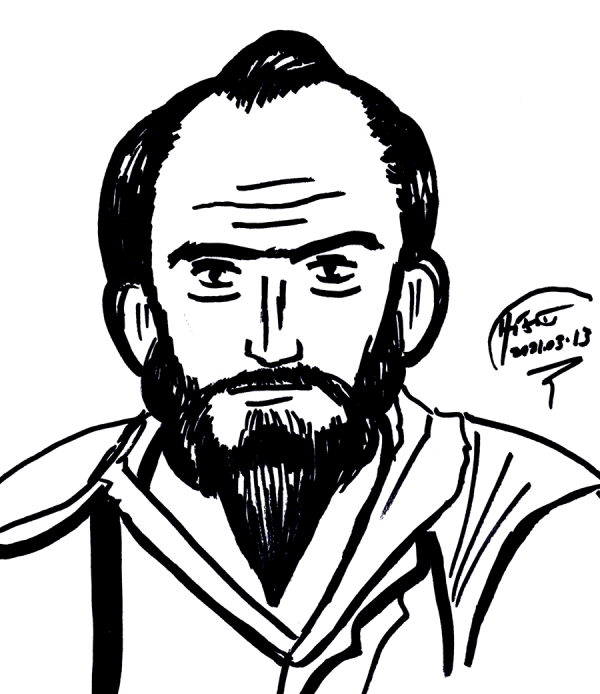 Sharpie sketch of the Apostle Paul, interpolated from the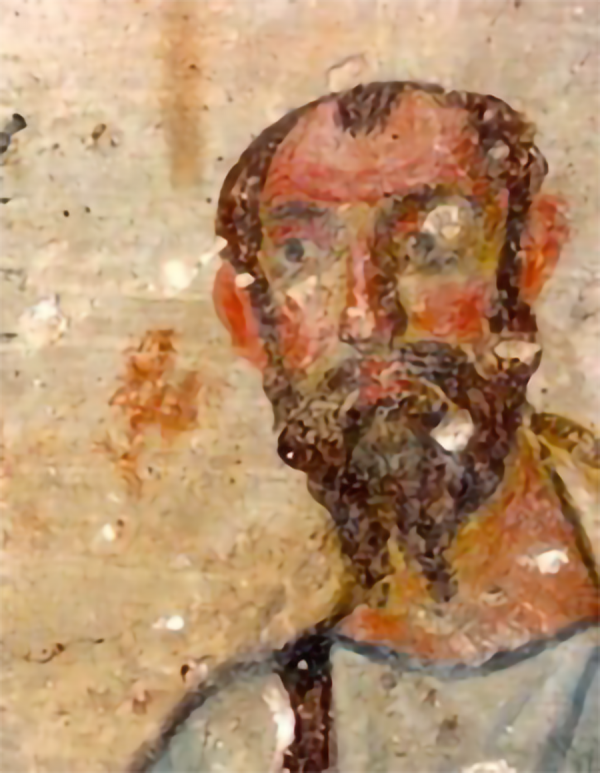
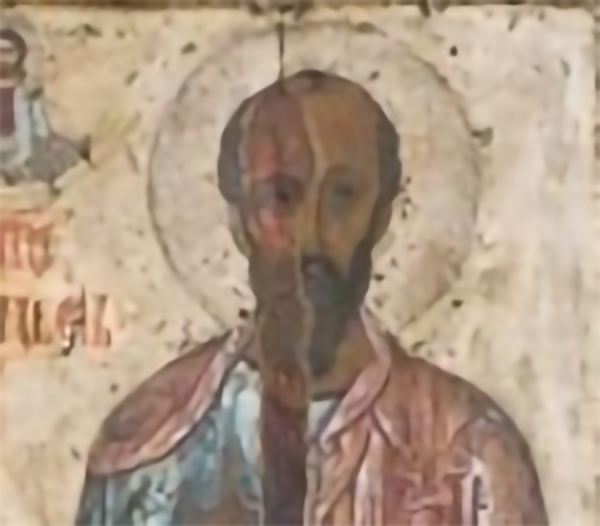
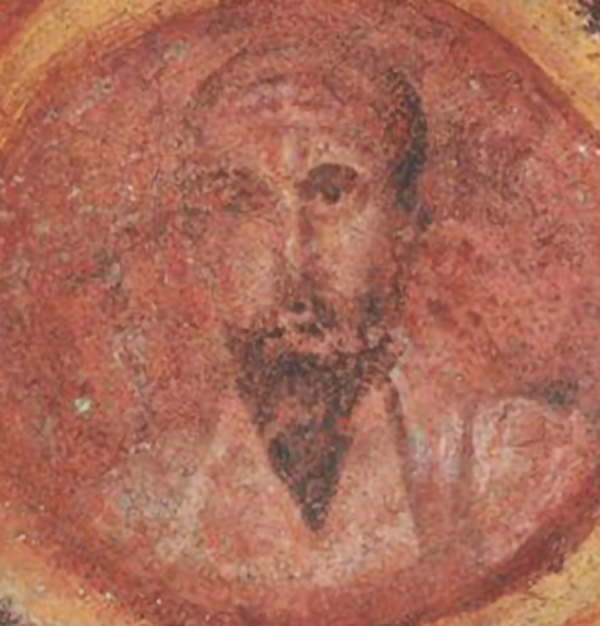 Drawing every day.
-the Centaur
Drawing every day.
-the Centaur 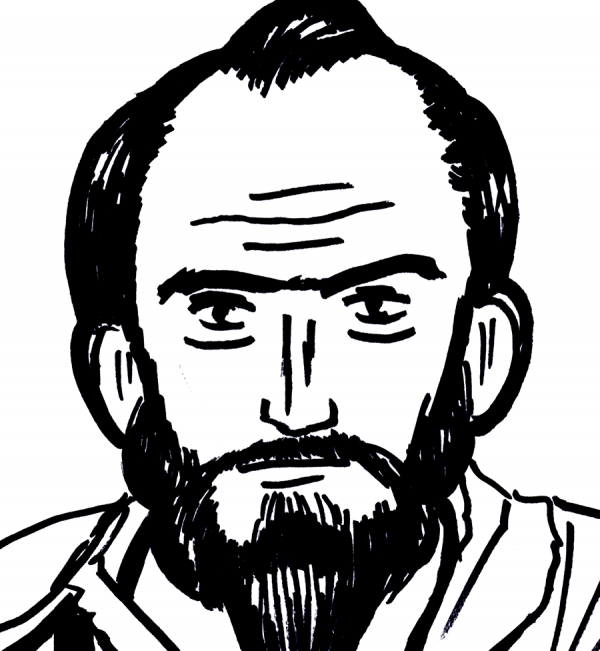 The Old Testament is filled with rules and regulations - reams of them scattered through Exodus, Leviticus, and Numbers, and then fleshed out further in Deuteronomy. And Jesus said that He didn't come to abolish the law and the prophets, but to fulfill them.
But not so fast. Even though Jesus said in the Sermon on the Mount that nothing would be struck from the the law until "all was accomplished," elsewhere, He said the law and the prophets were proclaimed - past tense - until John, and since then the Gospel has been proclaimed, and everyone's trying to get in.
What's this mean? And how do we fit this in with the fact that Jesus reinterpreted the law all the time? The key comes from this comment by the Apostle Paul: "All things are lawful unto me, but all things are not expedient: all things are lawful for me, but I will not be brought under the power of any."
This phrase is part of a longer explanation by Paul of principles that Jesus demonstrates by example. Both Paul's arguments in Corinthians, and Jesus's frequent rebuttals of the Pharisees, both reject strict applications of the law in favor of appeals to focus on what's good for everyone involved.
I've argued before that Jesus's approach to the law is surprisingly modern and scientific, focusing not on whether someone is strictly obedient to the letter of the law but instead on what various acts do to people. Food passes through the body, and so doesn't make us unclean; but bad thoughts do.
Paul's approach is similar, suggesting that believers resolve disputes not with lawsuits but by arbitration by fellow Christians, and that people who are hurting themselves or others with greed, theft, idolatry, lust, or betrayal are committing sins against their own bodies, which should be sanctified for God.
While both Paul and Jesus condemn various behaviors, we shouldn't take those as an exhaustive list. That's the whole point of the passages: just because something isn't listed on that list doesn't make it right, and conversely, treating Paul or Jesus's examples as Pharisaical commands misses the point.
In Catholic theology, this kind of thinking is called having a "scrupulous conscience" - taking the law as a very literal set of rules which we should follow to the letter, like a roleplayer in a D&D game trying to argue with the gamemaster about whether a given spell would or would not slay a crystal dragon.
But what's printed in the rules of D&D - no matter how specific, regardless of edition - takes second place to what the gamemaster wants to run in his campaign. Similarly, Jesus and Paul want us to develop our own moral imagination, so we can decide, as Jesus did, that it's okay to rescue an ox on the Sabbath.
To unpack this, the laws of the Old Testament are ceremonial, civil and moral. Ceremonial law had to do with Israel's worship, which Christians think pointed ahead to Jesus's coming, became obsolete with his Resurrection, and were arguably - though disputedly - set aside in the Incident at Antioch.
The civil laws of the Old Testament, like the declaration of a jubilee year or the rules for managing slaves, had to do with a society which is very different from the one we have today, and even though they're described as being eternal laws, few Christians think we should apply them all strictly.
Moral laws, like the Ten Commandments and the Great Commandment (which is normally associated with Jesus, but is also present in the Old Testament) retain their force. Not coveting, lying, cheating, stealing, or murdering remain as problematic for us today as they were back in the day.
Jesus's ministry, especially the Sermons of the Mount and the Plain, both adds to and takes away from our understanding of these Old Testament laws. He reinforces some old laws, reinterprets laws like divorce, and provides new examples that set a higher standard.
And yet, He still says the law wasn't going to pass away until everything is fulfilled - a fulfillment which many people take to mean His Resurrection. But I think there's more to it than that. Jesus was God, and taught with authority, so for him to emphasize the law, even as he went beyond it, meant something.
Paul again provides us the key. Perhaps it is true that all things are lawful now, but not everything's good for us. And on the principle that things are not good because the law says so, but that the law says so because things are good for us - we should study the law and use it to guide our understanding.
Yes, we no longer celebrate a jubilee year. Yes, the Jewish dietary restrictions are no longer relevant. Yes, the Biblical attitude to homosexuality is grounded in the prejudices of the cultures at the time, and shows neither a correct understanding of human sexuality nor a Christian respect for individual persons.
But it's worth understanding why these were laws in the first place. It's worthwhile to consider canceling debts. It's worthwhile to consider whether our diets are healthy. It's worthwhile to consider our expression of our sexuality and ask whether it is building up our tearing down our lives and the lives of our partners.
All things may be lawful in the Christian faith if the most important point of Christianity is believing in Jesus and choosing to follow Him - but that can be a difficult path, so it's worth reviewing our lives and asking whether we're making it easy to follow Him, or throwing stumbling blocks down for ourselves.
-the Centaur
Pictured: the Apostle Paul, interpolated from three early paintings and the only physical description of him that I know of: of middling size, with scanty hair, large eyes, a long nose, and eyebrows that met.
The Old Testament is filled with rules and regulations - reams of them scattered through Exodus, Leviticus, and Numbers, and then fleshed out further in Deuteronomy. And Jesus said that He didn't come to abolish the law and the prophets, but to fulfill them.
But not so fast. Even though Jesus said in the Sermon on the Mount that nothing would be struck from the the law until "all was accomplished," elsewhere, He said the law and the prophets were proclaimed - past tense - until John, and since then the Gospel has been proclaimed, and everyone's trying to get in.
What's this mean? And how do we fit this in with the fact that Jesus reinterpreted the law all the time? The key comes from this comment by the Apostle Paul: "All things are lawful unto me, but all things are not expedient: all things are lawful for me, but I will not be brought under the power of any."
This phrase is part of a longer explanation by Paul of principles that Jesus demonstrates by example. Both Paul's arguments in Corinthians, and Jesus's frequent rebuttals of the Pharisees, both reject strict applications of the law in favor of appeals to focus on what's good for everyone involved.
I've argued before that Jesus's approach to the law is surprisingly modern and scientific, focusing not on whether someone is strictly obedient to the letter of the law but instead on what various acts do to people. Food passes through the body, and so doesn't make us unclean; but bad thoughts do.
Paul's approach is similar, suggesting that believers resolve disputes not with lawsuits but by arbitration by fellow Christians, and that people who are hurting themselves or others with greed, theft, idolatry, lust, or betrayal are committing sins against their own bodies, which should be sanctified for God.
While both Paul and Jesus condemn various behaviors, we shouldn't take those as an exhaustive list. That's the whole point of the passages: just because something isn't listed on that list doesn't make it right, and conversely, treating Paul or Jesus's examples as Pharisaical commands misses the point.
In Catholic theology, this kind of thinking is called having a "scrupulous conscience" - taking the law as a very literal set of rules which we should follow to the letter, like a roleplayer in a D&D game trying to argue with the gamemaster about whether a given spell would or would not slay a crystal dragon.
But what's printed in the rules of D&D - no matter how specific, regardless of edition - takes second place to what the gamemaster wants to run in his campaign. Similarly, Jesus and Paul want us to develop our own moral imagination, so we can decide, as Jesus did, that it's okay to rescue an ox on the Sabbath.
To unpack this, the laws of the Old Testament are ceremonial, civil and moral. Ceremonial law had to do with Israel's worship, which Christians think pointed ahead to Jesus's coming, became obsolete with his Resurrection, and were arguably - though disputedly - set aside in the Incident at Antioch.
The civil laws of the Old Testament, like the declaration of a jubilee year or the rules for managing slaves, had to do with a society which is very different from the one we have today, and even though they're described as being eternal laws, few Christians think we should apply them all strictly.
Moral laws, like the Ten Commandments and the Great Commandment (which is normally associated with Jesus, but is also present in the Old Testament) retain their force. Not coveting, lying, cheating, stealing, or murdering remain as problematic for us today as they were back in the day.
Jesus's ministry, especially the Sermons of the Mount and the Plain, both adds to and takes away from our understanding of these Old Testament laws. He reinforces some old laws, reinterprets laws like divorce, and provides new examples that set a higher standard.
And yet, He still says the law wasn't going to pass away until everything is fulfilled - a fulfillment which many people take to mean His Resurrection. But I think there's more to it than that. Jesus was God, and taught with authority, so for him to emphasize the law, even as he went beyond it, meant something.
Paul again provides us the key. Perhaps it is true that all things are lawful now, but not everything's good for us. And on the principle that things are not good because the law says so, but that the law says so because things are good for us - we should study the law and use it to guide our understanding.
Yes, we no longer celebrate a jubilee year. Yes, the Jewish dietary restrictions are no longer relevant. Yes, the Biblical attitude to homosexuality is grounded in the prejudices of the cultures at the time, and shows neither a correct understanding of human sexuality nor a Christian respect for individual persons.
But it's worth understanding why these were laws in the first place. It's worthwhile to consider canceling debts. It's worthwhile to consider whether our diets are healthy. It's worthwhile to consider our expression of our sexuality and ask whether it is building up our tearing down our lives and the lives of our partners.
All things may be lawful in the Christian faith if the most important point of Christianity is believing in Jesus and choosing to follow Him - but that can be a difficult path, so it's worth reviewing our lives and asking whether we're making it easy to follow Him, or throwing stumbling blocks down for ourselves.
-the Centaur
Pictured: the Apostle Paul, interpolated from three early paintings and the only physical description of him that I know of: of middling size, with scanty hair, large eyes, a long nose, and eyebrows that met. 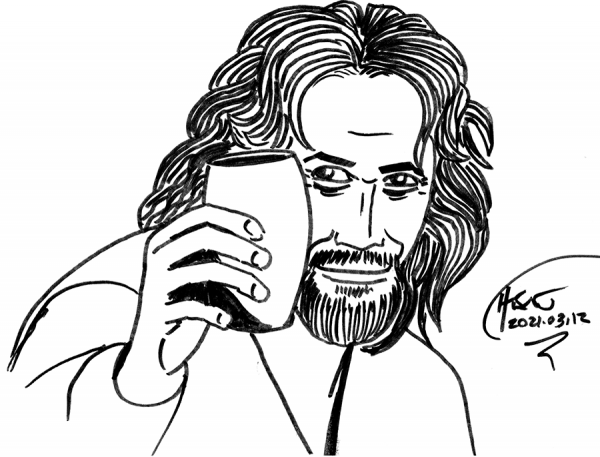 Suuuuper quick sketch of Willem Dafoe in The Last Temptation of Christ, done with a big honking Sharpie. My first failed drawing on Strathmore 9x12 served as a basis for a quick resketch on 9x12 tracing paper, again with the Sharpie - it has such a crystallizing effect on your drawing, as those huge darn lines cannot be taken back and you just gotta GO with it. Not altogether bad for 10 minutes, though that darn "head de-tiltification" thing is still working against me:
 Drawing every day.
-the Centaur
Drawing every day.
-the Centaur