
Can I do it? Oh yeah.
Posts tagged as “Dragon Writers”
~20,000 words behind schedule, 42,000 words to go. Fortunately I'm taking off the entire week of Thanksgiving and hiding in an undisclosed location until I'm caught up. A further taste, of raw unedited text:
Reading it I can already see things I want to fix. Not now. Must press onward.
-the Centaur
“Sooo…” she said, still staring across the aisle. “What brings you to San Francisco?”
“Oh, hell,” I said, leaning back in the chair. I felt the baby in the seat behind me reach at my Mohawk, grabbing a thread of purple before her mother pulled her back. “I’ve got quite the agenda, but mostly … negotiating with people to establish some new rules for magic.”
“Rules for magic?” Granola Girl asked, brow furrowing. “Really?”
“Well, that, some other, uh, business, plus taking my daughter to colleges—”
“Go back to the rules for magic bit,” Granola Girl said—and no, really, I’m not making fun of her; she ordered yogurt-and-granola on the flight out. “Magic isn’t just ‘more than the sum of its parts;’ it transcends the parts that invoke it. You can’t reduce magic to something less than what it is. If you start putting rules on magic—a tabu on mana—you’ll cripple it.”
I let out my breath. I’d heard all this before. Heck, I had to break all the rules I knew just to start practicing magic. But to keep practicing magic, you had to be really careful, or it would kill you. And recently, I’d found that it could kill other people too.
Reading it I can already see things I want to fix. Not now. Must press onward.
-the Centaur
... to have just one more thing off your todo list. Really, I have just about as much to do now as I did before I finished the edits of _Frost Moon_. It's just that I feel much better about what I have left.
Completion. A wonderful feeling.
-the Centaur
Completion. A wonderful feeling.
-the Centaur
That is all. I now resume my regularly scheduled Nanowrimoing.
...the idea you can make something happen if you "prioritize" it works only if you have enough time with which to make the time. Editing two novels and writing a third - all on deadlines, some of them tight - while working late many nights AND taking care of a new and extremely needy cat can lead to you crashing out repeatedly before blogging, and sometimes it's only after you've crashed early several nights but have been sniffling and coughing enough that only way you can sleep is on Nyquil that you realize, maybe, just maybe, you're fighting off a bug.
Meanwhile, Warren Ellis is fighting as many deadlines as I am while also writing a seven-volume epic mashup called War and Peace of the Worlds featuring the entire cast of Archie Comics turned gritty postmodern superheroes, is doing it all one handed on his Palm Pilot while using the other to lean on his cane as he climbs Mount Everest after having coughed up a lung ... and is still blogging three times a day.
@!$%##?!
-the Centaur
Meanwhile, Warren Ellis is fighting as many deadlines as I am while also writing a seven-volume epic mashup called War and Peace of the Worlds featuring the entire cast of Archie Comics turned gritty postmodern superheroes, is doing it all one handed on his Palm Pilot while using the other to lean on his cane as he climbs Mount Everest after having coughed up a lung ... and is still blogging three times a day.
@!$%##?!
-the Centaur
Between the new cat, work, finishing up Blood Rock, and business with Frost Moon, I've gotten far behind on Nanowrimo this month. But now I'm back on track, have finished a more detailed outline which solves some of my plot problems and gives me some fun crunchy stuff to work with ... and have finally caught up to my first day's target word count, ~1700 words (you need to do at least 1666 words a day to complete Nano). Hopefully things will speed up from this point ... need to do ~1933 words a day to finish successfully.
Well, it is that time of year again: November, and National Novel Writing Month. This year I'm working on Book 3 of the Dakota Frost series, Liquid Fire, which features Dakota, firespinning, and dragons:
Wish me luck.
-the Centaur
What is life? No scientist can tell you. Oh, the pocket-protector variety will say that living things move, eat and grow, wrapped up in ten-dollar words like ‘locomotion’ and ‘intake’ and ‘self-organization’. But these by themselves are not life: a waterfall moves more vibrantly than any animal, a fire eats more efficiently, a crystal is more organized.As usual, I have a theme, plot, and know almost exactly how it will end. But more than the previous two books in the series, I feel like I'm stepping off into a great void, even though the magic of this book - firespinning - is an art I myself perform, unlike the tattoos featured in Frost Moon (of which I have none) and the graffiti featured in Blood Rock (of which I have done none). All I have to go on this one are love, fire ... and the nightmares from the Hadean.
A worldly scientist, aware of the dance of the sexes, will mention the heat of metabolism, the fire of reproduction. But a fire eats to live just like we do, but faster: and where we breed in a slow dance of desire, a fire lives in a hot orgy of giving, casting off its own substance, flying sparks, glowing seeds, drifting through the air to start the cycle again. If metabolizing and reproducing were all there were to life, would not fire be alive?
But life is not any one of these things: life is all of them together. It is the combination of moving and eating and organizing, of metabolism and reproduction, of a thousand things more. Put them all together, and you get more than you started with: a holistic — holy — combination that is more than the sum of its parts. Life is magic.
Or more precisely, magic is life.
Wish me luck.
-the Centaur
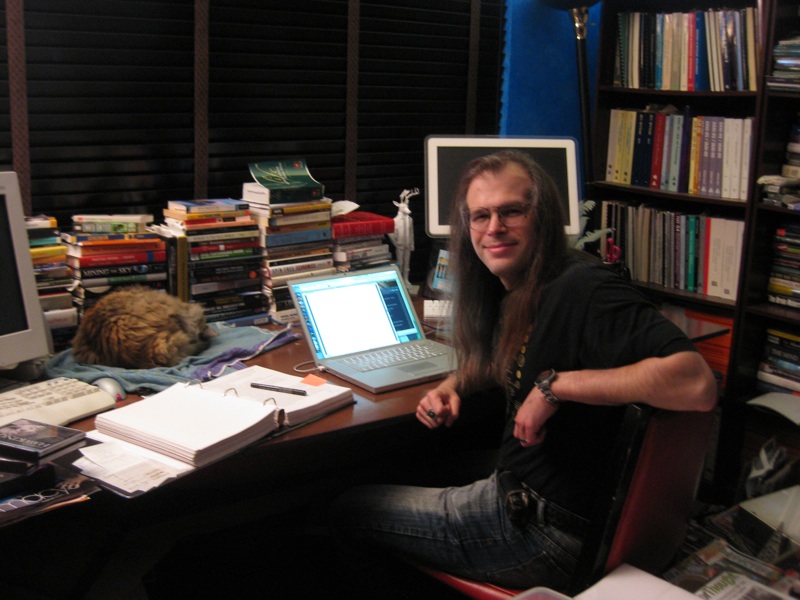
Recently a few friends (most recently Jim Davies) have sent me pointers to the Where I Write project, which shows off the creative spaces where many science fiction and fantasy artists do their writing. Some of the writing setups are amazingly spare; others are simply amazing. Check it out!
-the Centaur
Pictured above is one of my "creative spaces", though a fully accurate picture would probably show me at my local Barnes and Noble writing group or at Borders with the laptop and a Javakula from Seattle's Best Coffee.
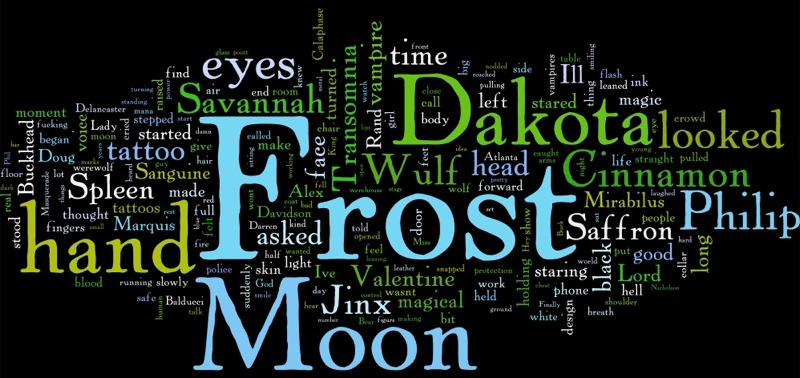
Frost Moon, the first novel I wrote that ever got serious interest from a publisher, is now back in the hands of the editor. Things are looking good, we're on the same page for the first twelve chapters ... though, sadly, their 2009 schedule has filled and there's no way the book is going to come out before the beginning of 2010.
Now it's the race to finish the edits of Blood Rock by the end of October, so I can send it to my beta readers and start work on "Liquid Fire" for National Novel Writing Month...
Wish me luck!
-the Centaur
The Internet. A huge distraction. You're writing happily away when suddenly you wonder whether your steampunk heroine ran into Einstein during her trip to Germany and, if so, was he young enough to date her. Thirty seconds later Wikipedia tells you yes ... but thirty minutes later you mysteriously find yourself still researching the priority of relativity controversy.
So: the Internet goes off when I'm writing now, and I collect questions in a text file while I work for later research. So far, this plan is working well.
Sent from my gPhone.
It's a fun thing in writer's circles to critique Dan Brown. Let me quote Tom Chivers in the Telegraph, who picked what he thought were 20 of Dan Brown's worst sentences, highlighting in bold one in particular I've heard other writers critique:
Professor Pullum, here, is Geoffrey Pullum, "famous" in my small circles for this small essay about why he thinks the first sentence of The Da Vinci Code is so bad:
If you agree with this assessment of Dan Brown's work, you might as well stop reading, because you've completely missed the point of what Dan Brown is doing. In fact, the key to what's wrongheaded about The Telegraph's list and Pullum's critique is contained in the very first sentence I quoted by Pullum:
He's struggling to come up with that convincing account because the very first sentence of the Da Vinci Code wasn't bad. In fact, Pullum's critique inadvertently nails precisely what's great about the opening sentence: it incorporates newspaper style details like the "renowned" status of the curator and his advanced age even into its action sequences, effortlessly, as a way of grounding us in otherwise fantastic action.
At the end of this opening sentence, you not only know an old man is running for his life, you know he's very, very old, respected to the point of being famous, and knows the paintings on the wall so well he mentally categorizes them by artist, even if you personally have no idea who Caravaggio is. And by weaving massive amounts of detail through even the action sequences of the story, Dan Brown establishes an authoritative air which provides the necessary grounding for his fantastic tale of a secret Christian history.
The Da Vinci Code is a great book that attracted millions of readers by sucking them into a great detective story that seemed almost real - and the stylistic elements Pullum critiques above are precisely what enable readers to make that mental shift. I'm not sure why Pullum reacted the way he did, but I strongly suspect that he simply doesn't enjoy pure escapist literature - which is his right - but failed to recognize that was the reason behind his dislike and confabulated these erroneous rationalizations to justify that dislike - as the human mind so often does.
Similarly, both the Telegraph list and some critiques I've heard in writing groups sound like the blind application of writing workshop rules. But "rules" like "show, don't tell" aren't hard and fast rules; they are guidelines designed to help authors, and moreover guidelines whose importance changes as writing styles change. And if you read widely and deep, you'll find that a vast number of "great authors" and "classic works" violate each and every rule you can find in a writing workshop - or repeat many of the sins Pullum and Chivers outline above.
The Da Vinci Code is ridiculous escapist nonsense. But that nonsense is anchored by a fantastic-in-every-sense-of-the-word idea and grounded by what to an average person would seem like an immense amount of erudition. Brown's research will not satisfy experts in an area, and it still is escapist nonsense - but it is immensely well crafted escapist nonsense. If what The Da Vinci Code is is not your bag, then just say "I don't like The Da Vinci Code, because it took itself entirely too seriously for a bit of escapist nonsense" and leave it at that; don't feel the need to impugn Dan Brown's talent.
To finish, let me quote Chivers #1 bad sentence:
This analysis is so bad, I'll just let it speak for itself. Oh, no, I won't. If by some chance you actually agree, stop and think for a moment until you realize what is so very, grievously wrong with what Chivers is saying here.
For the rest of us ... well, first off, "Da Vinci" does not read as "of Vinci" in English. And we're reading English here; and English can (and frequently does) go and appropriate any string of symbols it wants to refer to anything it wants, regardless of whether that string of symbols would make sense if it was transliterated. A brief search of Google or Amazon will reveal just how many people use that brief two-word string which now distinctively identifies that man. Your brain is designed to understand "The Da Vinci Code" as referring to the context of Leonardo Da Vinci. Get over it.
But more importantly, most of the rest of us can immediately recognize why "The Da Vinci Code" sent Dan Brown laughing all the way to the bank: it sounds really cool.
-the Centaur
P.S. In a violation of my usual style, I am not going to go obsessively read Leonardo da Vinci's Wikipedia page or dig through my mammoth library. I'm just going to let the essay speak for itself ... and if I'm wrong in some details, I'm wrong.
4, 3, and 2. The Da Vinci Code, opening sentence: Renowned curator Jacques Saunière staggered through the vaulted archway of the museum's Grand Gallery.
Angels and Demons, opening sentence: Physicist Leonardo Vetra smelled burning flesh, and he knew it was his own.
Deception Point, opening sentences: Death, in this forsaken place, could come in countless forms. Geologist Charles Brophy had endured the savage splendor of this terrain for years, and yet nothing could prepare him for a fate as barbarous and unnatural as the one about to befall him.
Professor Pullum: "Renowned author Dan Brown staggered through his formulaic opening sentence".
Professor Pullum, here, is Geoffrey Pullum, "famous" in my small circles for this small essay about why he thinks the first sentence of The Da Vinci Code is so bad:
I am still trying to come up with a fully convincing account of just what it was about his very first sentence, indeed the very first word, that told me instantly that I was in for a very bad time stylistically.
The Da Vinci Code may well be the only novel ever written that begins with the word renowned. Here is the paragraph with which the book opens. The scene (says a dateline under the chapter heading, 'Prologue') is the Louvre, late at night:
Renowned curator Jacques Saunière staggered through the vaulted archway of the museum's Grand Gallery. He lunged for the nearest painting he could see, a Caravaggio. Grabbing the gilded frame, the seventy-six-year-old man heaved the masterpiece toward himself until it tore from the wall and Saunière collapsed backward in a heap beneath the canvas.
I think what enabled the first word to tip me off that I was about to spend a number of hours in the company of one of the worst prose stylists in the history of literature was this. Putting curriculum vitae details into complex modifiers on proper names or definite descriptions is what you do in journalistic stories about deaths; you just don't do it in describing an event in a narrative. So this might be reasonable text for the opening of a newspaper report the next day:
Renowned curator Jacques Saunière died last night in the Louvre at the age of 76.
But Brown packs such details into the first two words of an action sequence — details of not only his protagonist's profession but also his prestige in the field. It doesn't work here. It has the ring of utter ineptitude. The details have no relevance, of course, to what is being narrated (Saunière is fleeing an attacker and pulls down the painting to trigger the alarm system and the security gates). We could have deduced that he would be fairly well known in the museum trade from the fact that he was curating at the Louvre.
If you agree with this assessment of Dan Brown's work, you might as well stop reading, because you've completely missed the point of what Dan Brown is doing. In fact, the key to what's wrongheaded about The Telegraph's list and Pullum's critique is contained in the very first sentence I quoted by Pullum:
I am still trying to come up with a fully convincing account of just what it was about his very first sentence, indeed the very first word, that told me instantly that I was in for a very bad time stylistically.
He's struggling to come up with that convincing account because the very first sentence of the Da Vinci Code wasn't bad. In fact, Pullum's critique inadvertently nails precisely what's great about the opening sentence: it incorporates newspaper style details like the "renowned" status of the curator and his advanced age even into its action sequences, effortlessly, as a way of grounding us in otherwise fantastic action.
At the end of this opening sentence, you not only know an old man is running for his life, you know he's very, very old, respected to the point of being famous, and knows the paintings on the wall so well he mentally categorizes them by artist, even if you personally have no idea who Caravaggio is. And by weaving massive amounts of detail through even the action sequences of the story, Dan Brown establishes an authoritative air which provides the necessary grounding for his fantastic tale of a secret Christian history.
The Da Vinci Code is a great book that attracted millions of readers by sucking them into a great detective story that seemed almost real - and the stylistic elements Pullum critiques above are precisely what enable readers to make that mental shift. I'm not sure why Pullum reacted the way he did, but I strongly suspect that he simply doesn't enjoy pure escapist literature - which is his right - but failed to recognize that was the reason behind his dislike and confabulated these erroneous rationalizations to justify that dislike - as the human mind so often does.
Similarly, both the Telegraph list and some critiques I've heard in writing groups sound like the blind application of writing workshop rules. But "rules" like "show, don't tell" aren't hard and fast rules; they are guidelines designed to help authors, and moreover guidelines whose importance changes as writing styles change. And if you read widely and deep, you'll find that a vast number of "great authors" and "classic works" violate each and every rule you can find in a writing workshop - or repeat many of the sins Pullum and Chivers outline above.
The Da Vinci Code is ridiculous escapist nonsense. But that nonsense is anchored by a fantastic-in-every-sense-of-the-word idea and grounded by what to an average person would seem like an immense amount of erudition. Brown's research will not satisfy experts in an area, and it still is escapist nonsense - but it is immensely well crafted escapist nonsense. If what The Da Vinci Code is is not your bag, then just say "I don't like The Da Vinci Code, because it took itself entirely too seriously for a bit of escapist nonsense" and leave it at that; don't feel the need to impugn Dan Brown's talent.
To finish, let me quote Chivers #1 bad sentence:
1. The Da Vinci Code: Title. The Da Vinci Code.
Leonardo’s surname was not Da Vinci. He was from Vinci, or of Vinci. As many critics have pointed out, calling it The Da Vinci Code is like saying Mr Of Arabia or asking What Would Of Nazareth Do?
This analysis is so bad, I'll just let it speak for itself. Oh, no, I won't. If by some chance you actually agree, stop and think for a moment until you realize what is so very, grievously wrong with what Chivers is saying here.
For the rest of us ... well, first off, "Da Vinci" does not read as "of Vinci" in English. And we're reading English here; and English can (and frequently does) go and appropriate any string of symbols it wants to refer to anything it wants, regardless of whether that string of symbols would make sense if it was transliterated. A brief search of Google or Amazon will reveal just how many people use that brief two-word string which now distinctively identifies that man. Your brain is designed to understand "The Da Vinci Code" as referring to the context of Leonardo Da Vinci. Get over it.
But more importantly, most of the rest of us can immediately recognize why "The Da Vinci Code" sent Dan Brown laughing all the way to the bank: it sounds really cool.
-the Centaur
P.S. In a violation of my usual style, I am not going to go obsessively read Leonardo da Vinci's Wikipedia page or dig through my mammoth library. I'm just going to let the essay speak for itself ... and if I'm wrong in some details, I'm wrong.
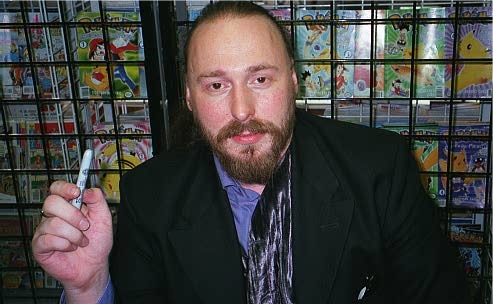
I apparently started writing before Warren Ellis did. The bastard's only one year older than me, and his bibliography warrants its own Wikipedia page, whereas I have one (1) published short story.
Yes, yes, I know, I was busy getting a Ph.D. in Artificial Intelligence while Warren Ellis was pulling his fingernails out trying to climb the walls of the unholy well that is Marvel Comics. I don't care. I see this as just another sign that his insane writing skills are a result of a deal with Cthulhu or the Devil.
I mean to track this walking abomination down, pin him to the wall, and get him to confess what deal he made, with whom, and whether it's still open. I mean, my soul is not for sale, but we're just talking some temp contract work for tentacular star-spawn in exchange for the preternatural ability to sway the minds of men with the written word, hey, maybe we can work something out.
-the Centaur
P.S. Actually, Mr. Ellis, I have no intention of tracking you down. First off, as a Christian I can't do any soultrading; second, I'm afraid if I actually met you it would be too much like Death meeting Alan Moore.

Ah, Dragon*Con: that magic time in September when 50,000 of my closest friends get together to transform four hotels in Atlanta into a gateway to another world.
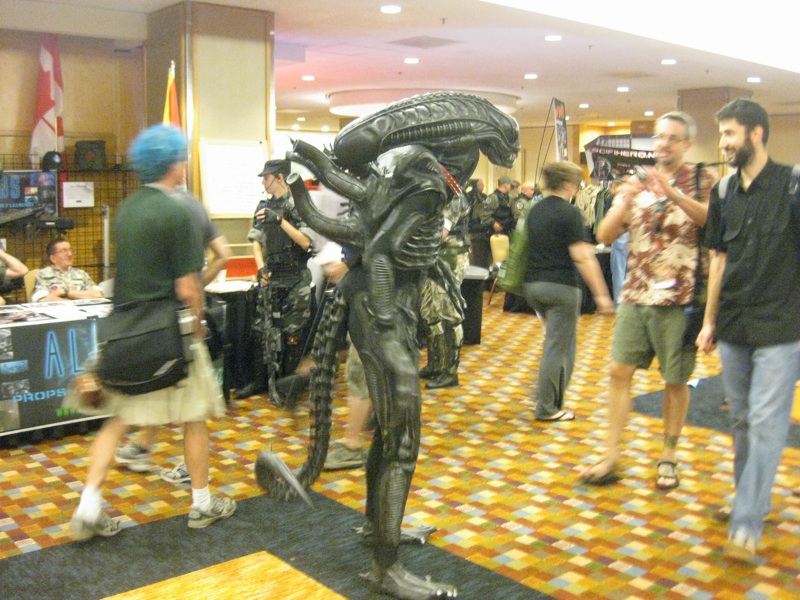
Dragon*Con has some of the best costumes you'll see this side of an Anime convention - much better than what you'll find at the much larger San Diego Comicon. Practically everyone is dressed up and some of them are amazing.
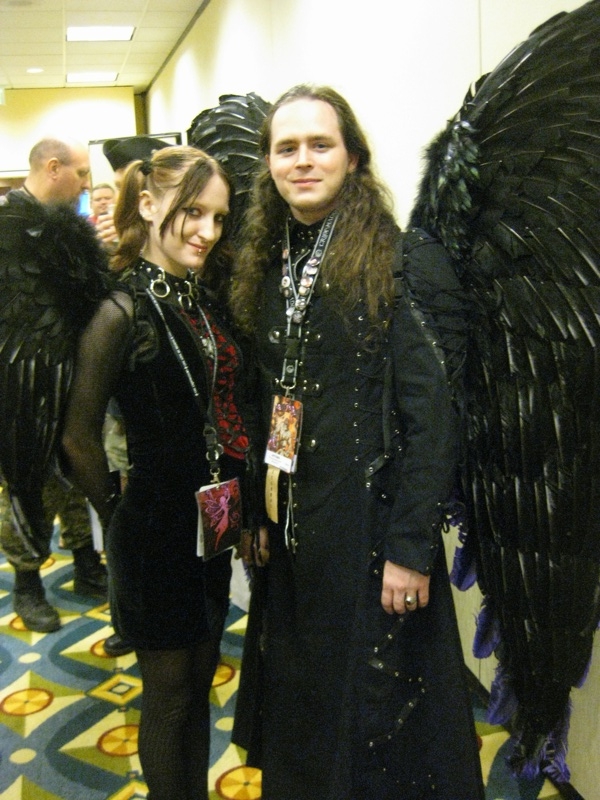
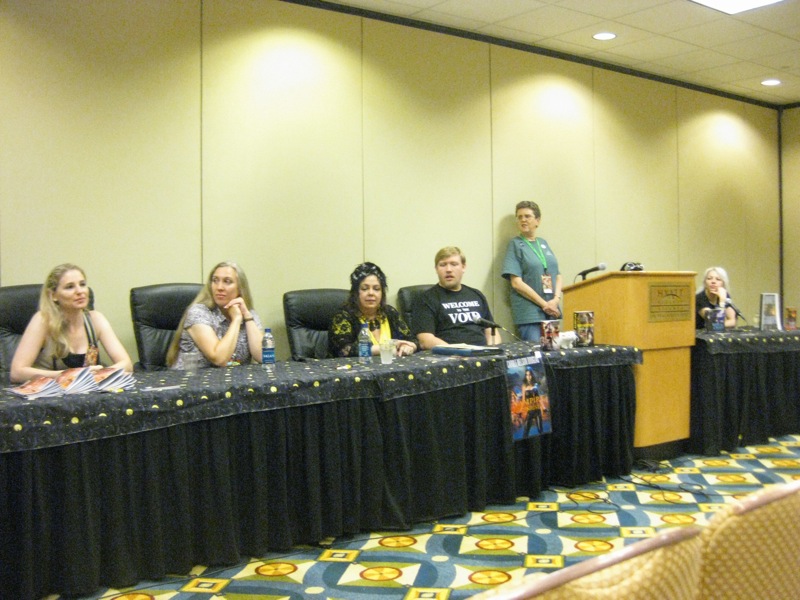
Another real draw is the fantastic variety of panels. There are literally dozens of tracks at Dragon*Con and programming goes on until 11:30 pm or later - and there are often social events until 2 and 3 in the morning.
After the panels it's fun to just peoplewatch; you can do it for hours.
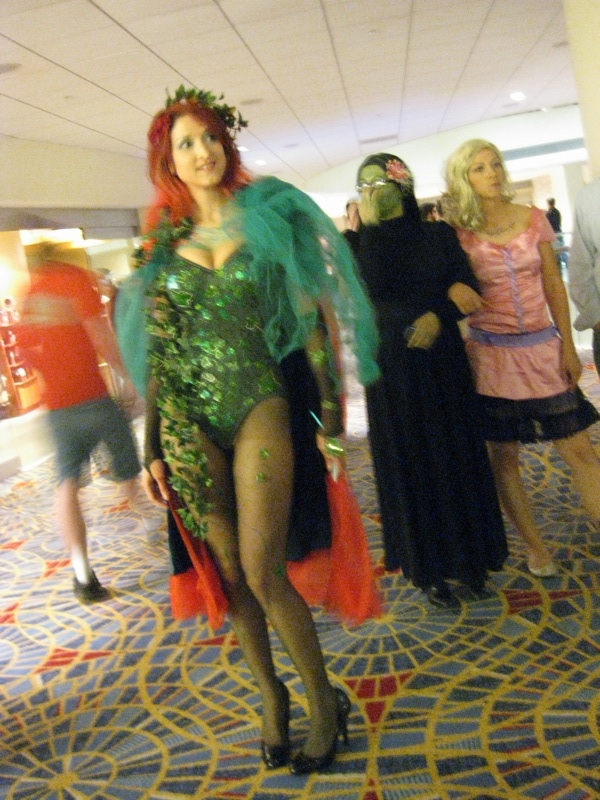
Women dressed up get quite a bit of attention - though sometimes, as in this case, they seem more surprised to have people taking their picture than you'd expect for all the effort they've put into their costumes.

Another piece of the fun is the sheer variety of fans. You see of course people pulling off Cylons ... somewhat less impressive with the helmets off...

You see costumes that mean something only to the viewer, as in this Dakota Frost lookalike...
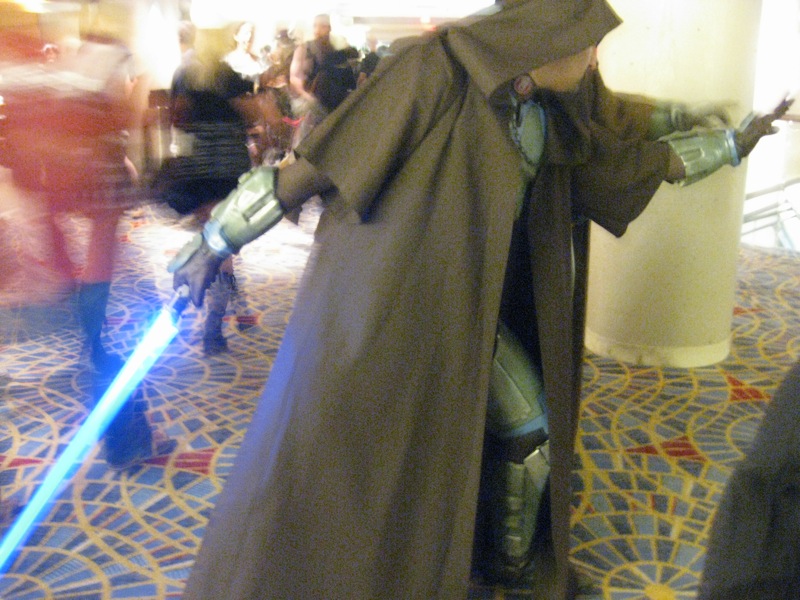
The ubiquitous Jedi, in this case posing for a photo taken by a Sith ...
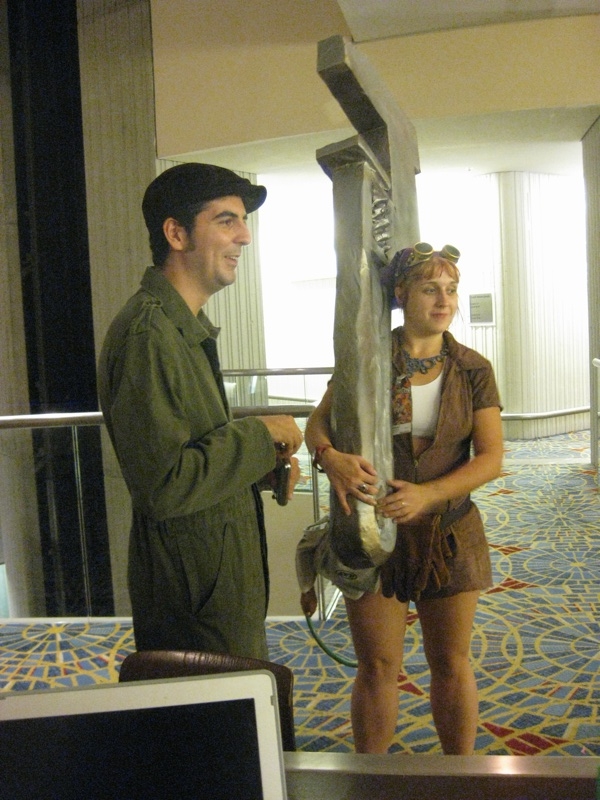
... and then finally sheer randomness by simply creative people.
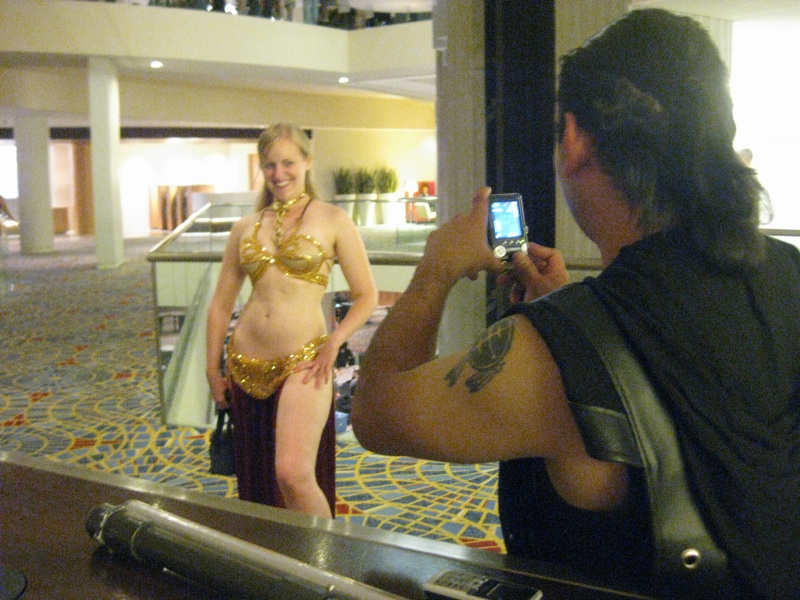
Fans love taking pictures of fans - it was quite interesting sitting with a Sith shutterbug, watching him take pictures of passing Poison Ivys and Slave Leias.

But then some people wanted to take pictures of him ... and then, bizarrely, two women wanted to have their pictures taken fellating his lightsabers. Utterly weird, and a great source of amusement to us and the other people at our table.
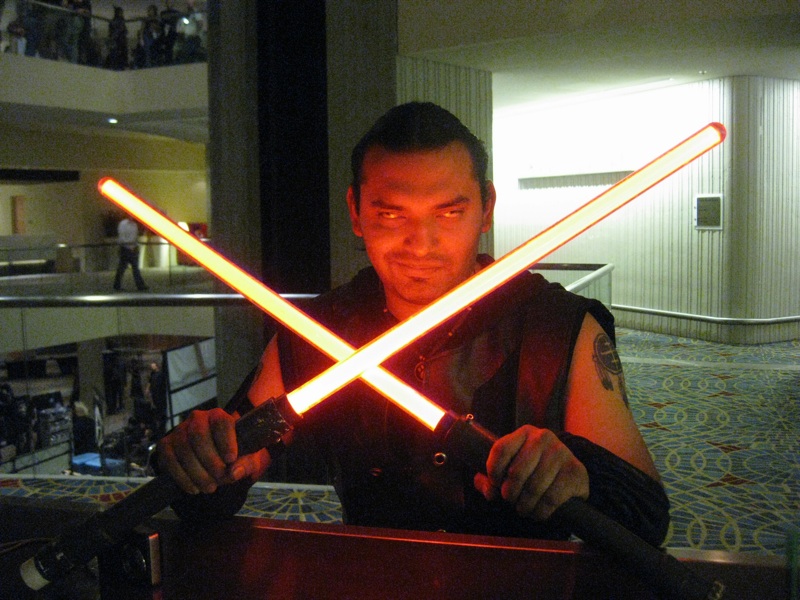
But ultimately that's the fun of Dragon*Con: not just seeing Jedi taking pictures of Sith, but running into old friends dressed as Jedi taking pictures of old friends dressed as Sith. Because in the end its the friendships that make Dragon*Con more than just a fan playground or a party: it's a family.
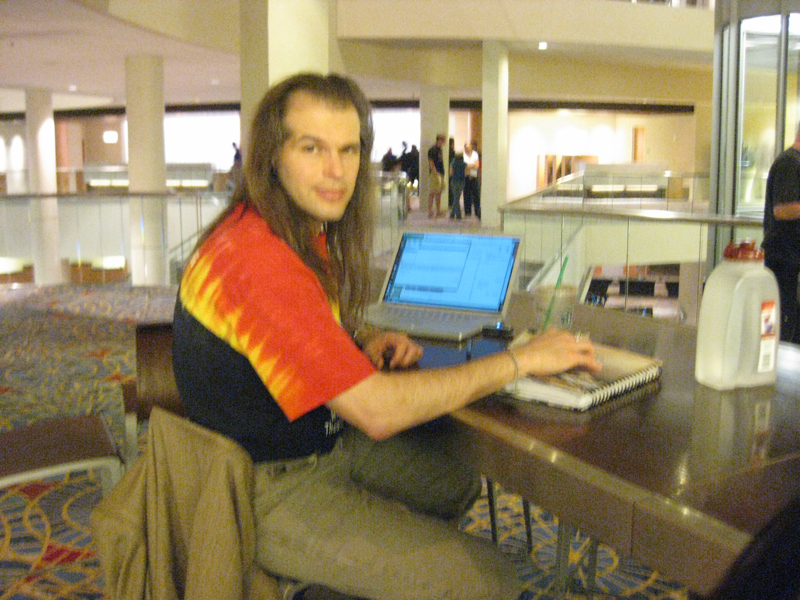
From the Dragon*Con Convention floor(1), this is your Centaur reporting. Good night, and good luck.
-the Centaur
(1) Technically, sent from my hotel room because connectivity on the con floor was too poor.
... in case there was any doubt:
No, really, I'm interested.
-the Centaur
No, really, I'm interested.
-the Centaur
... even to myself:

But sometimes it is necessary.
-the Centaur
But sometimes it is necessary.
-the Centaur
My friends Fred, David, Derek and I were on an Edge vacation somewhere - I don't quite know where - and Fred had rented a convertible to drive us around town. While we were there, we heard that they were going to blow up a mall as part of shooting some movie, and we decided to show up to watch.
We pulled behind a massive structure like Phipps Plaza in Atlanta, waiting in a long narrow street cutting through the big grassy fields behind the mall. There were a few other onlookers, maybe in the hundreds, but we pulled up in our convertible just as they were about to get started, so we didn't even get out.
Then the mall detonated. The parking structure behind it collapsed, tumbling down like the proverbial deck of cards. Giant concrete columns, easily three feet across, were tumbling over like dominoes.
Then something went wrong - one of the timed explosions was too powerful, or maybe there was a boiler overlooked in the security office underneath the parking deck. A secondary blast sent dozens of concrete columns flying, giant treetrunks sailing through the air - one of them right over us.
I looked up, frozen, as the column seemed to hang there in the air, long enough that it seemed to stretch out of our field of view to the left and right, wide enough to kill us. Then it began to shift in my vision, and I realized it was going to fall in front of us.
In that moment, I realized missing us would not be enough. I shouted, "Back up, back up, back up!" and Fred put the convertible in reverse. The column crashed to the ground in front of us and began rolling forward, bouncing - it would have rolled straight over the top of the car, flattening us. We screeched backwards, but quickly the column rumbled to a stop, and Fred stopped the car.
"Wow," Fred said, looking back at us. The column covered the whole road in front of us. More concrete columns were scattered all over the field, but miraculously no bystanders had been killed. "Normally I'm the first one to react. Good catch Anthony!"
I was not so sure.
Thinking over it later, there was no way Fred could have responded in time from my shout to put the car in reverse and start moving; he must have already been acting when I leaned forward and yelled in his ear, and in the confusion of events interpreted things after the fact to think that he'd reacted to my warning.
But what really struck me while Fred was congratulating me was my memory of that moment where the column was hanging in the air: that moment where I knew it was going to fall and hit or nearly hit us, and I didn't say anything because I was frozen. If we had to rely on that reaction time, we'd all be dead.
Must go faster.
Thank God, it was only a dream....
The easiest way to ruin a poem
is to read it like a poem
with stilted voice and stately oration
designed to show the poet's construction
- poetry, as read by "poets"
who learned in English class that
"poetry is the highest form of language."
I do not agree.
Poetry is distilled emotion,
concentrated essence of the darlings a novelist must murder,
packaged up with that punch that took Emily Dickinsons' head off.
Poems should be read
as if by Robert Frost's neighbor,
with sinewy hands moving rocks through the darkness,
springing forth to hurl them through our defensive walls:
the poet as savage.
Poetry should be many things:
inspiring, depressing,
comforting, enlightening,
homespun, heartwrenching.
It should never be safe.
is to read it like a poem
with stilted voice and stately oration
designed to show the poet's construction
- poetry, as read by "poets"
who learned in English class that
"poetry is the highest form of language."
I do not agree.
Poetry is distilled emotion,
concentrated essence of the darlings a novelist must murder,
packaged up with that punch that took Emily Dickinsons' head off.
Poems should be read
as if by Robert Frost's neighbor,
with sinewy hands moving rocks through the darkness,
springing forth to hurl them through our defensive walls:
the poet as savage.
Poetry should be many things:
inspiring, depressing,
comforting, enlightening,
homespun, heartwrenching.
It should never be safe.

That's Dakota Frost, in the flesh, penciled and inked by me, based on my own sketches, internet references for the Mohawk and tattoos, and the body of my lovely wife, who was kind enough to model for me.
I had to do some promotional flyers for Frost Moon, have talked to the publisher about a frontispiece; this may be it.
-the Centaur
Posting some Q&A; about Frost Moon from an email...
Hope that clears all that up...
-the Centaur
- Q. How long is Frost Moon?
A. Frost Moon is ~90,000 words. The version my friends and beta readers read was 87,000, but the draft the publisher and I are working on has expanded that to 91,000. - Q. How does that compare to a normal novel?
A. "That depends." The scuttlebutt in the writing community led me to believe that are about 60,000 to 90,000 words, and I was shooting for 75,000 when I wrote Frost Moon. Since then I've done some research, and it seems like novels range from 60,000 to 100,000 with a sweet spot at 75,000 to 80,000 words ... but again, that depends:- The always entertaining Orson Scott Card weighs in, giving us this answer with many caveats: "a book feels like a normal novel somewhere around 100,000 words and is hard to publish at less than 75,000"
- Wikipedia presents a range of evidence on the topic, ranging from Animal Farm at 30,000 words (typically considered a novella) to War and Peace at nearly 600,000.
- Fantasy novels tend to be larger ... 250,000 words is not unusual.For comparison, Atlas Shrugged is almost 650,000 words, and Lord of the Rings (considered to be one novel published in three volumes) is 525,000. Romance novels, on the other hand, tend to be shorter ... 50,000 to 60,000 words.
- Q. What format will Frost Moon be published in?
A. The publisher is thinking Frost Moon will be a trade paperback, a slightly larger sized format that's easy to print on demand. However, depending on interest, this publisher will basically reissue Frost Moon in whatever size and format sells. - Q. Why aren't you mentioning the publisher's name?
A. Two reasons:- Until we have a signed contract that would be presumptuous, and
- Don't jinx it.
Hope that clears all that up...
-the Centaur
Here's hoping I don't jinx it, but it looks like Frost Moon is going to be published. I'm working with the editor on what we hope is the final on-spec draft prior to signing the contract, but it appears we have time to get it on the print calendar for Fall. If we miss that date, the next date would be January 2010, but it's still coming.
Keep your fingers crossed!
-the Centaur
Keep your fingers crossed!
-the Centaur