

The 2012 election season is over. Win or lose, be proud of yourselves, Americans. You made your choice.
Win or lose, be proud of yourselves, Americans. You made a difference.
God bless America? God bless democracy.
-the Centaur
Words, Art & Science by Anthony Francis
The 2012 election season is over. Win or lose, be proud of yourselves, Americans. You made your choice.
Win or lose, be proud of yourselves, Americans. You made a difference.
God bless America? God bless democracy.
-the Centaur

Yes, the election is OVER today ... but the outcome is up to YOU!

My wife and I have an election evening ritual to review all the candidates and make our decisions.

To find out where to vote, check out Google's Voting Guide, which will tell you where the polling places are, who's up for election, and what the referenda are in your district, if any. Since we're in California, we also used resources like the KQED Proposition Guide, the San Jose Mercury News endorsements, and the LA Times endorsements - less for the endorsement value than the discussions they prompted. For some more obscure races, the Smart Voter site and simple Googling helped.

I've already stated my reasons why I think Obama should remain President:
... the left of us are going to vote for the guy who passed healthcare reform, repealed don’t-ask-don’t-tell, ended the war in Iraq, repaired our relations with the world, and made a good-faith effort to close Guantanamo, and the moderates among us are going to vote for the guy who saved the auto industry, passed the stimulus, refused to prosecute those who were prosecuting the war on terror, repeated Bush’s surge trick in Afghanistan, piffed Osama bin Laden, and finally put the smackdown on Gaddafi the way Reagan wanted to oh so many years ago.
And in the same article, I outlined why I have a hard time voting for Republicans for the U.S. House of Representatives, the U.S. Senate, or for California state offices - though I think they make swell governors and have voted for a few of them myself, and they can be excellent local representatives. (Though I mostly voted for Democrats this time).

The propositions are a murkier matter: I recommend voting against the deceptive Proposition 38, which says it provides money for schools but will actually most likely cause a loss of six billion dollars to schools, against Proposition 31 which is a grab-all reform of the state legislature, against Proposition 32 which is bankrolled by corporations in an attempt to prevent unions from doing the same kind of bankrolling, and in favor of the backwards Proposition 40, where a yes vote actually means to leave the new election districts the way they are - and even the backers of the measure have backed off their support (meaning, even the people who wanted you to vote no now want you to vote yes). For the bulk of the rest of them, it depends on your feelings about contentious issues like the size of government, the food labeling, and capital punishment. Vote your (well-informed) conscience.

But vote! Because, remember, cats can't vote ...

And if they could, it would be just for more food.
-the Centaur
Pictured: our vote by mail ballots, which enable us to vote the night before and walk the ballots over to the polling place at our leisure. Go democracy! Hooray America! And if you're not in a democracy like America's, you should think about getting yourself one!
 Andrew Breitbart is dead at 43. He was apparently a conservative commentator; I wasn't too familiar with him except for some of the scandals he broke.
But the point, as John Scalzi said, is that he was 43. I'm used to hearing about accomplished people who are much younger than I am ... Larry Page, Britney Spears, Christopher Paolini, that last born when I entered high school.
Occasionally people in that age bracket die. It's a damn shame, everyone says, they died so young. But when Andrew Breitbart died, while it was clear that he died young - to the point of spawning (what at first appear to be ridiculous) conspiracy theories - no-one is too surprised.
Because a male's chance of dying of a heart attack triples when you move up to 35-44 year age bracket, and triples again when you roll over into 45-54. I'd enter some snark about white males like myself being worse off, but it doesn't seem to be the case.
So Andrew's about the right age where people should start worrying about dying of a heart attack. So am I.
God speed, Andrew. And may God be with us all.
-the Centaur
Pictured: a memento mori featuring my cat, Caesar, curling up in the lap of luxury next to the skull of one of his less evolutionarily successful distant relatives. Looks like Caesar had an easier time taking down that giraffe than his buddy there.
I try to avoid too much of the politics here. My experience of blogs that dip political is that they're often shrill, partisan, and most likely to make mistakes about the things they're most likely to post - the same trap I usually fall in when I post to my friends's shared mailing group. When you're engaged enough to respond, you're enraged enough to gaffe.
But a friend and I were discussing the recent election, I said something complimentary about Romney "even though I wouldn't vote for him" and my friend responded: "Can you conceive of a situation where you wouldn't vote for Obama?" And that gave me pause.
I try to be open minded. I currently vote liberal, but I was a College Republican, with deep admiration for President Reagan and President Nixon (no that wasn't a typo), and even though accepting reality forces one to lean to the left (and trying to be moral leans one even moreso), there are very important values on the right we can't just throw out with the bathwater. Economic freedom. Gun rights. Lower taxes when possible. Limits to the size and reach of government. Promoting the needs of families, businessmen, farmers, soldiers. I'd call myself a libertarian, but that's not a good descriptor either. Short story, i try to keep an open mind.
The last election cycle was ideal for me: a Republican I admired and had supported up against an eloquent technocrat who finally broke the color barrier. I couldn't lose. I printed out Obama and McCain's political positions and went through them with a fine tooth comb, and found myself on the fence, 50-50. I was undecided right up until August 29, 2008, when McCain selected Palin as his running mate. I take running mates very seriously, especially with an older headliner, and while McCain had earned my admiration and reflected my values, Palin ... hadn't, and didn't. So (big surprise) I voted for Obama. A Democrat.
Fast forward almost 4 years, and our conversation about Romney. I saw this article, and was impressed enough to write:
“I’m very pleased with the campaign, its organization. The candidate sometimes makes some mistakes, and so I’m trying to do better and work harder and make sure that we get our message across,” Romney told reporters during a visit to his campaign headquarters here. “In the final analysis, I anticipate becoming the nominee.”Q: Candidate Romney, where does the buck stop?A: Where does the buck stop? The buck stops here. Next question.
But (based on other conversations) my friend's a bit bitter, as he thinks there's nothing that's going to stop Obama, and was probably frustrated to see me say I'd never vote for him. That lead to the question: "Can you conceive of a situation where you wouldn't vote for Obama?" ... and this (correcting a few typos) is what I wrote:
TL;DR: No.Conceive of? Sure. He's unmasked as a space alien or secret Communist plant or something. Or contrafactually, had McCain selected almost anyone else with real credentials combined with appeal to a moderate base (Pataki? Powell? Rice?) it could have happened in 2008.
Realistically? No, for three reasons.Put another way, from the perspective of a liberal moderate, Obama is one of the most successful presidents in history, so no, too much would have to change. The Republicans would have to radically shift to the center, and Obama would have to turn into some kind of monster.
- The Republican establishment has moved too far to the right, becoming deliberately obstructionist (you can verify this with their public statements) turning their backs on even hardline conservatives (you can also verify this with their public statements) and now see "moderate" as a dirty word. When you vote for a President, you vote for his party, and I cannot in good conscience vote for the Republican party. When the current conservative movement implodes and the party once again is open to a variety of opinions then I'll reconsider.
- Obama's values, governance and style reflect my values, understanding of the facts, and preferred way that politicians should operate. He's not a Dukakis, or Carter, or LBJ, or one of the scarier people the Democrats have waiting in the wings ... he's more like a Clinton or JFK. SO he's not a bad choice to have up there, regardless of the Republican opposition, with the possible exception of his positions on space and domestic spying.
- You don't change horses in a river ... or a President in wartime.
In 2016, however, who knows? Bloomberg? Romney? Christie? Could it be ... Jeb Bush? (And yes I looked up their political positions before making that statement, though I reserve the right to change my mind if they have diarrhea of the mouth in the 2016 campaign).
Partisans may pshaw at this, evidence free as their reasoning is, because I'm not even a RINO (Republican in Name Only). If you have to put a name on what I am, I'm a left-leaning moderate. I haven't voted for a Republican President since Bush's dad. But Republicans are doing nothing to sell me on their party. I listen carefully to their positions. I'm trying to learn from their wisdom and defend their important values: the steering wheel of state needs to turn both ways.
But they've been drifting to the right since Bush lost to Clinton, since Bush violated his campaign promises and drifted to the right, and people like me ended up voting for the other guy. I still remember that day when a conservative shopkeeper, who had in front of him a voter telling him he switched parties because Bush went too far to the right, stood up enraged and told me that the reason Bush lost was because he wasn't conservative enough.
Keep telling yourselves that.
In the meantime, the left of us are going to vote for the guy who passed healthcare reform, repealed don't-ask-don't-tell, ended the war in Iraq, repaired our relations with the world, and made a good-faith effort to close Guantanamo, and the moderates among us are going to vote for the guy who saved the auto industry, passed the stimulus, refused to prosecute those who were prosecuting the war on terror, repeated Bush's surge trick in Afghanistan, piffed Osama bin Laden, and finally put the smackdown on Gaddafi the way Reagan wanted to oh so many years ago.
I'm sure if I went through and extensively fact-checked this article I'd have to blunt some of my criticism and praise; the real story is always too big to fit in the boxes that we want to fit it in. In particular, I know Obama's not perfect. But I'm going to go with the guy who's willing to take on ideas from the other side, if not their votes, because all the other side is trying to do now is make him fail - even if it means turning on their own ideas ... or turning on their own. There's a lot of good on the right ... but right now, on many issues, the right's in the wrong, and is extraordinarily resistant to accepting facts, reason, or even their own history, even in areas where Obama's choosing to follow firmly in Bush's footsteps to the point some of the left want to tear their hair out.
In the end, it's not about parroting the current set of litmus positions to establish one's group identification.
It's about being effective at doing what's right.
-the Centaur
P.S. For the record, while I admire Ron Paul's clear moral compass, and would love to see Newt Gingrich debate Obama just for the fireworks of seeing two powerful minds clearly articulate their conflicting ideals, if I did have to pick a Republican candidate I would pick Mitt Romney because I think he's the most experienced, levelheaded, and dare I say moderate of the current pack. I agree with my friend: he is the best choice out of the Republican field, even though I have the option of selecting a different candidate from a different party that better reflects my personal values. Best of luck, Mitt, though I will be voting for the other guy.
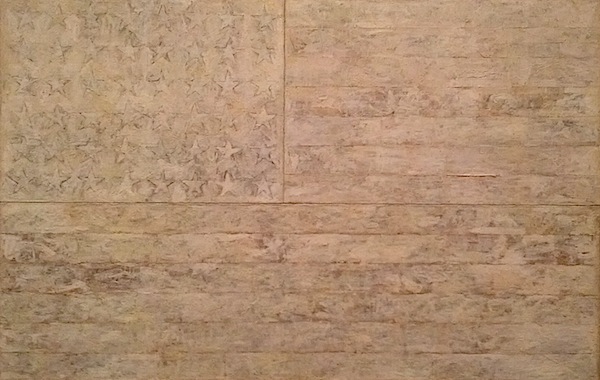
Pictured: White Flag by Jasper Johns, currently hanging in the Metropolitan Museum of Art.
 Shortly after a study from a former climate skeptic seemed to show that global warming is indeed happening, anti-climate skeptics are now accusing him of "hiding the truth" because the globe hasn't warmed in the last 10 years.
Ok, let's grant that, for sake of argument. I for one believe it. But climate is defined as the weather averaged over 30 years. So even if the temperature hasn't risen for 13 years, as they suggest, that means that it has risen for 17 out of the last 30 - and that the temperature is still rising.
Wait another decade and then you've got a case to make that global warming has stopped. If the skeptics are right, as they haven't been about almost anything for the past century or so, then we can throw a party. If they're wrong ... well, waiting another ten years makes fixing the problem much harder.
Understand: climate skeptics are just stalling in the hope the the problem will just go away. Personally, I wait in joyful hope for the Resurrection --- but when dealing with temporal problems, I pray for God's good favor, then get to work.
Why don't we all try being real about what our problems are and working hard to fix them, for a change?
-the Centaur
The Centaur's Bio (his Old .plan File) Hi. This is the personal page of the Centaur, otherwise known as Anthony Francis. I'm ostensibly a graduate student in Artificial Intelligence at the College of Computing, but that's just a hobby. For the past eight years, I've been a science fiction writer, a vocation that became professional when I published my first short story, "Sibling Rivalry," in the February 1995 issue of _The Leading Edge_ magazine. The love of my life is a redheaded historian, Shannon Duffy. When I'm not with her I spend time with my best friends in the Edge Group, which consists of Michael Boyd, David Cater, Anthony Francis, Derek Reubish, David Stephens, and Fred Zust in the core Edge franchise as well as William Morse, and Stuart Myerburg in our recently opened Atlanta branch. [Editor's note: Sad to say, Shannon and I are no longer together; we simply had different ideas about where we wanted to take our lives. We're still friends, though, and hope to keep it that way.] I'm sorry, I can't tell you what we at the Edge Group do; we'd have to kill you (we do bad movies, good software, and great times, in no particular order). When I'm not hanging with the Edge Group I'm jamming with my other best friends Steve Arnold, Eric Christian and his fiancee Chalie, Joe Goldenburg, Kenny Moorman and his wife Carla, Ruth Oldaker, Mark Pharo and his wife Yvette, Patsy Voigt, and Fred's girlfriend Marina. The weekend tradition is to jam with William, Stuart, Mallory and sometimes Joe at Anis, Huey's, Oxford at Pharr, Phipps and wherever else we can get into trouble. (Occasionally, you can find me at the Cedar Tree or Yakitori Den-Chan with Mark & Yvette). If not, I'm either hanging with Fred & Marina, Eric & Chalie and Dave & Ruth up in ole Greenvile, South Carolina, watching (or filming) movies at my house, eating dinner with my loving parents Tony and Susan Francis, perforating the odd target with musket fire at Eric's or just noshing on late-night food at Stax' Omega or IHOP. If I'm not doing any of the above, I'm liable to be curled up with Shanny in O'Flaherty's Irish Channel Pub in the French Quarter in New Orleans, listening to Irish ballads and soaking up each other's company over an Irish Coffee (her) and a diet Coke (me). Since people have asked, my favorite authors are H.P. Lovecraft, Larry Niven, C.J. Cherryh and Douglas Hofstadter, in that order. My favorite TV show is Dr.Who, followed neck-and-neck by Babylon 5 and Star Trek (TOS TNG TMS DS9 VOY ANI, in that order) and nipped at the heels by the Tripods and the Six Million Dollar Man. My favorite comic book is Elfquest, followed closely by Albedo Anthropomorphics, Superman, Cerebus, and Usagi Yojimbo. My favorite band is Tangerine Dream, although I do listen to Rush, Yes, Vangelis, and Genesis. My favorite style of music is now called "New Age" (uuugh) but used to be called electronic music, minimalist, or just electronic rock. My second favorite style of music is soundtrack music (music for the visual image). I can stand rock. I hate disco. Rap held my interest for a while, but it officially lost me with "Whoomp(t) there it is." My favorite cuisine is Lebanese, a gift from my parents and my family, the best damn extended family in the whole wide world. I shock my parents and family by also appreciating Chinese, Japanese, Thai, Cajun, Mexican, Italian, Korean, Vietnamese, Spanish and Indian cuisine; I also have a great appreciation for the foods of the South, a culture which I find to be both vastly underrated and overdiscussed abroad. When I'm not dining out or curled up with a good book or laptop computer at Captain D's at Corporate Square in Atlanta drinking inordinate amounts of iced tea, I'm at home honing my patented personal tabbouleh (Lebanese salad) recipe, slowly learning to cook Chinese, and honing the art of grilling steaks and microwaving potatoes so that they both finish at the same time. My favorite form of literary expression is science fiction; my preferred style is flashbacks within a framing story, usually in third-person limited, although I've begun to experiment with a more liberal third-person style derived from the narrative structure of contemporary motion pictures. My primary means of plotting and expression are visual images. My favorite fictional creature is, of course, the centaur; however, the genetically engineered spaceborne professionals of *my* fiction bear little resemblance to the bearded primitves that stalk the wooded glades of your average fantasy novel (unfair though that may be to my inspirations, which include the very nice halfhorse folk of the Giesenthal valley dreamed up by Donna Barr, the ambiguous Titanides from _Titan, Wizard, Demon_ by John Varley, and Timoth the warrior sage of the Advanced Dungeons and Dragons comic. Just don't call my Porsche St.George a halfhorse too; she'll be liable to pummel a fictionalized version of you in a story sooner or later if you do). My favorite style of AI is symbolic AI with a situated/behaviorist twist. I play around with memory, agents, case-based reasoning, natural language understanding, and semiotics; I have nothing against genetic algorithms or connectionist systems other than the fact that I don't have time to pursue them as avidly. I also fiddle around with animal cognition, and can talk your ear off about chimpanzee culture and dolphin language if given the chance. My favorite style of science is Kuhnian with a cognitive flair. I have no respect for positivism or any of the horrible things it's done for science. My philosophy is somewhere between Kant, Plato and something no-one has a name for yet. To sum: the universe is real; deal, but don't assume you have the answers and *don't* assume that a single level of description can capture all of reality. My religion is theist; I believe in the tripartite single God at the heart of mainstream Christianity, and accept the messiah aspect as my savior. My theology is liberal Episcopalian with a strong theological background in my Catholic upbringing. My disagreements with the Catholic Church are primarily theological and only partially pragmatic; I gave up on waiting for them to catch up with Jesus, but they're still mostly good people. The religious right, on the other hand, is a bipartite oxymoron: neither religious nor right, and certainly not in keeping with the anti-Phariseean radical I follow. Genteel religious discussions are welcome; rude evangelizers will be biblically and theologically diced *before* I turn you over to Shannon, Joe, William, and Eric. Bring references to authorities, but don't expect me to respect them. Arguments against evolution will either be summarily flushed or buried underneath my copies of Eldredge's _Time Frames_, A.G. Cairns-Smith's _Genetic Takeover_, Dawkin's _The Selfish Gene_, _The Saint Paul Family Catechism_ and my copy of the New American Bible, flipped to the part of the preface discussing evolution. Read the gospel of Thomas; it's an eye opener, and you haven't even seen the Dead Sea Scrolls yet... Politically, I am a Goldwater liberal. I believe in war, gays in the military, religious freedom, no state-mandated prayer in schools, free ownership of automatic weapons, licensing of gun owners, aid to the Contras, prosecution of IranContra, investigation of Whitewater, and support and respect for the president regardless of party. I voted for George *and* Bill once each, don't regret it, and would do the same knowing what I know now. I believe in AIDS spending, military spending, research spending, and the space program; I also believe in welfare reform, cutting waste, a line item veto, and perhaps even some kind of budget amendment if I could be convinced it wouldn't get us into trouble in wartime. I don't believe in "school choice", "political correctness", "multiculturalism", "Rush as Equal Time", "the liberal media", "the conservative media", or "anti-special-rights amendments". I don't think we should take "In God We Trust" off of our coins and I don't think we should picket funerals of people who had AIDS. I don't believe acceptance of homosexuals as equal citizens has anything to do with the disintegration of the American family. I don't believe in hobbling industry with overregulation nor do I believe in letting them cut down trees holding endangered species just because they planned our logging programs poorly. My political heroes are Barry Goldwater, Ronald Reagan, Bill Clinton and Margaret Thatcher.Interesting. Well, that is what it was. There are definitely opinions I would tweak, things I now think I got wrong, and snapshots of relationships that no longer hold. But the Edge is still here, I'm still here, I'm still writing, I'm still a Christian, and still a scientist. SO, all things considered, I think I'll have to stand by my dot plan file after all. -the Centaur
http://www.scotusblog.com/2010/04/court-to-rule-on-violent-videos/ The Supreme Court agreed Monday to rule on the constitutionality of a state law banning the sale or rental of violent video games to minors. The Court accepted for review an appeal by the state of California, urging the Court to adopt a new constitutional standard that would enable states to ban such games for those under age 18. The case is Schwarzenegger v. Video Software Dealers Association (08-1448). The Court apparently had been holding the case until it decided another First Amendment case involving violent expression — U.S. v. Stevens (08-769). In that ruling, issued last Tuesday, the Court struck down a federal law that banned the depiction in videotapes of animal cruelty. In that ruling, the Justices refused to create a new exception to the First Amendment free speech right. The Court could have opted to send the California case back to the Ninth Circuit Court to weigh the impact of the Stevens decision. Instead, it simply granted review; the case will be heard and decided in the Court’s next Term, starting Oct. 4.From IGDA's call to action:
The IGDA in partnership with the AIAS, is working with the ESA to put together an AMICUS brief to support the decision to revoke this ban and declare this law unconstitutional. With the concept that video/computer/electronic games are a new form of media and art form, our industry should be afforded the freedom of speech protections that have been fought for and won by print, audio and video groups from newspapers to rap artists to filmmakers across the country. We need your help in securing powerful arguments that explain how this industry has evolved into a true profession over the years, and a medium that touches children and adults around the world every day.So, if you care about your rights to buy videogames, or about giving government yet another tool to control what we see and hear, you might consider weighing in - if not on this court case, if to your elected representatives asking them what on Earth they were thinking in the first place. -Anthony
"We're fed up with Washington! The Government can't get anything done! It apparently takes a supermajority to pass anything! Let's make sure no-one has that!"No, no, no, no, NO! For goodness sake, people, listen to what your opponents are saying instead of projecting your desires upon them. What the people who just voted a Republican into Ted Kennedy's seat are saying is this:
"We're fed up with Washington! The Government is doing things we don't like! Fortunately, it takes a supermajority to pass anything! Let's make sure the bad guys don't have that!"Not that I think the Democrats are the bad guys - I voted for them - so let's just say that this is my creative way of making the point that it's pretty darn stupid to imagine that the people who voted out the Democrats are motivated by what Democratic voters want. If you need a reminder, in general, excluding social conservative and military issues, it's Democrats who want government action and Republicans who want to stop the government from acting.


I bumped into a couple African Americans in a Safeway line the other day. All three of us were looking at a magazine cover with Barack Obama's family on the cover. As the line moved and I turned forward, one of the men behind me said, "Wow, it still hasn't hit me," and the other said, "Yeah, I know, I can't believe it either". I couldn't help but smile.
Then the first man said "Yeah, and the big thing is, it isn't the big story---" And his friend jumped in and said, "No, Proposition 8 is. And when that fails in the courts, they're going to look at it, and say, California, which is so liberal, didn't pass it twice ... so maybe that will make 'them' think twice."
I was dumbfounded, and had bought my pound cake and mouthwash and walked out of the store before I could think of an adequate comeback: "Did getting turned away from one or two schoolhouses make the civil rights movement stop? No. And this isn't going to go away either."
-the Centaur
The election season has been difficult for all of us, but especially for conservatives that bring a rational rather than partisan approach to the table. I was speaking to a good friend tonight who's quite frustrated about how things turned out, and he mentioned how irritated he was at a demand by the ACLU that Obama close Guantanamo Bay "with the stroke of a pen".
We talked about it for a while, with things getting quite heated, but from my perspective it was clear that our differences about how to treat the enemy combatants in Guantanamo Bay were the result of real substantive disagreement on issues that were not simple, as opposed to the frothing cariactures of the right that I have often heard from those on the left.
However, there was one little quip that bugged me. When I said I voted for Obama because "McCain's choice of Palin demonstrated his values to me", my friend told me that I was "smarter than that" and that I should realize that the choice of a VP is always a bone thrown to a minority member of the party.
Well, that is one theory, but it isn't the whole story. In my recent memory, at least two Presidents have picked running mates designed to enhance their experience (Bush+Cheney, Obama+Biden), one picked them to appeal to their fan base (Bush+Quayle) and at least three picked running mates that reflected part of their values.
Yes, Palin was more conservative than McCain, and Gore was more liberal than Clinton, but both McCain and Clinton spoke louder than words by selecting someone that reflected key positions that they held: Palin is a sterling, if even heroic defender of the pro-life cause, and we all know how Gore turned out as a proponent of environmentalism.
I think the best example though is Reagan's selection of ex-CIA director Bush: to me, that was a clear reflection of the values Reagan expressed after his service on the Rockefeller Commission's review of U.S. intelligence agencies in 1975, something that arguably later reflected some of Reagan's actions in office. A VP may be designed to appeal to a group of voters, but the choice of a VP still reflects the P's values. The candidates can say a lot, but who they pick for that slot says a lot to me about what they care about and what they're likely to do.
If McCain had selected Condoleeza Rice, I would have voted for him without a second thought --- but the slice of the party McCain was reaching out to was not centrists worried about national security (and pleased to have the chance to vote for a black man or a woman or both). The slice of the party McCain picked was the religious conservative wing, a group whose influence I feel is corrupting on the entire body politic. I would feel about the same if Obama had picked an actual Communist, a group that had a similar corrupting influence on an earlier era.
And, admittedly, it's only because McCain and Obama were such a toss-up up on issues that mattered to me that could I afford to let the decision rest on the choice of the VP. When the case was more clear - as in Bush vs Dukakis - I sucked it up and voted for Bush, even though I didn't approve of Quayle.
But the candidates were very close. I did a lot of research on this campaign. I read the bios of both candidates. I researched their tax policies, the economic effects, their foreign policy stances, their decisions. I followed up on information provided by partisan friends on the left and on the right, and read sources as diverse as the National Review Online and the New Yorker. I went through the positions of both candidates with a blue pen ticking off what I did and didn't like, and they came damn near close to even. So I didn't make this decision blind, or just on the basis of Palin.
But she sure didn't help. Left or right, you're never going to win me over appealing purely to your base.
-the Centaur
I voted for Barack Obama; despite my long-standing desire to see John McCain become president, I didn't agree with his choice of Sarah Palin as she does not reflect my values. But I don't agree with Obama on everything either, of course, and there has been a fair amount of back and forth on The Edge mailing lists on what's good and bad about Obama's views.
But sometimes it isn't the politician's proposals that are scary; it is what the people who are allied with them believe. Recently I came across this commentary by someone more sympathetic to Obama's views than I am:
Obama raises a long-neglected concept: sacrificeNow, let me not exaggerate: what Loren Steffy is saying here is not crazy and much of it is very sensible. Even in this snippet, there are many points to agree with that have already been discussed on the Edge mailing list:At some point, higher taxes are inevitable to bring the deficit back in line, and Obama’s plan to limit the increases to the rich aren’t likely to be enough. That is the sort of sacrifice we must make to resolve the crisis. The economy is too precarious to endure tax increases to stabilize our finances right now, and some of the ambitious programs outlined on the campaign trail will have to be sacrificed to fiscal prudence.
We must make sacrifices at the personal level, too, by reducing our use of credit and curtailing our spending, building our savings so that we are better prepared. This is a crisis spawned, in large part, by our own delusion. We wanted to believe in ever-rising stocks, in a shop-till-the-terrorists-are-defeated foreign policy and homes that were worth whatever our mortgage broker told us.For eight years, our government borrowed to pay for wars, tax cuts and prescription drugs, while we borrowed to pay for HDTVs, iPhones and Xboxes. Buy now, pay later wasn’t just a sales pitch, it was fiscal policy. Later is now. To fix our economy we first must change our views of debt and savings.
That will take sacrifice, the one word from the president-elect’s speech that we must hear before all others. Sacrifice, after all, is the prefix for change.
But the attitude of "sacrifice is required" is what I find disturbing - because deep down I don't think he isn't proposing that he make a sacrifice. I seriously doubt he sees himself as one of "the rich" whom he wants to tax, or that he has an HDTV that he paid for on credit. Instead he's proposing that others make sacrifices he thinks they ought to to make the economy more healthy. As one commenter to the article said:
I agree that in tough times success often requires sacrifices. But the great concern is who will be selected to make those sacrifices, and if it isn't voluntary, is "sacrifice" really the right word? If it is only the wealthy and companies who are volunteered, then that indicates another round of partisan politics. But if ALL Americans are asked to put some skin in the game, then it will be a chance for bonding, healing, and real change.
This is why I think the language of responsibility is so more important than the language of sacrifice. Most of the issues that Steffy raises in the article have been raised by my friends in The Edge. But if both the language of "sacrifice" and the language of "responsibility" led to similar policy recommendations, why should it matter?
The problem is that sacrifice is easy in a political context, because the people who propose sacrifice rarely have to do it. One of my friends was talking about the BART expansion in glowing concerns about the jobs it will create. But who will pay for this? On another occasion I heard my friend talk about the glories of public transportation, and I know they don't have a great deal of income. So in the long run they'll gain more from being able to more quickly get to work than they'll lose in the (very modestly) increased taxes. So it's very easy to justify a sacrifice ... if you don't have any skin in the game. (Full disclosure: I voted for the BART expansion too).
Responsibility, on the other hand, never stops. I had to look at many different propositions on the ballot; none of them will raise California's taxes more than I can pay. From that perspective, I could easily say "we need to sacrifice in taxes to pay for these needed services". But I couldn't look at it that way: I had to look at the graph of the debt load of all the propositions on the ballot, and choose: which of these things can we actually afford? Yes on disaster relief, and, (based on my experiences in Japan, London, and Washington D.C.), yes on more extensive public transportation, which costs money but is AFAIK ultimately an economic lubricant. But no on everything else. Looking at the bond load over the next thirty years, I decided California couldn't afford all of it ... even if I personally was willing to make the "sacrifice".
That's why I prefer the language of responsibility over the language of sacrifice. Sacrifice is easy to make ... it's something you can do to someone else, after all. Responsibility is something you have to take on yourself.
-the Centaur
(1) The Edge is a private group of friends, not to be confused with the Edge Foundation, even though just about everyone on the Edge would find what Edge Foundation discusses as interesting, and vice versa. Interestingly, the Edge Foundation and the Edge appear to have "officially" started at almost exactly the same time, though we didn't know about them and I'm pretty darn sure they didn't know about us.
I and a number of my friends have been arguing about Obama and McCain's financial packages ... one of them even asked, "So, which of these guys is going to win the war on pandering?"
In sum, looking at the economy as a whole:
The actual economic picture is MUCH more complicated than this Keynesian ideal (for example, net exports have an opposite effect, and this does not factor in investor confidence, etc), but at the 50,000 foot view, it seems like a few corolloraries in this crisis might be:
So, shockingly, the two candidate's plans to cut taxes are not as horrible as I thought they were. I'm not completely sure about the above logic, as the economy is very complicated, but while I'm speculating I'm going to go further on a limb and try a few more ideas:
I'm not arguing here based on whether I think government should be big or small, or whether I want higher or lower taxes. I want lower taxes so I can buy more books, pay off my house more quickly, or get a new hybrid electric car; but more importantly, I want lower taxes because I think it will get the economy moving, as I've stated above. Speaking frankly, I have no desire to soak the rich: the rich pay most of our taxes (no, really) and do most of our investment upon which many of us rely for their jobs. So I don't want to make their lives harder; however, the rich have a greater ability to pay and still be able to invest and consume so if (if!) we were to raise taxes they should go up on the higher end. So based on these ideas ...
A few notes on things not completely covered by this model:
Unfortunately, I think we are in "uncharted waters", as both the Google CEO Eric Schmidt and Google gadlfy Mark Cuban. We have a crisis of investor confidence, which has led to a severe drop in the amount of investment recently. Some bold people with liquid cash, like Warren Buffet, may make money ... unless we are on the high side of a slide down to the market losing 90% of its value, as another friend pointed out happened in the Great Depression.
In this case, larger issues that the simple Keynesian model come into play:
If we could wave a magic wand and fix things, we'd see a country with:
Right now I'm still researching, so these are more discussion points for ideas, not proposals at this point. But my big point here is I'm not talking ideology here. I'm not saying that big government is good or bad or saying that it would be wrong to redistribute wealth or wrong to encourage dependence on government. I'm saying, economically, some things will work and some things won't. Taxing the hell out of ourselves is going to slow the economy. Cutting government spending is going to slow the economy. Running with low taxes and high spending too long is going to raise debt and slow the overall growth rate of the economy, so when we get the economy running again we need to trim spending further to raise the investment rate - even if you want to ultimately provide more government services, you have to grow the economy first or you're trying to save the world with your hands tied.
If we want to have the resources available to us to do what we want - whether we want to buy guns or butter - we need to clean out the tank, release the parking brake, and drive the country's economy in the right direction.
-the Centaur
A few followup thoughts on the bailout, after discussion with friends:
So where do I stand? Right now everyone's too partisan to think clearly: the Republicans are blaming the Democrats, the Democrats are blaming the capitalists, the libertarians are blaming the government, the bankers are looking at their shoes, and no-one's trying to look at the many Americans we were encouraging to buy homes and who are now defaulting. I don't know if everyone's so scared they're grabbing for their favorite bugaboos or whether, more cynically, they're trying to use the crisis to get their favorite policy change implemented - or perhaps both.
But what I do know is that the amount of the bailout - seven hundred billion dollars - is only around 5 percent of our current GDP. At the "worst" point of the Great Depression, 1933, the GDP fell to about 50% of its pre-Depression levels. So at worst, the bet Bernanke is making is 10% of the GDP we should expect to have if things go really south. So ask yourself: is it worth it to take 5% of your income for a year --- roughly $2300 from each American --- to invest in a business upon which you depend for 50% of your income? Of course, the question isn't that simple: what help is the $2300? what's the chance that the business will fail anyway? what's the chance you will get it back? and, really, what's the likelihood that the $2300 is going to cause your crazy uncle to do something stupid again?
So I think it is worth it as long as we do the following things with the bailout money:
In short, if we carefully use this money responsibly, we may be able to blunt the impact of this downturn; if we're even more careful in how we invest it, as we appear to have done by investing in the major banks, the taxpayers may even come out ahead. We're not out of the woods yet, but there is reason to be hopeful that the bailout can help if we hang on to our principles.
-the Centaur
So the bailout of the financial system passed this week. And I breathed a sigh of relief, sort of, and wondered what I would have done if that was my decision to make. I'm torn by two conflicting feelings: first, that we cannot afford to let the financial system collapse, and second, that we cannot afford to throw good money after bad.
Sometimes, of course, we have to let things die. But the overall financial system is not one of them. Financial instability is a vicious cycle: once the system becomes unstable, investors become afraid to invest money, making it hard for people and businesses to get money, causing more failures and instability. Put another way, Main Street depends on the jobs provided by businesses that depend on Wall Street's ability to lend money.
As I understand it, currently many businesses large and small depend on short-term loans for everything from operating capital to pay for stock in their warehouses to emergency funds to pay for the roof busted in last month's storm. They get this money from banks, who in turn get that money from you and me; they pay these loans back with interest, which the banks shave off as their cut before paying you and me our interest.
But banks right now are afraid to lend money, because so many banks, funds and businesses have recently collapsed. On paper, the banks have enough assets to loan out, just the same way as the average American with a decent-priced home has enough assets to buy a Lamborghini. However, most Americans can't buy a Lamborghini at the drop of a hat, even if they wanted to, because their wealth is tied up in longterm IRAs or CDs or in stocks which have dropped or homes with heavy mortgages. SO on paper you have the money to spend on a midlife crisismobile, but in practice you don't.
The technical term for this is illiquidity, which is just a fancy way of saying that have wealth on paper, but can't turn it into money without incurring terrible losses. A lot of banks are in precisely this situation: they want to loan money to a potential new homeowner or to a businessman trying to repair his roof, but their money is all tied up in investments they can't move without losing big --- in this case, mortgage-backed securities.
These "mortgage backed securities" arose because over the past several years housing prices were going up and up, and the government encouraged banks to make loans to people who traditionally were at higher risk than normal. These so-called subprime mortgages were packaged up into "investment vehicles" and "sold off" --- essentially meaning the banks that made the loans sold the rights to the interest that the mortgages would make to other people. That was a good deal while the economy was great because people were paying their mortgages or trading up to better homes. Then the economy started to stall and the housing bubble burst ... and suddenly people aren't making those payments.
This led to a "liquidity crisis" which is just another big fancy word for "runs on the banks". Perfectly good banks with great track records and billions of dollars on their books that hit a few rocky patches suddenly saw their money dry up in a number of weeks, leaving them with large short-term debts which in theory they could easily pay off ... except they couldn't move their mortage-backed securities. One bank failed after the other and in the end banks got afraid to loan money to anyone.
So the point of the bailout: those mortgage backed securities are not actually worthless. If the economy gets back on its feet (which, eventually, it almost certainly will) and home prices start to rise again (which, eventually, they almost certainly will), some huge percentage of those securities will pay off. It's just a long waiting game, a game which banks can't play because they're constantly lending and spending, but which the government can play, because of its deeper pocketbooks and constant source of real income from taxpayers. So the theory behind the bailout is, the government will buy those illiquid securities, allowing Wall Street to start lending money again, so business owners can stay in business, and Main Street can keep its jobs.
Which goes to my second concern, throwing good money after bad. Our civilization has experienced Dark Ages. Our country has experienced a Great Depression. What if we go through ten or twenty years of economic depression, and most of those mortgage backed securities are essentially worthless? That's over two thousand dollars out of the pocket of every taxpayer, another $700B on top of our $10T debt. Or, worse, what if the problems in our economic system are more systemic, and other banks are about to fail for other reasons? We might need that $700B for something else.
So, as I understand it, the bailout is needed. But, as I understand it, the bailout is risky. So what would I do if I was in charge? Well, here are a few rough ideas:
Some people have decried the culture of greed and called to make sure that none of this money goes into CEO's parachutes. I empathize with that but ultimately don't understand it. The problem here wasn't greed --- it was risk. We want people to be "greedy" in the sense we want them to take actions that benefit themselves --- to make a profit, in short. But in business you have what's called a "fiduciary duty" to make sound decisions for your shareholders. Some of the people who are involved in this really fucked up --- be they homeowners who got too big for their britches or CEOs who chomped one too many expensive cigars. But many other people played by the rules and then got caug ht by extraordinary circumstances.
Like a response to a hurricane, we need to come in and help the survivors without recriminations --- and then make sure that when it is time to rebuild we don't encourage people to put themselves at risk.
I'm not in the market to sell my home, but thanks to the site Zillow I have a rough gauge of how my home is doing on the market. In the first year that I owned my home, I have reason to believe it appreciated between 1% and 2% of its value. More recently ... that's started to change for the worst.
Two months ago, according to Zillow's "zestimate", it had dropped 2% of its value.
Two days ago, it had dropped 10% of its value.
Today, it has dropped an additional 1% of its value.
Fun fun fun! I see "not moving anytime soon" in my immediate (and not-so-immediate) future.
-the Centaur
Mayor Ray Nagin urged people to cross a bridge leading to the dry lands of the city's suburban west bank ... [but] evacuees who tried that route ... were met by police with shotguns who refused to allow them into Gretna, a nearby town on the other side.
"On another note: I've just been told that we're being monitored in Iraq! To all the troops there, from one soldier to another, we're hanging tough here and you hang tough too. No matter what you're hearing, we love you guys and want you to know that we know how hard you've got it. Stay strong! "