
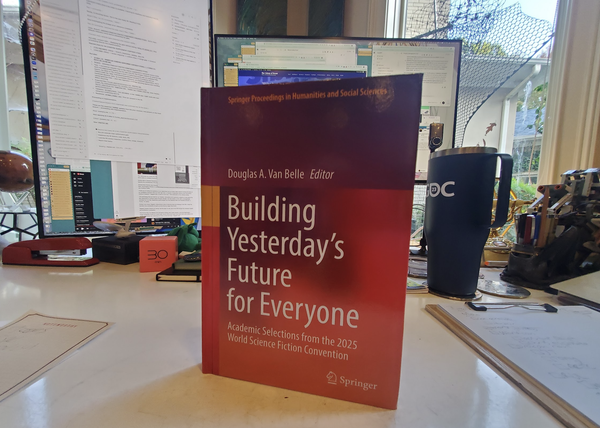
At last, it’s here! My personal copy of the Worldcon Academic book has arrived at the Boobie Hatch!
This book, which captures the articles submitted to the 2025 Worldcon Academic Track, has the first fruits of the thirty-year-old research project I (re)started with my good friend Kenneth Moorman – the Captain’s Advisory Tool system, a tongue-in-cheek project to advise starship captains on how to tackle problems based on Captain’s Log entries from previous episodes.
The original CAT project was infeasible – not just because Captain’s Log entries don’t really exist, but because Kenny’s thesis project, ISAAC, was a system to read science fiction stories. For the project to work, he would need to have finished his thesis, built a time machine, and then sent it back to us. Like most solutions that require a time machine, this replaced a small problem with a big one.
Thirty years later, large language models (LLMs) made it feasible to process text, so we rechristened the project LCATS (the LLM Captain’s Advisory Tool System, after LCARS, the Library Computer Access/Retrieval System from Star Trek). But we soon found ourselves back at the same problem: we needed a collection of stories, and Star Trek synopses weren’t cutting it.
Digging into Project Gutenberg as an alternative source, we found that many stories contained multiple problems, so we turned to “scene and sequel” theory in professional writing craft as a way of extracting reasonable problem-solution sequences out of stories. To our surprise, dramatic scenes and dramatic sequels appear well-grounded in cognitive science, and were extractable via LLMS.
Our paper in this volume chronicles just the start of this research project, but we feel it makes a strong case for using digital humanities analysis to bridge the gap between literary criticism, cognitive science, and professional writing craft. I posted the abstract already, so here’s the first paragraph, which (ahem) a little bit less dry than abstract writing:
A funny thing happened on our way towards building an artificial intelligence system that learned from science fiction stories: We discovered that techniques from professional writing craft were surprisingly compatible with cognitive science models of how readers process stories. Our work to harmonize writing technique with narrative science resulted in a model of story structure that not only helps explain why stories have the impact that they do on humans, but may help machines extract useful lessons from stories. This paper presents our work to date developing this model of story structure, first laying the groundwork in our initial motivations, then exploring how writing craft and narrative science came together in the development of our model, and then finally sketching our work to build a corpus of stories to validate our ideas.
Our paper is the first in the volume, and we feel highly honored!

So please check it out, and buy the heck out of it so Springer will publish more of them. 😀
-the Centaur
